The Major Arcana are the 22 named cards of the tarot deck. They include choice, change, authority, search, crisis, an ending, and a new start. Different tarot traditions vary in the details, but the Major Arcana generally carry the broader themes of a reading. They often highlight an important stage in the situation, while the Minor Arcana tend to provide more immediate detail.
How the Major Arcana differ from the Minor Arcana
A tarot deck has 78 cards. Twenty-two are the Major Arcana. Fifty-six are the Minor Arcana, split into Wands, Cups, Swords, and Pentacles. Minors usually describe daily circumstances, actions, feelings, and reactions. Each major has its own name, scene, and a denser set of symbols.
Historically these cards come from the trumps of a card game. Later esoteric and psychological readings treated them as archetypes: shared images for describing experience. One common way to read them is as stages, from an impulse toward awareness and then toward a completed cycle. That is a reading model, not a rule the cards originally carried.
The 22 cards in order
This is the Rider–Waite–Smith order. These short descriptions are guides, not fixed verdicts. Tone depends on the question, the position, and the cards nearby. Full interpretations are in the card meanings.
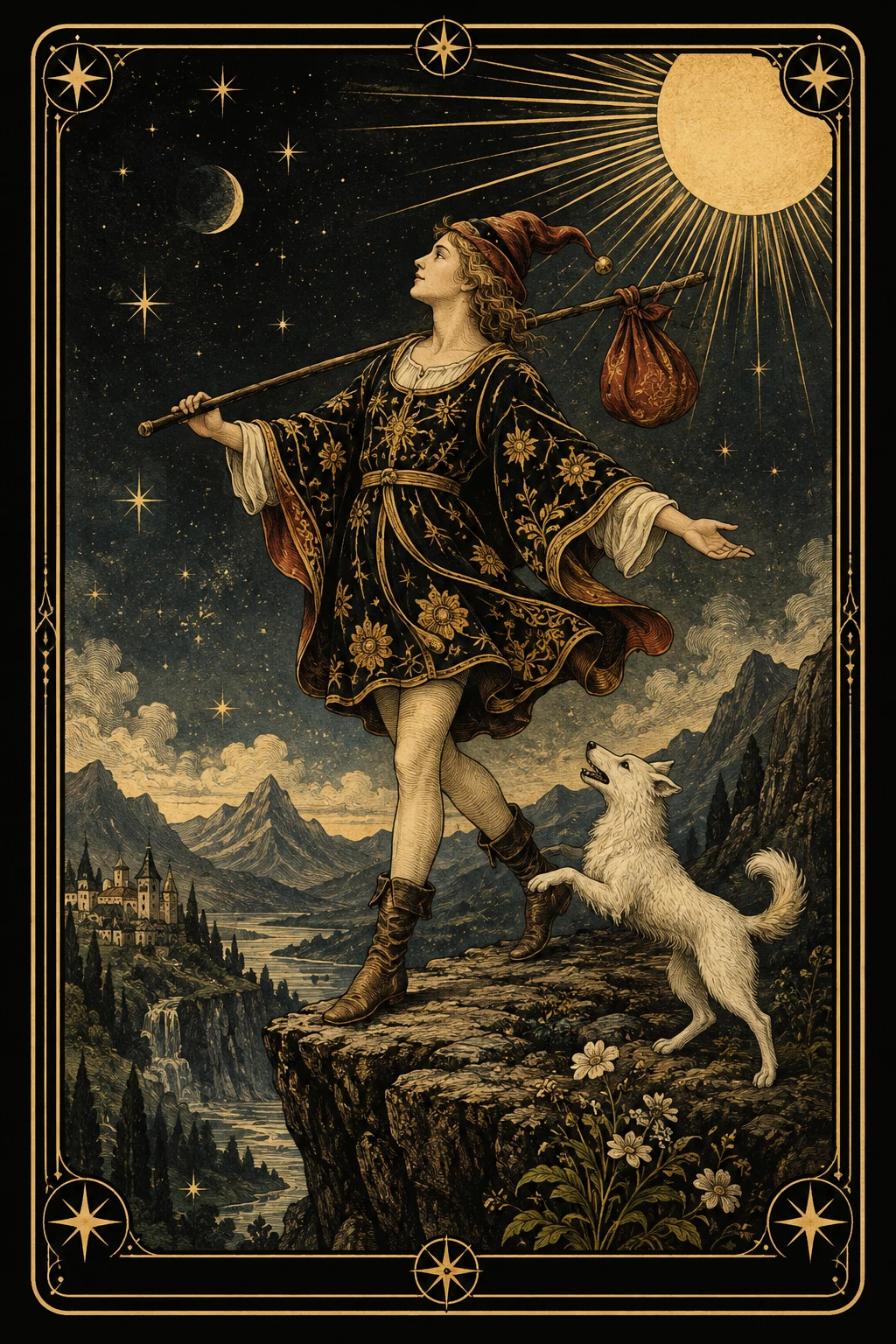
| 0. | The Fool — an open start, a step into what is not yet known. |
| I. | The Magician — will, initiative, bringing an idea into form. |
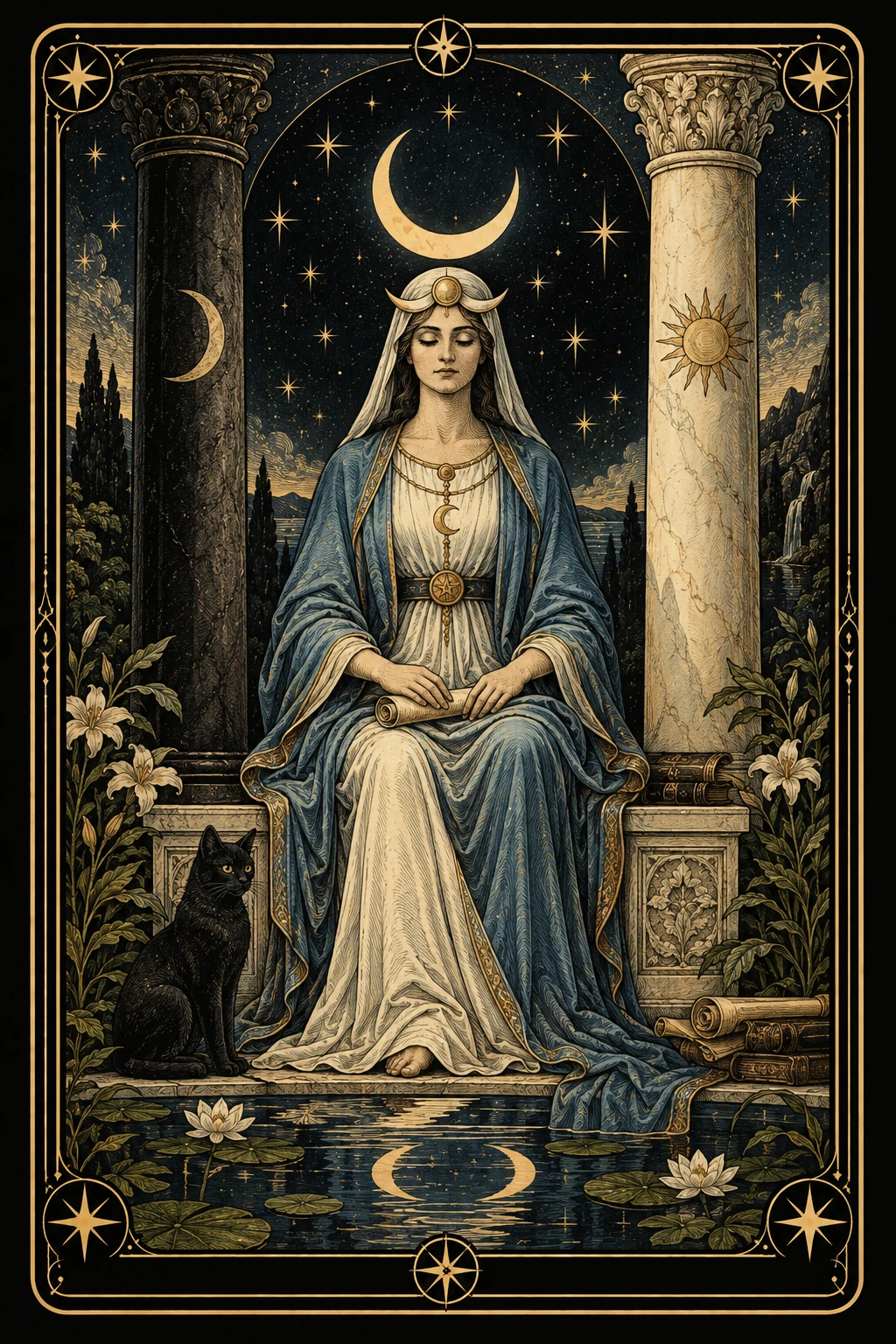
| II. | The High Priestess — intuition, what is still hidden, inner quiet. |
| III. | The Empress — growth, care, making something flourish. |
| IV. | The Emperor — structure, order, boundaries, responsibility. |
| V. | The Hierophant — tradition, teaching, a shared system of values. |
| VI. | The Lovers — a choice, a union, desire weighed against principle. |
| VII. | The Chariot — movement, self-command, a directed aim. |
| VIII. | Strength — steady courage, handling force without crushing it. |
| IX. | The Hermit — a search for meaning, solitude, mature attention. |
| X. | Wheel of Fortune — a turn in the cycle, change of conditions. |
| XI. | Justice — balance, consequences, careful judgement. |
| XII. | The Hanged Man — a pause, a change of viewpoint. |
| XIII. | Death — an ending of an old form, a deep change. |
| XIV. | Temperance — measure, mixing what was separate, recovery of balance. |
| XV. | The Devil — attachment, temptation, a bond that narrows choice. |
| XVI. | The Tower — a sudden break in an old structure. |
| XVII. | The Star — hope, repair, a reason to trust the next stretch. |
| XVIII. | The Moon — uncertainty, fluctuation, unease that is hard to name. |
| XIX. | The Sun — clarity, vitality, plain warmth. |
| XX. | Judgement — a waking up, a reckoning, a new level of understanding. |
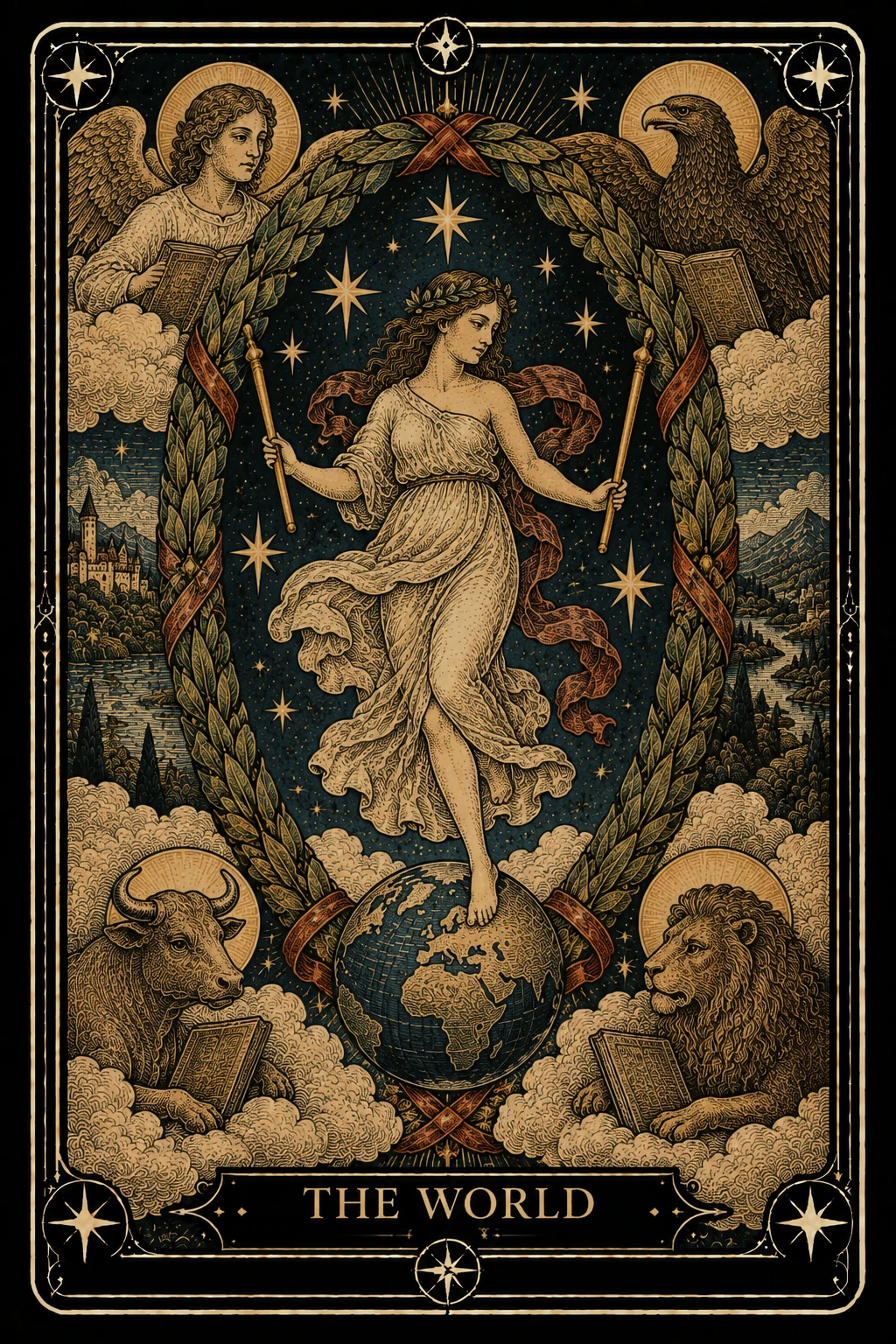
| XXI. | The World — a cycle completed, experience brought together. |
Names should not be taken at face value. Death usually speaks of an ending and a change of form, not of physical death. The Devil more often marks a habit, a tie, or a dependency the person is still feeding.
Archetypes, and a psychological reading
Reading the Major Arcana as archetypes is one approach among several. In that key the cards are recognisable patterns. The Fool can recall a beginning and a willingness to learn by going. The Magician, the ability to act and gather means. The High Priestess, knowledge that has to be heard inwardly first. The Emperor, the need for a boundary. The Hermit, a pause used to clarify, not to disappear.
Some cards show a transition more sharply. Strength is not suppression. It is a way of meeting one’s own force without harshness. Death marks the end of a previous form and room for another. Judgement is a moment of recognition. The World is the sense that separate stages have become one piece. That reading does not cancel a divinatory one. It adds the inner movement: where someone is stuck, what is ready to change, and what may still be needed for the next step.
Major Arcana in a spread
In a reading the majors usually draw more attention than the minors. Several of them together can mean the theme is significant, or that the question concerns a significant stage or turning point. Meaning still depends on position.
The Hermit as advice often means taking time and looking at the matter alone. The Chariot as a result can describe forward movement, and only if the direction is actually held. The Tower as an obstacle can suggest that an existing structure is under pressure or no longer working, and that resisting necessary change may increase the strain.
Read them with the question and with the cards beside them. They name what kind of stage is underway. The minors then say how that stage shows up in ordinary life.
Rider–Waite–Smith and Marseille
Two influential traditions are often compared in tarot study. Marseille is older and visually spare. Its majors are plain and strict, and its minors are often pips without a scene. In that line Justice is usually VIII and Strength XI.
The Rider–Waite–Smith deck, made in the early twentieth century under Arthur Edward Waite and illustrated by Pamela Colman Smith, gave all 78 cards detailed scenes. Strength and Justice swapped numbers: Strength is VIII, Justice is XI. That is the order TARORIA uses. The pictures are dense with Western esoteric symbols, so many modern meanings follow them.
The emphasis of the same card can shift between traditions. The Lovers in Marseille are more often a theme of choice. In Rider–Waite–Smith they are also a union and a bringing of meanings together. The name is not enough. The picture belongs in the reading.
Studying the majors without overload
Start with one card. Describe what you see: figures, gestures, colour, the direction of a look, the background. Then ask what that picture could mean in a life. A card of the day works well here. Note the theme as the day goes on, and write a few lines in the evening. The meaning sticks through use, not through a list.
Comparing the same card in another deck shows what is stable and what belongs to one tradition. A common mistake is to read dramatic imagery too literally: Death as catastrophe, or Strength as a fight. Position, neighbours, and the question keep the majors a precise language rather than a set of alarming words.