Justice — tarot card meaning
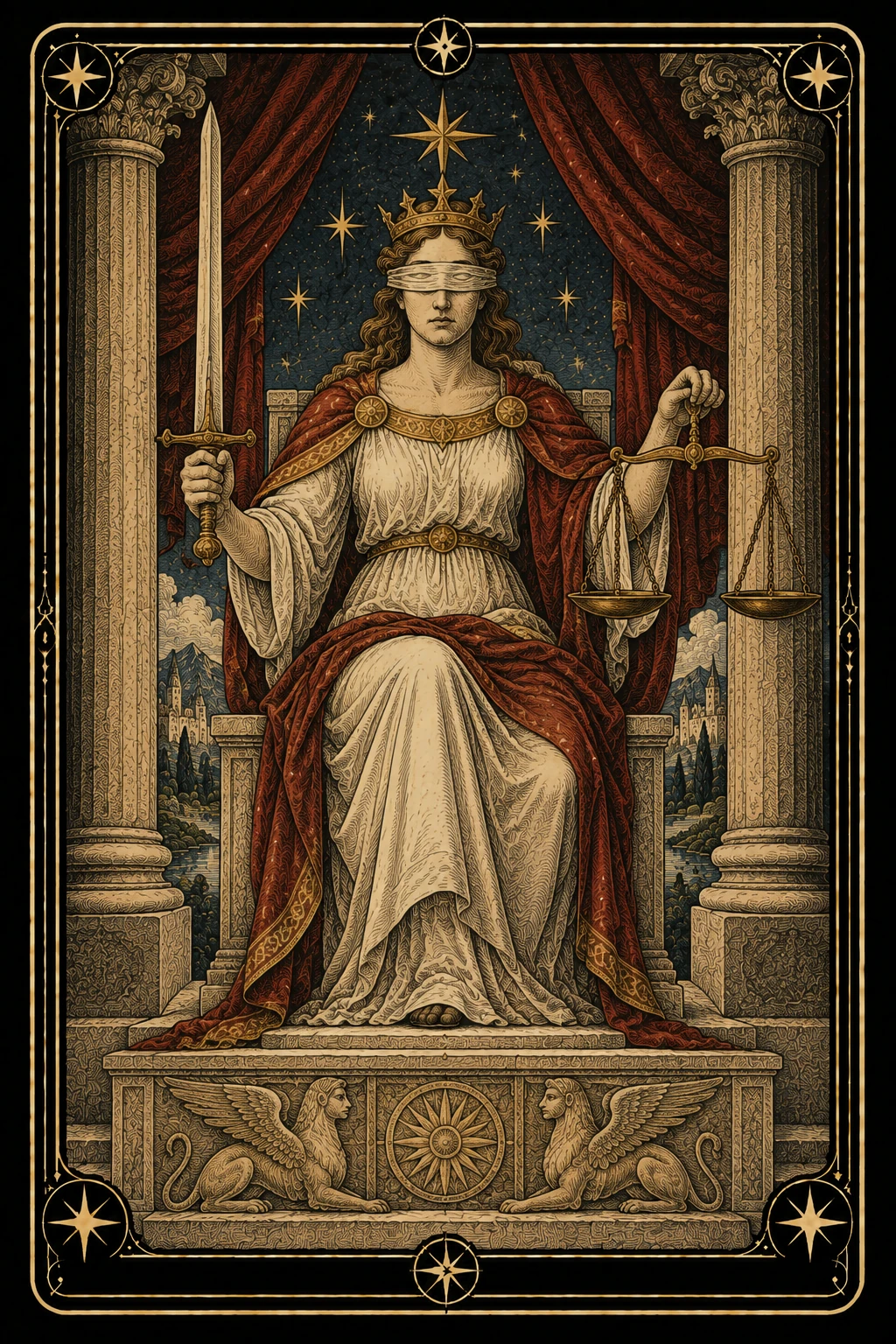
Major Arcana · XI
Justice
Justice is truth that has weight. In a spread, Justice more often points to consequences, a contract, and a need to call things by their names.
The key question is balance, not “I am owed.” The card can describe a court, a conversation grounded in facts, honesty with yourself. It does not promise that the truth will be convenient. It asks whether you are ready to accept your part in how the situation developed.
General meaning
In a reading, Justice describes a moment when it is time to take stock and look at a situation honestly. The card can mark a period when imbalance can no longer be ignored: a debt, a promise, a lie, unequal terms need a clear look.
Sometimes the Arcana points to an external authority: a lawyer, a regulation, a third party who judges without bias. More often it points to your own capacity to be honest with yourself. Reading this as “you will certainly be avenged” or “you are owed” is too crude. What matters is the consequences of your own decisions.
Next to cards of uncertainty, Justice strengthens a need to lean on facts. Next to cards of revenge, it warns against confusing truth with punishment.
Upright
Upright, the emphasis is on a clear sense of fairness. Upright Justice often supports an honest conversation, signing a contract, restoring boundaries, a decision based on facts rather than hurt.
If the question is “who is right,” the card favors looking at deeds and at whether agreements were kept, not at a beautiful story. The emphasis is on transparency. This is not a promise of winning an argument: a sign that truth is stronger than intrigue now.
Reversed
Reversed, the balance is broken. Reversed Justice can describe bias, avoiding responsibility, an unequal contract, self-justification. At the other extreme is a cruel “truth” without mercy: a person uses facts in order to wound.
When the question concerns a situation, the reversed card often asks where you are looking away, and where you demand punishment without looking at your own part. This does not mean there will be no truth. It is a signal to restore balance, beginning with yourself.
Love and relationships
In love, upright often describes honesty, a mature, honest conversation, reciprocity in care, sometimes making something official, or, on the contrary, a clear parting without dirty play. In a new connection, a question of whether words match deeds. For a couple, restoring balance after hurt. For someone who is single, an unwillingness to enter a relationship where the balance is already broken.
Reversed, this can be double standards, a silent ledger of grievances, manipulation through guilt. It is worth distinguishing truth from a wish to punish. Justice does not promise that a partner will admit everything at once. It shows whether equality is being maintained.
Work and career
At work, upright often points to a contract, an evaluation, ethics, resolving a conflict on the basis of facts, a role where impartiality matters. The card can support talks about terms, a way out of a questionable or non-transparent arrangement, recognition of a contribution.
Reversed, it points to unpaid work or debts, private interests, favoritism, or office politics in place of transparent rules. It is useful to ask which fact you are avoiding acknowledging, and whether you are playing judge without a mandate.
Money and finances
In money questions Justice is more often about accounts, debts, taxes, a fair price, a division. Upright, it can support a transparent budget, a repayment, a contract in which both sides understand the terms.
Reversed, it speaks of hidden fees, a refusal to pay bills, yours or someone else’s, money used as an instrument of guilt. It is worth putting the numbers on the table. The scales here want specifics.
Advice
Name the facts. Put aside the beautiful version that excuses you. If the balance is broken, restore it with a deed: a conversation, a signature, a repayment, an apology without theatre.
Do not confuse justice with revenge. The card suggests weighing your own share as honestly as the other person’s. Truth here is a working tool, not a weapon.
Symbolism
In the classical Rider–Waite tradition, a figure sits between pillars, with a sword and scales. The sword is often read as discriminating mind, speech that cuts ambiguity. The scales represent an exchange that can be measured. The crown and red mantle are often interpreted as marking that judgment here is not a household quarrel, but responsibility.
The curtain behind is often interpreted as hiding what has already been weighed: a decision is taking shape offstage. Depending on the question, the emphasis may fall on the sword, the scales, the law, or your readiness to look at the situation without bias.
Combinations with other cards
Next to Judgement, the theme of responsibility becomes a theme of a call and a summing up: it is not enough to assess the situation, you still have to take responsibility. With the Devil, objectivity meets dependence and self-deception. With the Lovers, the choice needs not only the heart, but clear terms.
Neighboring Arcana show the price of transparency. Justice does not mean you should ignore feeling. It asks you not to replace feeling with a convenient story.
Frequently asked questions
What does Justice mean in a spread?
Often responsibility, consequences, and a need to restore balance. The card points toward honest accounting, not a promise that you will win in court.
Is this always about a court or lawyers?
Sometimes, if the question is legal. More often it is any impartial assessment: a contract, a conversation grounded in facts, honesty with yourself. Context clarifies whether an external authority is involved.
How should I read reversed Justice?
The reversed card can speak of bias, avoiding responsibility, or a harsh judgment without mercy. Ask where the balance is broken, and what your share is.
What does Justice mean in love?
Equality and an honest conversation. Reversed, double standards and a ledger of grievances. Look at deeds, not only at promises.