Death — tarot card meaning
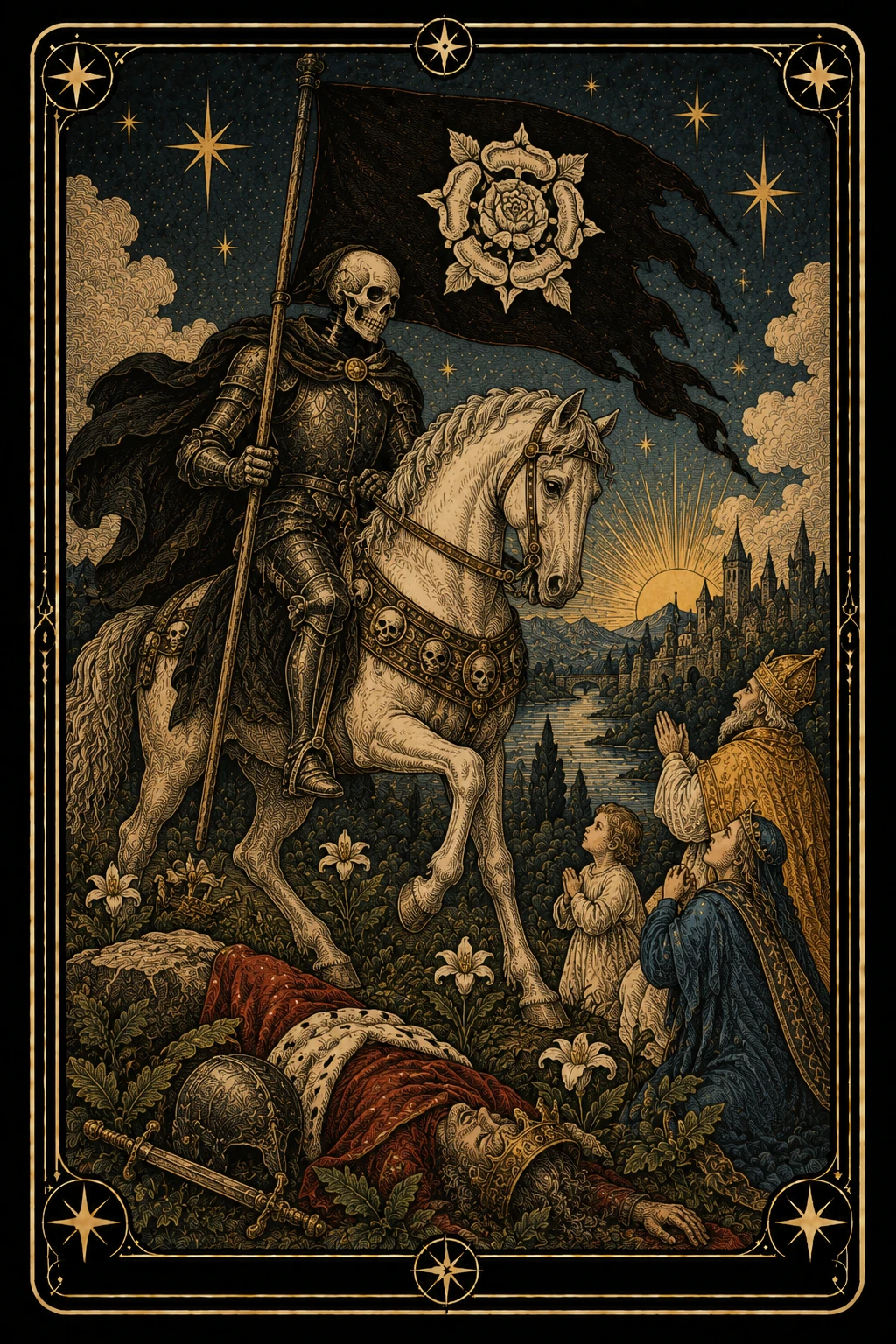
Major Arcana · XIII
Death
Death frightens by its name, but in a spread it is usually not about a physical end. More often it points to the close of a chapter: a role, a bond, a period that has already run its course.
At the heart of the card is transition and transformation. The card can describe a breakup, leaving a job, a major inner change. It does not promise that this will be easy. It asks what has already ended, and what you are still trying to hold.
General meaning
In a reading, Death describes an inevitable change of circumstances. The card can mark a period when an old pattern is coming to an end: a habit, a status, a pattern of “how it should be.”
Sometimes the Arcana points to grief that has already arrived, rather than to a catastrophe from outside. Reading this as a prediction of dying is a mistake and a harm: in tarot this card almost never means physical death. What matters is the end of a chapter. Without that end, the next one does not begin.
Next to cards of growth, Death reminds you that a harvest also ends with a season. Next to cards of clinging, that holding on to something that has outlived its purpose costs more than letting go.
Upright
Upright, the emphasis is on a clear ending. Upright Death often supports an honest close, a clearing out, an agreement that it cannot go on this way, a way out of a shell that has become too tight.
If the question is “will it end,” the card more often says the situation has already run its course. The emphasis is on transformation through farewell. This is not a promise of instant new happiness: a hint that dragging a situation that has already run its course is pointless.
Reversed
Reversed, the ending drags. Reversed Death can describe a refusal to let go, living among what is already finished, a fear of the emptiness that follows a refusal. At the other extreme is a sharp cut without grieving: a person cuts everything away so as not to feel.
When the question concerns a situation, the reversed card often asks what you are preserving from a fear of emptiness. This does not mean you are not allowed to change. It is a signal that the transition is already at the door, and you are holding it shut.
Love and relationships
In love, upright often describes the end of a phase: a breakup, a way out of an illusion, the close of a previous “we,” after which another kind of closeness is possible, or honest solitude. For a couple this can be a need to let go of an old pattern in order to stay. In a new connection, a meeting is possible if the past has truly been released and is not being dragged into a new story.
Reversed, this can be an inability to part, a bond held by inertia, a refusal to admit that feelings have changed. It is worth distinguishing loyalty from an attempt to keep a relationship pattern that is no longer alive. Death does not tell you who is to blame. It shows which form of closeness is no longer alive.
Work and career
At work, upright often points to the end of a role, a project, a professional identity. The card can support leaving, closing, an agreement that this path has run its course.
Reversed, it points to delaying a resignation, work on an idea that has long since run its course, a fear of losing status. It is useful to ask which role you have already outgrown, and whether you are holding a place from a dread of an empty résumé.
Money and finances
In money questions Death is more often about closing something down: the end of a source of income, a sale, shutting down an arrangement that no longer works. Upright, it can support an honest refusal of what is losing money, clearing debts as the end of a chapter.
Reversed, it speaks of money put into what no longer works, a fear of cutting an expense, living by an outdated view of your finances. It is worth closing the arrangement rather than feeding it “a little longer.”
Advice
Name what has already ended. Farewell here is work, not weakness. Do not promise yourself that the new will come before you let the old go.
If you are making a drastic cut simply to avoid grieving, the card suggests slowing down and feeling the end. If you are still holding a situation that has already run its course, let it go. Transition begins with an honest “this was.”
Symbolism
In the classical Rider–Waite tradition, a rider on a white horse carries a black banner with a white rose. A king already lies on the ground; a child and a maiden also appear before the rider. Later tradition often reads their attitudes as denial, pleading, and an innocent look. The sun rises between towers: often read as the end of a day and the beginning of another.
The skeleton does not celebrate evil. It takes away what has outlived itself. Depending on the question, the emphasis may fall on the banner, the fallen crown, the sunrise, or the fact that the rider does not stop.
Combinations with other cards
Next to the Tower, crisis speeds an ending: the situation does not have time to close quietly. With the Fool, after farewell a new threshold is possible, but only if grieving is not bypassed. With the Empress, the end of a season meets the question of what can still grow on the same ground.
Neighboring Arcana show the quality of the transition. Death does not erase life. It removes what keeps you from moving on.
Frequently asked questions
Does the Death card predict dying?
No. In a tarot reading this Arcana is almost always about an ending and a transition, not about physical death. Look at which chapter has already run its course.
Does this always mean a breakup in love?
Not always. Sometimes a couple’s pattern ends and the people remain. Sometimes the bond does end. The card shows that the current pattern or situation has run its course. What follows depends on circumstances and on a readiness to let the old go. There is no full control over the outcome.
How should I read reversed Death?
The reversed card often speaks of a drawn-out ending, a fear of emptiness, or a cut without grieving. Ask what you refuse to let go.
What does Death mean at work?
The end of a role, a project, or a professional identity. Upright, it favors closing a chapter honestly rather than holding what has already run its course.