The Hierophant — tarot card meaning
Major Arcana · V
The Hierophant
The Hierophant is about tradition, the passing on of knowledge, rules, and the experience of those who came before. In a spread, he more often points to a school, a religious or social tradition, a family, a professional culture, official rules, marriage, or mentorship, and asks whether those things help, or whether a person follows them only because “that is how it is done.”
The central theme is belonging to a community and shared values, norms, and ideas. The card can describe a teacher, a rite of passage, a search for blessing. It does not order you to obey every authority. It shows what obligations come with entering a system or a community.
General meaning
More broadly, the Hierophant describes a period of learning, accepting rules, turning to a teacher, or making something official. The card can speak of study, marriage, consulting a specialist, looking for a community.
Sometimes the Arcana points to a mentor, a teacher, a consultant, or a more experienced person. Reading that as “always listen to authority” misses the point. What matters is the transmission of knowledge, experience, and tradition. A useful tradition helps you learn first and then form your own position. An outdated one demands obedience without a clear reason.
Next to cards associated with independence or breaking convention, the Hierophant often asks which system you are leaving and what you are choosing instead. Next to cards of rigidity and conservatism, it warns that rules or traditions have already lost practical meaning.
Upright
Upright, the focus is a proven path. An existing approach may be more useful than inventing everything yourself, especially if there is knowledge, training, a method, or the experience of specialists. The upright Hierophant often supports learning, a rite of passage, making an arrangement official, an ethical code, the search for a mentor.
If the question is whether to follow an established path, the card suggests considering the advantages of a proven approach. The emphasis is on belonging, not a command to surrender your judgment. Tradition can be warm or strict, but rules and structure may now offer needed support.
Reversed
Reversed, rules may become oppressive or lose their purpose. The reversed Hierophant can describe dogma, moralizing, pressure from rigid rules, a marriage or a job kept up for appearances, or rejecting rules as a matter of principle.
At the other extreme is a refusal to learn: a person rejects other people’s experience and is left without support. In this context, the reversed card often asks where you confuse independent thinking with contempt for any norm, and where you keep rules only because “you are supposed to.” This does not mean you have to reject community or tradition altogether. It is a signal to check whether the rules help, or demand obedience without a reason.
Love and relationships
In love, upright often brings themes of commitment, shared values, and defining a relationship more clearly: meeting a family, making a union official, or talking about marriage. In a new connection this can be the question “are we serious.” For a couple, it can raise themes of engagement, marriage, family tradition, or an agreement that strengthens the relationship rather than resting on passion alone.
Reversed, this can be a marriage kept up for appearances, morality in place of warmth, pressure from relatives, or a fear of commitment and of making a relationship official. Useful shared rules are not the same as living for social approval. The card shows whether the partners’ basic values and ideas of a serious relationship match.
Work and career
At work, upright often points to training, certification, corporate culture, mentorship, a profession with a code. The card can support professional study, learning accepted standards, work under a more experienced person.
Reversed, it points to outdated or pointless rules, office politics in place of usefulness, or a refusal to accept any rules of the game. It is useful to ask which rules, training, or professional culture help you grow, and which system demands obedience without a clear benefit.
Money and finances
In money questions the Hierophant is more often about established approaches: an official contract, a specialist’s advice, clear rules, a conventional way of earning, a responsible attitude to obligations, family money beliefs. Upright, it can support transparent, lawful, straightforward methods and decisions.
Reversed, it speaks of doubtful schemes dressed as tradition, of financial decisions made only because “that is how it is done,” of family pressure, shame around talking about money, or a refusal of professional advice on principle. It is worth separating useful counsel from the pressure of “we don’t do that here.”
Advice
Find a learning system that genuinely fits your needs, a mentor, rules, or a proven approach. If there is a teacher, a code, or a ritual that still has meaning, it is more honest to rely on it than to pretend you need no one. If the rules are already outdated and no longer help, do not confuse loyalty with a fear of leaving.
Ask what you want to learn, and from whom you are willing to learn. Taking part in a tradition or a community should help you grow, not take away your own judgment.
Symbolism
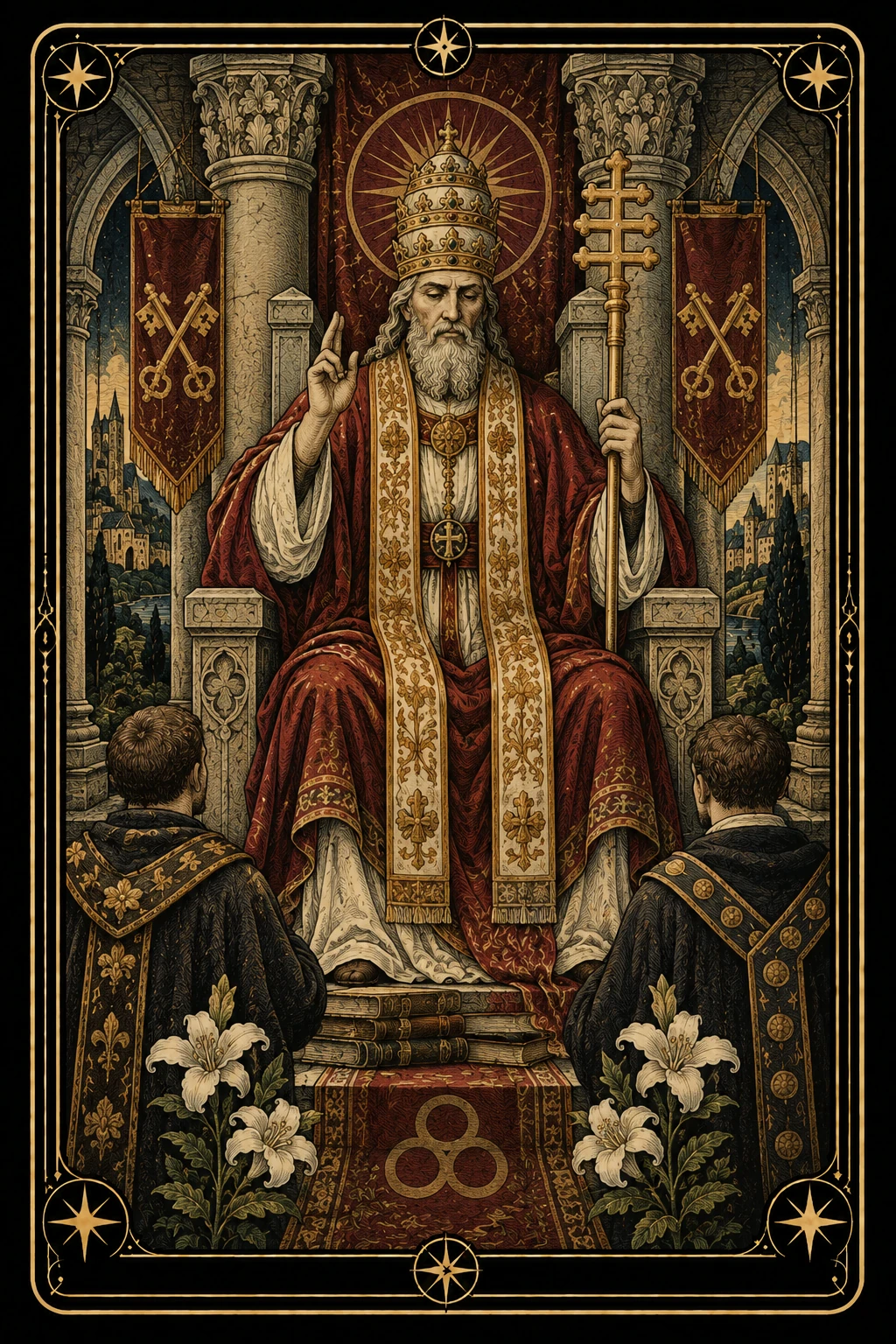
In the classical Rider–Waite tradition, the Hierophant sits between the grey pillars of a temple. The triple tiara and the staff with a triple cross are often linked with levels of knowledge and spiritual authority. At his feet are two keys, traditionally read as access to open and hidden knowledge.
Two acolytes kneel before him. Their presence is traditionally associated with teaching, initiation, and the transmission of knowledge within an established tradition. The blessing gesture is often read as a link between the upper and the lower. Depending on the question, the emphasis may fall on the keys, the acolytes, the staff, or the crown. The emphasis can help distinguish genuine transmission of knowledge from authority that rests mainly on status.
Combinations with other cards
Next to the Lovers, the theme of union becomes a question of vow and chosen values. With the Devil, rules, authority, or moral positions can turn into pressure, dependence, or guilt. With the Fool, the traditional path meets a wish to begin in one’s own way: either the school lets someone go further, or a beginner breaks the rules before understanding why they were there.
Neighboring Arcana help you see whether the system provides support or restricts a person too tightly. The Hierophant does not erase freedom. It asks why you are entering a community, and what you are willing to accept.
Frequently asked questions
What does the Hierophant mean in a spread?
Often learning, tradition, making something official, and belonging to a community. The card can suggest learning from an established or proven approach, not an order to obey every authority.
Is this only a church card?
The religious setting is only one layer of the card. More often it describes a school, a family, a profession, a community, or official rules. Context shows whether the system provides support or demands obedience without benefit.
What does the Hierophant mean in love and marriage?
Upright, it often brings themes of commitment, shared values, and the possibility of making a relationship official. Reversed, it can describe a marriage kept up for appearances, morality in place of warmth, or a fear of commitment.
How should I read the reversed Hierophant?
The reversed card can speak of dogma, moralizing, or rejecting rules as a matter of principle. Ask where the rules have become restrictive, and where you refuse to learn from others.