The Emperor — tarot card meaning
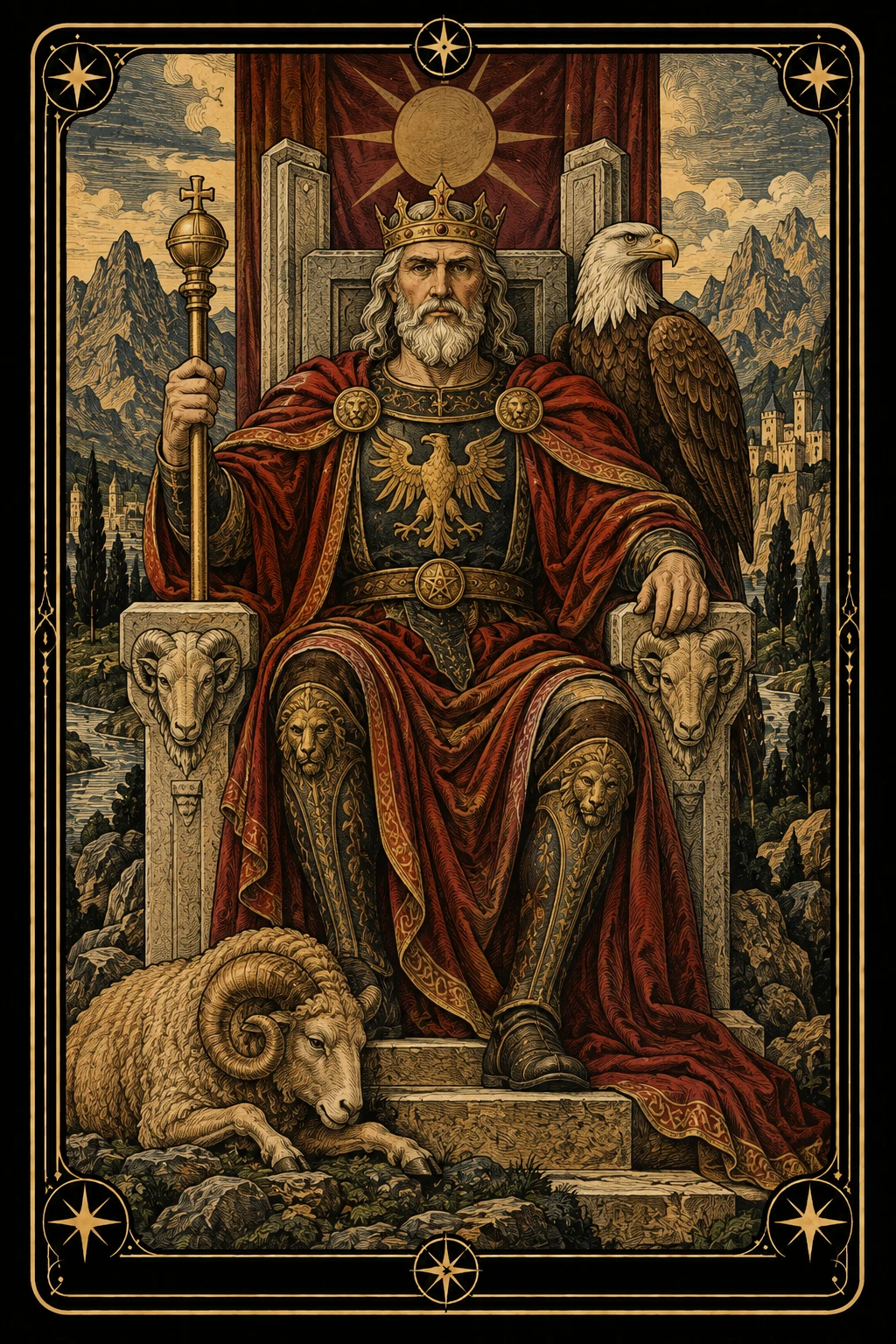
Major Arcana · IV
The Emperor
The Emperor is the structure without which life spills in every direction. In a spread, he more often points to organization, discipline, and the ability to govern your own area of responsibility: clear terms, a division of roles, a yes and a no that can no longer be postponed.
The card is closely connected with leadership, obligations, and the capacity to decide. The card can describe a fatherly role, an authority figure, or responsibility for others, a contract, the state, inner discipline. It does not mean that the rules in place will please everyone. It asks whether they maintain stability, or already restrict freedom and initiative too tightly.
General meaning
In a reading, the Emperor describes a need to organize a situation and assign roles. The card can mark a period when discussion needs to give way to a clear decision.
Sometimes the Arcana points to external authority: a boss, a father, a representative of an organization or a public institution, or to inner discipline and the ability to set clear terms yourself. Reducing the card only to an image of a harsh or unpleasant man is too narrow. A lack of structure leads to disorder. Excess control restricts freedom and initiative.
Next to cards of feeling, flexibility, or uncertainty, the Emperor often helps bring clearer boundaries and expectations to the situation. Next to cards associated with pressure or control, it warns that the demands have become too rigid.
Upright
Upright, the emphasis is on the ability to govern your area of responsibility with confidence. The upright Emperor can point to a need to put things in order, settle agreements, or divide duties clearly: a schedule, the protection of boundaries, organizing a project, a wish for a leading role or more professional independence, fatherhood as real participation and responsibility.
If the question is about leadership, the card can indicate that it is time to decide for yourself and take responsibility for the consequences, rather than stay in the position of someone who constantly waits for other people’s instructions. The focus is on reliability and self-organization. Clear terms and a division of duties may now be more useful than uncertainty.
Reversed
Reversed, organization either stops working or turns into excessive control. The reversed Emperor can describe authoritarianism, a fear of losing power, demands that are met only under pressure rather than because they are truly needed. At the opposite extreme are weak boundaries: a person does not keep their word, cannot stand by their decisions, and too easily hands other people responsibility for their own choices.
When the question concerns a situation, the reversed card often asks where you confuse strength with pressure, and where, on the contrary, you avoid responsibility or an independent decision. It is a signal to check whether the existing demands help, or already get in the way.
Love and relationships
In relationships, upright often describes reliability and a readiness to build something shared on clear terms. For a couple this can mean clear agreements and a division of duties. In a new connection, it can describe a serious approach and a preference for clarity. For someone without a relationship, the card can remind you that a sense of safety is better grounded not only in a partner, but in your own stability and independence: there is a risk of expecting a partner to carry too much responsibility for your own sense of stability.
Reversed, this can be control, jealousy expressed as limits and bans, emotional distance, an attempt to manage a partner, or a person who will not take on commitments. Reliability should not become an order. The Emperor does not guarantee marriage. What matters is whether the agreements help the relationship, or whether control is beginning to crowd out closeness and trust.
Work and career
At work, upright often points to leadership, managing processes, organizing work, or a position that requires independent decisions. The card can accompany a wish for promotion, a leading role, or more independence, a project of your own, putting a poorly built process in order, a fact-based conversation with management.
Reversed, it points to authoritarian leadership, a rigid hierarchy with no room for initiative, ignoring necessary rules, or resisting requirements. Another possibility is excessive self-control: fear of a mistake, perfectionism, a fear of acting without a detailed instruction. It is useful to ask which rules actually help the work, and which already hinder effectiveness and initiative.
Money and finances
In money questions the Emperor is more often about budget, accounting, discipline, and a wish for financial stability than about a lucky break. Upright, it can point to the value of steady saving and planning, clear financial records, financial decisions that require careful calculation and an understanding of consequences.
Reversed, it speaks of saving excessively out of fear, financial control by a partner or family, a lack of budgeting, debts, unpaid bills, and obligations. It is worth understanding income, expenses, obligations, and who is responsible for shared money.
Advice
Define your area of responsibility and set clear boundaries. Make the decision that has been waiting long enough, and make it concrete: a contract, a schedule, an honest no. Do not confuse firmness with authoritarianism.
If you have long avoided a concrete step, name your role and do what is actually within your competence. If you are trying to control everything and everyone, leave other people their decisions and their responsibility. Order should help you live, not replace living.
Symbolism
In the classical Rider–Waite tradition, the Emperor sits on a stone throne. Ram heads decorating the throne are usually linked with Aries, the energy of action, drive, and leadership. Armor visible beneath his robes can symbolize a readiness to protect what has been achieved and to take on obligations. In one hand is a scepter, often read as a sign of authority. In the other is an orb, which can symbolize power and responsibility.
The barren mountain landscape behind him is traditionally associated with firmness, stability, and the demands of holding a position.
Combinations with other cards
Next to the Empress, the pairing can underline a need to join organization and care, practicality and growth. With the Tower, a crisis of rules, a system of management, or an established order is possible. With the Hierophant, themes of official structures, authority, tradition, rules, and responsibility grow stronger. Context shows whether they provide support or become too rigid.
Neighboring Arcana clarify whether the established order helps, or already gets in the way. In relationships, agreements and stability do not replace emotional closeness.
Frequently asked questions
What does the Emperor mean in a spread?
Often organization, obligations, and boundaries. The card points toward putting things in order, not a promise that the rules in place will please everyone.
Is this always about a man or a father?
Not necessarily. Sometimes the context does point to a particular person. More often the card describes qualities and a role: responsibility, leadership, rules, and the capacity to provide stability.
How should I read the reversed Emperor?
The reversed card can speak of authoritarianism or excessive control, a fear of losing power, or weak boundaries. Ask where strength became pressure, and where you are avoiding an independent decision.
What does the Emperor mean in relationships?
Reliability and clear terms, or, reversed, control and emotional distance. Look at whether the agreements support closeness, or whether control has become more important than trust.