The Magician — tarot card meaning
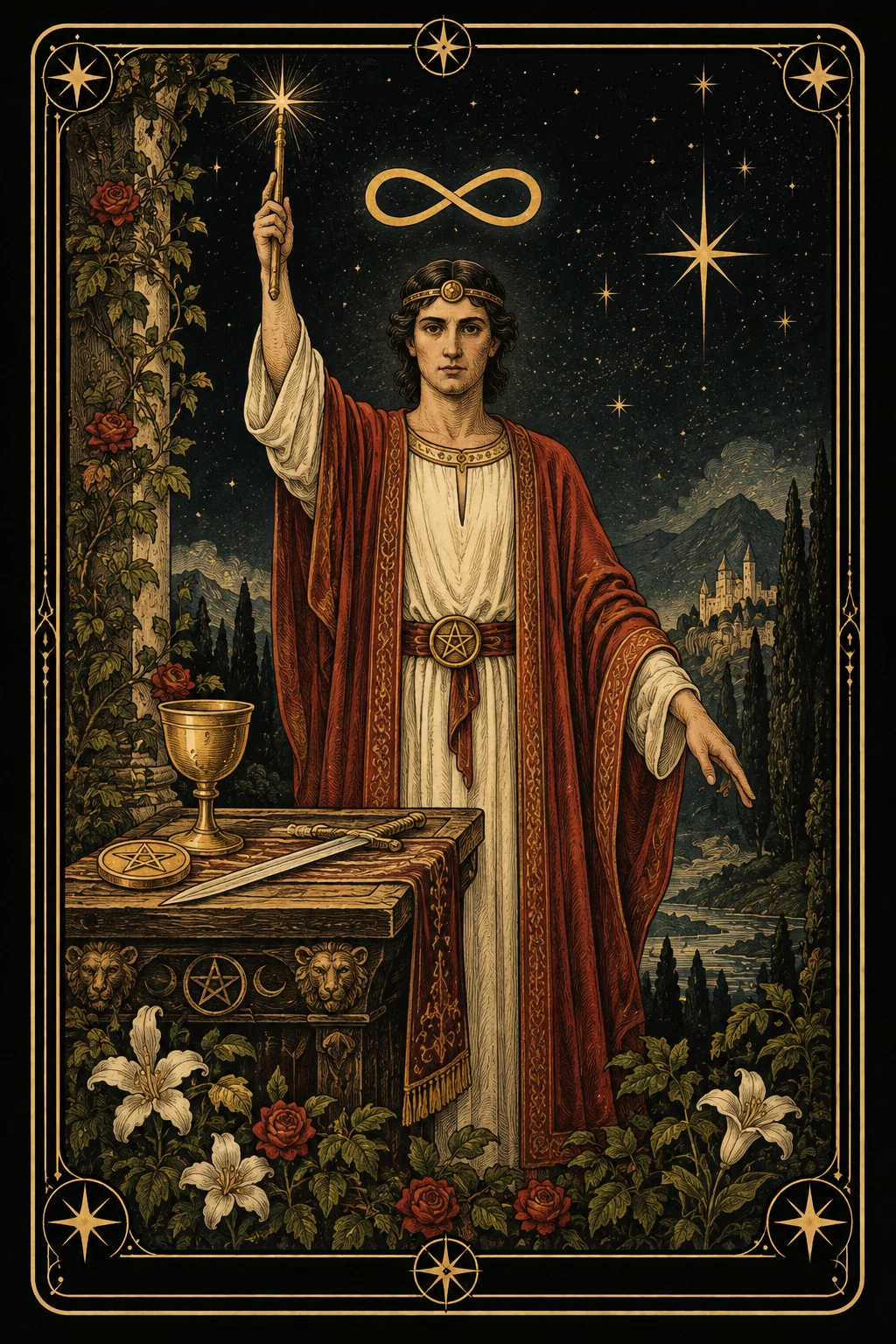
Major Arcana · I
The Magician
The Magician is about focused will. In a spread, the card more often points not to a miracle from above, but to the skill of using what is already at hand and joining intention to action.
The question is usually not whether power exists, but where it is aimed. The card can describe a launch, a conversation, a craft, a deal: anything whose result depends on attention and a concrete step, not on waiting for a sign.
General meaning
In a reading, the Magician describes a moment when an idea, skills, and resources can be brought together in a concrete course of action. What is needed may already be available. The work is to see how to use it. The card often marks a period when a person first feels like the author of a situation rather than a spectator.
Sometimes the Arcana points to a go-between: someone who can turn an idea into a practical result, a negotiator, a specialist, a person who can gather scattered pieces. Reading that as omnipotence is risky. The strength here is practical power expressed through action. It shows when you choose one task and take it through to a visible result.
Next to unfocused cards, the Magician often highlights a simple truth: the problem is not the absence of a chance, but the absence of concentration.
Upright
Upright, the emphasis is on a clear aim, concentration, and readiness to act. Words need to match deeds. The upright Magician often supports initiative: a conversation you have been putting off, a business proposal, a skill it is time to show.
The emphasis is on results through focus rather than frantic activity. If the question is “can I,” the card answers more like: you can, if you do not spread yourself too thin and do not replace the result with a promise. Upright is not a guarantee of easy success. It says the moment is right for acting with awareness.
Reversed
Reversed, it becomes hard to move from intention to action, or energy is spent without a result. The reversed Magician can describe fine speech without follow-through, manipulation, a trick in place of craft. At the other extreme is a lack of confidence in skills that are already there: everything is present, and you cannot bring yourself to act.
When the question is about a choice, the reversed card often warns against spreading yourself too thin, self-promotion without substance, or leaning too hard on another person’s confidence and promises. It is worth asking where words and deeds come apart, and whether you are hiding behind the appearance of competence.
Love and relationships
In love, upright often describes clear intentions and the ability to name them. A person does not only feel. They act: they write, they invite, they keep their word. In a new connection this can be lively interest without fog. In an existing couple, a period when it matters to speak plainly and back words with deeds.
Reversed, the card can read as charm and promises that are not backed up by actions: control through attention, unclear intentions. Or the opposite: constriction, “I don’t know how to ask.” Activity by itself does not prove feeling. The Magician does not tell you who is in love. Look at whether intentions are confirmed by what actually happens.
Work and career
At work, upright is one of the most active positions. A project, a presentation, a craft, a negotiation: anything that needs an idea turned into a concrete result. The card can support a launch, a rise in responsibility, a moment when it is time to show competence rather than prepare for another month.
Reversed, it warns against burnout from endless starts, bluffing on a résumé, or a culture that values the look of confidence more than actual skill. It helps to bring attention back to one task and finish it, rather than collecting plans.
Money and finances
In money questions the Magician can point to using professional skill, negotiating, finding ways to turn competence into income, and taking an active part in financial decisions. Upright, it can support a marketable skill, a deal whose rules you understand, income through knowledge and active work.
Reversed, it points to trying to look financially successful without real stability, an impulse to look successful first and deal with reality later, or a refusal to use what is already there. It is worth checking whether you are promising more than you can deliver, and whether you undervalue your own work or expertise.
Advice
Choose one task and make it visible. You do not need every resource at once. You need the one that answers the question. Intention without a concrete action stays a plan: a letter, a call, a draft, an invoice.
If you catch yourself in words without deeds, return to the aim: why you are doing this. If the aim is there and you still hesitate, begin with one small finished step. Mastery here is not a pose. It is the repetition of honest action.
Symbolism
In the classical Rider–Waite tradition, the figure raises a wand toward the sky and points downward. That gesture is traditionally associated with intention being brought into the material world. Above the head is the sign of infinity, often read as attention able to hold an aim while it takes form. On the table are the four suit symbols: a wand, a cup, a sword, and a pentacle. They are traditionally associated with will, feeling, thought, and the material world. The tools are already in front of the Magician, which tradition links with available means and a readiness to use them.
The red cloak is linked with the heat of action, the white garment with clarity of purpose. The garden of roses and lilies at the feet reminds us that desire and clean intention live side by side and are easily confused. In the card’s traditional symbolism, it is useful to ask what is on your table now, and what you are avoiding touching.
Combinations with other cards
Next to the High Priestess, the Magician’s activity is balanced by observation and a need not to rush. With the Devil, skill and charisma can be used for manipulation or control. To the Fool, the Magician gives a way into action: a new beginning can become real work if the step is not replaced by a trick.
Neighboring Arcana clarify how the abilities are being used: constructively, chaotically, or manipulatively.
Frequently asked questions
What does the Magician mean in a spread?
Often initiative, skill, and access to means that are already there. The card favors acting with awareness, not waiting for an outside miracle.
What does the reversed Magician point to?
The reversed card can indicate scattered effort, the appearance of competence, or manipulation through words. It can also point to a refusal to use your own skills. Look at where words and deeds come apart.
How does the Magician read in work and career?
Upright, it often supports initiative, negotiation, and showing competence. Reversed, it is worth checking for bluff, burnout from false starts, and a culture that values the look of confidence more than actual skill.
How do I use the Magician’s advice?
Choose one task and take it through to a visible result. Intention without a concrete step stays a plan. Attention holds an aim better than waiting for inspiration.