The Fool — tarot card meaning
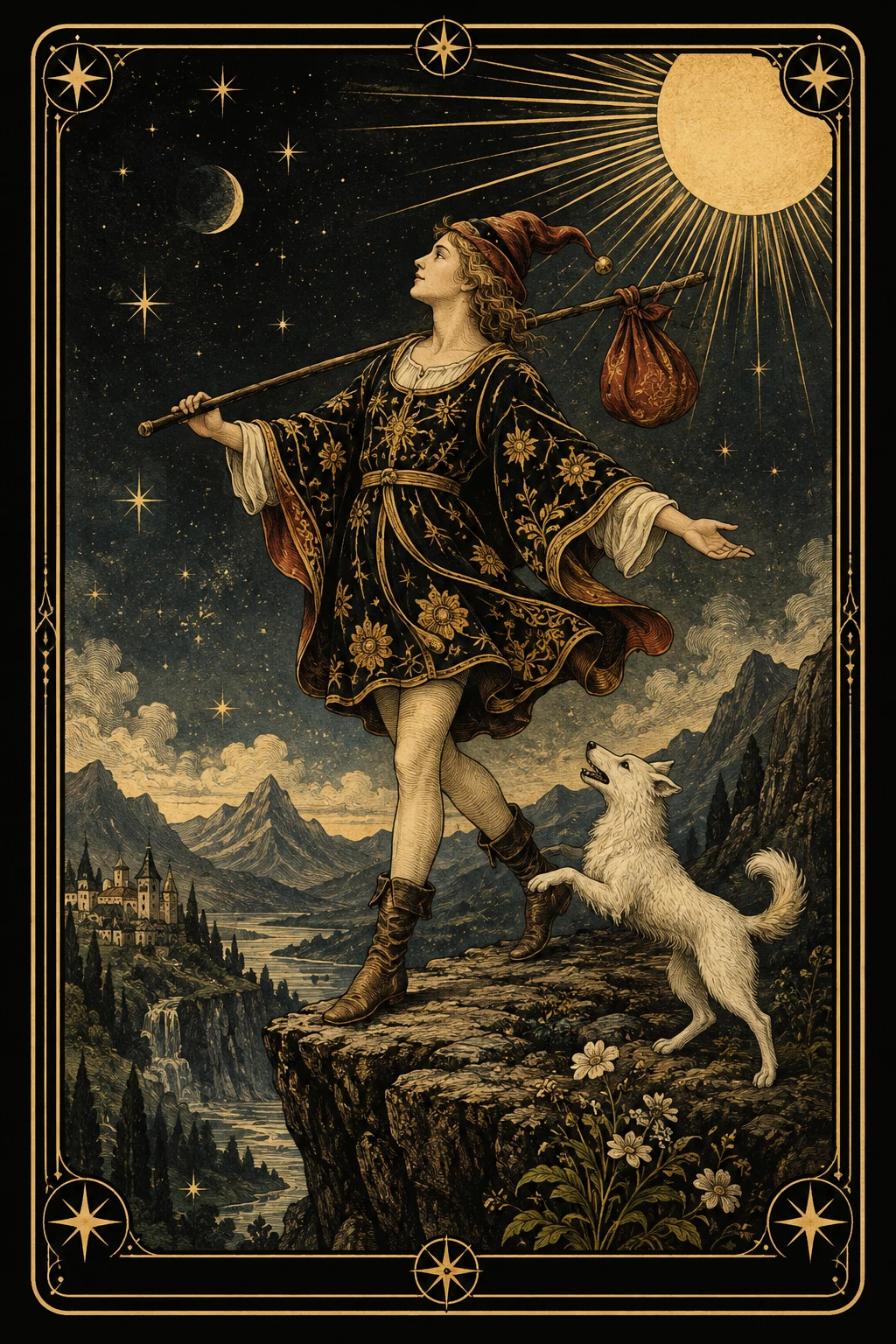
Major Arcana · 0
The Fool
The Fool stands at the edge of the deck: nothing has begun yet, and that is why almost anything still can. In a spread, the Fool is rarely about stupidity. It is more often about the willingness to step into what you cannot yet name, before old expectations and old fears have drawn the map.
This card often centers on openness to experience: a new cycle, a move, a first meeting, a first real risk. The useful question is simple. Are you walking into the new with your eyes open, or using it as a way to leave an unfinished situation behind?
General meaning
More broadly, the Fool points to unused potential. There is no settled position yet, and that is the point: you still have room to choose how to act instead of repeating a familiar pattern on autopilot.
The card can mark a period of apprenticeship, a change of scene, or the wish to start again. It is worth asking whether you actually want this new experience, or whether you mainly want out of the current one. Next to heavier Arcana the tone often softens: even a difficult chapter can still begin differently.
Sometimes the Fool describes someone who is still finding their feet and has not yet taken a stable place: a beginner, a person who has not locked into a status. The position is vulnerable, but it is also fresh. This is not a verdict of chaos. It is a chance to learn from lived experience.
Upright
Upright, the Fool more often speaks of a new period beginning. A person is ready to try something unfamiliar, even without a guaranteed result, and tries not to drag old disappointment into a new situation.
The upright card often supports study, a date without a fixed script or set of expectations, a creative experiment, a trip without a minute-by-minute plan. It does not promise ease. It suggests the moment is right for trying. If the question is about a decision, the Fool points away from endless analysis and toward experience: start while seeing the risks, not while pretending they are not there.
Reversed
Reversed, the focus shifts toward impulsiveness, lack of preparation, or a loss of awareness. A person may act too soon, or be so afraid of a mistake that they never begin. Sometimes the reversed Fool describes an attempt to step out of responsibility with “I just didn’t know” or “I didn’t think it would go that way,” even when the consequences are already visible.
When the question is about action, the reversed card often warns against quitting a job, leaving, or confessing as a way to escape current problems rather than because the new choice actually fits. Another possibility is the perpetual beginner who is always “not ready yet.” It is worth asking whether carelessness or a fear of responsibility is getting in the way. An honest look at the risks helps separate a useful warning from someone else’s anxiety.
Love and relationships
In love, the upright Fool often describes a beginning: a spark of interest, lightness, a meeting without a prewritten script. The connection may be fresh and still unformed. That can be its charm, if both people understand the circumstances, the expectations, and how ready they are for something more serious.
Reversed, the card can read as a fear of commitment, or as rushing into a relationship from a fear of being alone. Then come anxious checks, jealousy, constant messaging, and a hunt for proof of interest. Lightness should not replace a conversation about status. Look at whether the connection has room to grow naturally, and whether both people can talk about boundaries and expectations.
Work and career
At work, the upright card often points to a new field: an internship, a career change, a first project without a ready rulebook. There may not be many skills yet, but there may be enough to begin. A team may treat that position as unserious. It is usually more useful to gather real experience than to argue for maturity in words.
Reversed, the risk is a sharp career move without financial or professional preparation, or years of delaying an application for fear of looking like a beginner. It helps to weigh the goal, the contract, the timeline, the income, and the actual conditions.
Money and finances
In money questions the Fool rarely speaks of saving. More often it points to new expenses, study, travel, experiments, or putting resources into an unfamiliar direction, if that matches the question. Upright, it can support a modest experiment only when the budget is clear and a loss would be bearable. The card itself is not advice to gamble with money.
Reversed, it more often points to impulsive spending “for the feeling of being alive,” to endlessly postponing a financial decision from fear of getting it wrong, or to shopping as a way to dodge anxiety. It is worth separating a reasoned experiment inside a budget from the urge to spend so you do not have to think.
Advice
Take only what you need. Before you begin, look at possible consequences. That is not a reason to stay put forever. It is a reason to move with your eyes open. Trust your sense of the situation, but do not let other people’s fears, or your own impulsiveness, decide for you.
If a decision has been delayed in search of a perfect plan, the Fool suggests starting small. Experience teaches faster than another loop of doubt, as long as you can still see the risks.
Symbolism
In the classical Rider–Waite tradition, a young traveler stands at the edge of a cliff. The white rose is often linked with purity of intention, or with openness to what is new. The staff over the shoulder and the small bundle are a modest store, enough to keep from getting stuck. The dog at the feet is read both as a companion and as a warning of danger.
The cliff underlines the risk that comes with an unknown path. The sun lights the scene but does not take anyone by the hand. Distant mountains are often read as a far goal that becomes clearer only after the first step. Depending on the question, the emphasis may fall on clean intention, instinct, or risk.
Combinations with other cards
Next to the Magician, a beginning gains the means to become practical: interest or an idea can turn into action, if experience is not replaced by a trick. With the Wheel of Fortune, the theme of a sudden turn and new openings grows stronger. It helps not to confuse a lucky moment with an absence of responsibility for what follows. With the World, a completed cycle can pass into a new beginning through lightness rather than through struggle.
Crisis cards, restriction, or serious commitments nearby do not erase the new beginning. They show that it needs more careful preparation: a financial buffer, agreements, a plan of action, and a clear sense of consequences.
Frequently asked questions
What does the Fool mean in a situation reading?
Often a new period where the old rules have not yet formed. The card points toward openness and experiment, not a finished ending. Look at whether you understand your own motives and the real risks.
How should I read the reversed Fool?
The reversed Fool more often shifts the tone toward impulsiveness, escape, or a drawn-out “it’s too soon.” It is worth asking what is driving you: a fear of boredom, or a fear of responsibility.
What does the Fool mean in love?
A beginning, lightness, and boundaries that have not been named. Upright, it can support genuine interest without a prewritten script. Reversed, it can point to playing at carelessness or refusing to name feelings.
If the Fool appears, should I start something new?
The card favors experience if the decision is conscious. It is not an order to abandon everything at once. Start small, and do not close your eyes to the risks.