The High Priestess — tarot card meaning
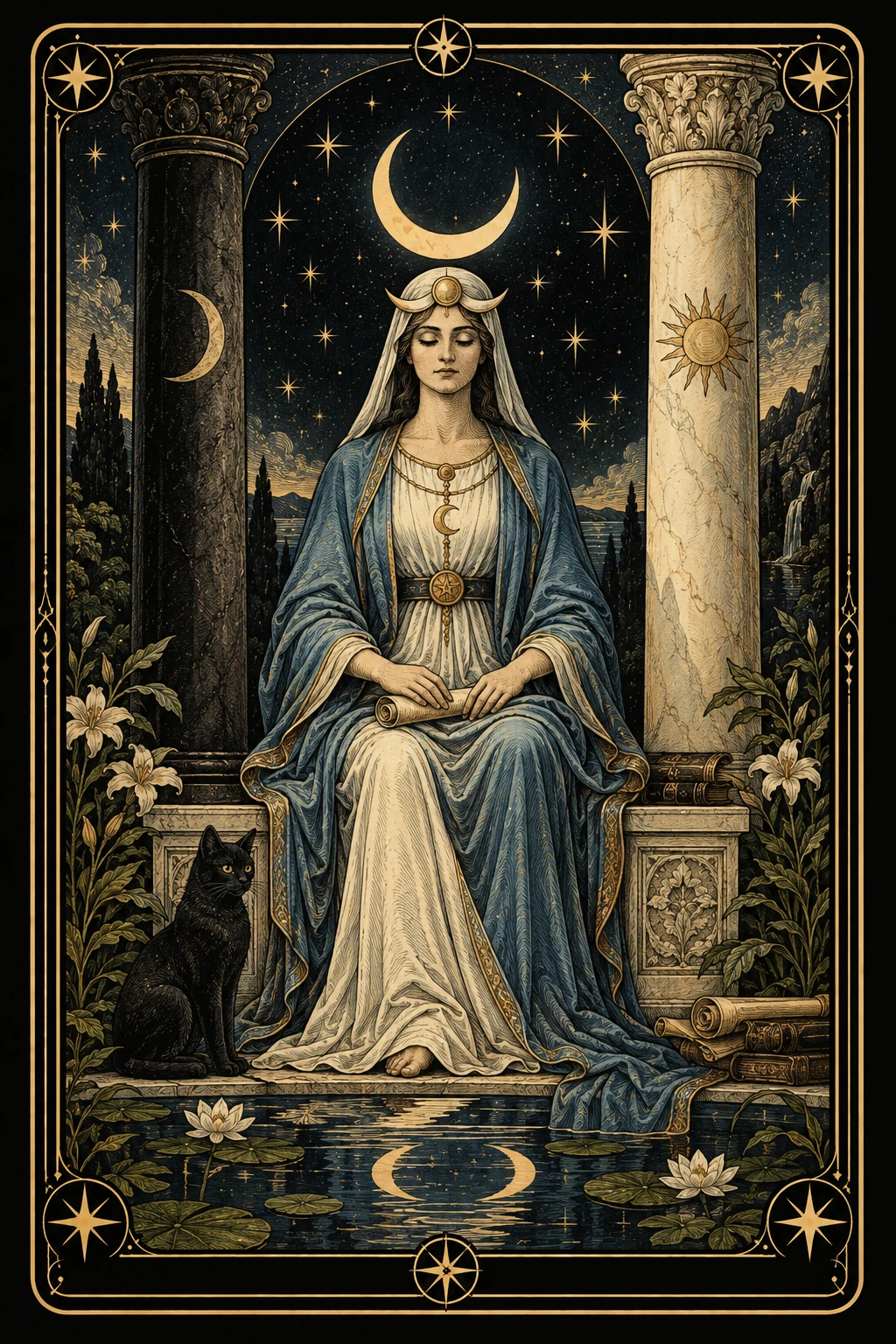
Major Arcana · II
The High Priestess
The High Priestess is an inner threshold. In a spread, the card more often points to information or understanding that has not fully surfaced yet: intuition, observation, knowledge still held back.
The key point is that not everything is known at once. Rushed conclusions can hide important details and your own reaction to the situation. The card can describe a secret, a wait, a reluctance to speak before you are ready. The question is not “what should I do immediately,” but what can already be understood if you do not rush the conclusion.
General meaning
In the larger context of a reading, the High Priestess points to what is happening beneath the surface. The card can mark a period when a person notices intuitive reactions, dreams, repeating thoughts, or a sense of mismatch more strongly, without those things replacing a factual check of the situation. It often makes sense not to rush a confession, not to close a deal without enough information, and not to draw premature conclusions.
Sometimes the Arcana describes a person who knows more than they say. That is not a withdrawal from life. Someone may simply need more time to understand the situation.
Next to cards of action, conflict, or haste, the High Priestess often asks for a quiet pause: watch and sort it out first, then act.
Upright
Upright, the card highlights intuition, observation, and attention to detail. Not everything becomes clear at once. The upright High Priestess often supports waiting, research, confidentiality, work with information that is still too early to share.
If the question is “speak or stay quiet,” the card favors checking whether you are talking or deciding before you have understood your own feelings or gathered enough facts. If the question is “know or not know,” the answer may come through observation, analysis, and more information, not through pressure on the situation. The absence of an answer can be part of the picture. It should not automatically be given a fixed meaning.
Reversed
Reversed, a person’s own reaction is either ignored or replaced by other people’s opinions. Either intuition is drowned in outside advice, or silence is used as power: secrecy, fog, unclear motives.
The reversed High Priestess can warn that waiting has already become avoidance, or that fears are being mistaken for intuition. It is worth asking whether the pause helps you understand the situation, or whether it is there so you do not have to decide. If the situation already needs a conversation or an answer, further silence can be a form of avoidance.
Love and relationships
In feelings, upright often describes emotions not yet put into words, caution in drawing closer, unclear intentions, or a private relationship. Attraction may be there. Words may be few. Reserve by itself does not let you name feelings with certainty. You need context and deeds. For someone who is single, the card can say: do not hurry into a relationship until you know what you actually want. Even a strong intuitive sense of connection is worth checking against a person’s real behavior.
Reversed, this can be painful silence, hidden motives, a refusal of an open conversation, ignoring obvious problems, or silence used as pressure. Temporary distance can help a relationship, or it can get in the way of ordinary contact.
Work and career
At work, upright often points to analytical work, research, confidential information, a preparatory stage of a project. The card can support professional caution and a situation where not all conditions are known yet: more data is needed before you publish a result.
Reversed, it can point to unclear tasks, hidden team rules, or ignoring your own tiredness. It is useful not to sign what you have not read, and not to agree to a decision if the conditions are unclear or there are grounded doubts.
Money and finances
In money questions the High Priestess is not, by itself, a direct sign of profit. More often it is about hidden conditions, missing information, the need to read a contract carefully, caution before investing, confidential financial matters. Upright: do not hurry until the picture is clearer, and do not decide from feeling alone.
Reversed, it can hint at opaque terms, doubtful offers of the “invest now, understand later” kind, or a refusal to look at your own accounts. Before signing a contract or putting money in, check the terms, the risks, and the information you can actually get.
Advice
Do not rush a conclusion if the information is incomplete. Give yourself a day without other people’s interpretations, and notice your own reaction: distinguish an intuitive sense from anxiety and fantasy.
Watch, and gather facts. Keep confidentiality where it is truly needed, but do not use silence to avoid a necessary conversation. You do not have to speak about a decision before you have named it to yourself.
Symbolism
In the classical Rider–Waite tradition, the High Priestess sits between two pillars, often marked B and J, Boaz and Jachin. They are commonly read as paired opposites at a threshold: one dark, one light. Later tradition associates the pillars with contrasting qualities; the card itself shows the threshold, not a finished verdict. The point is not to pretend the poles are not there. The pomegranate veil hides an inner space. Tradition links it with mystery and hidden knowledge, not with emptiness.
The moon-shaped crown and the crescent at her feet often tie knowledge to a natural cycle rather than a linear deadline. The scroll on her knees is partly hidden: the full picture is not available at once. In a reading, it may matter whether the emphasis falls on the threshold, hidden knowledge, the lunar rhythm, or the water of feeling.
Combinations with other cards
Next to the Moon, intuition and emotion grow stronger, and so does the risk of projection, fear, and false readings: it helps to distinguish a feeling from a fact. With the Hermit, the answer is sought through self-inquiry, solitude, and independent research. The Magician nearby raises a question of balance: if there is already enough information, it may be time to take a concrete step.
Neighboring Arcana help you see whether a pause is still needed, or whether there is already enough to act.
Frequently asked questions
What does the High Priestess mean in a spread?
Often intuition, hidden information, and caution with premature conclusions. The focus is on watching and gathering facts, not always on doing nothing.
How should I read the reversed High Priestess?
The reversed card can point to ignoring your own reaction, using silence as leverage, avoidance, or a mix-up between intuition and fear. Look at whether waiting is helping you understand, or keeping you from deciding.
What does the High Priestess mean in love and feelings?
Upright, it often speaks of unspoken feelings, caution, and unclear intentions. Reversed, of painful silence, hidden motives, or a refusal of an open conversation.
If the High Priestess appears, should I stay silent?
Not always. The advice is more about not hurrying a conclusion without facts, and not signing someone else’s decision blindly. One honest question to yourself is more useful than a chorus of advice.