The Tower — tarot card meaning
Major Arcana · XVI
The Tower
The Tower is the collapse of a false support. In a spread, the card more often points to a sudden exposure: a crack that can no longer be plastered over.
The central theme is a crisis of what used to look stable. The card can describe a scandal, a dismissal, a sharp conversation, a revision of how you see the world. It does not promise ruin. It asks what was kept more from a fear of change, or from a wish to maintain the appearance of well-being.
General meaning
In a reading, the Tower describes a moment when hiding or ignoring a problem becomes impossible. The card can mark a period of truth that arrives sharply: news, a conflict, a realization.
Sometimes the Arcana points not to an external event, but to a sharp inner recognition: a person can no longer live in the previous story about themselves. Reading this as a curse is too simple. A person may suddenly admit that the previous situation, belief, or way of life no longer fits.
Next to Arcana of avoidance or self-deception, the Tower hastens a confrontation with the fact. Next to cards of healing, it reminds you that after a crisis it matters to understand the causes of the problem, not simply restore the previous appearance of order.
Upright
Upright, the focus is an open crisis. The upright Tower often points to a sudden change, an exposure, the end of an order that seemed eternal.
If the question is “will it stay quiet,” the card more often answers that ignoring an obvious problem is becoming harder. The emphasis is on a sharp change or clarification whose consequences you will need to adapt to. The change will not necessarily be fair or gentle. Ignoring the obvious can only make the situation more complicated.
Reversed
Reversed, a person either tries to avoid or postpone a crisis, or change moves gradually and more inwardly. The reversed Tower can describe a fear of change, denial of a problem, living in a situation where difficulties have long been visible and continue to be ignored. Conversely, the card can also point to a gradual clarifying of the problem, or inner tension and a revision of views.
When the question concerns a situation, the reversed card often asks whether you are already living in circumstances that have long been unstable. Reversed by itself does not mean that serious consequences will be avoided. Look at whether you face facts with denial, panic, or an objective assessment of the situation.
Love and relationships
In love, upright often describes a serious conflict, an unexpected confession, the revealing of a secret, the breaking of an idealization of a partner, or a sharp change in the relationship. For a couple this is a crisis after which the relationship has to be revised: either the truth is spoken, or people part. A breakup is possible, but not predetermined. In a new connection, a revision of a previous idea of a person. For someone who is single, a refusal of expectations about relationships that reality has long not confirmed.
Reversed, this can be avoiding a serious conversation, chronic tension, an attempt to keep the appearance of well-being, a fear of admitting an existing problem, a gradual emotional distancing. Not every conflict is useful: it matters to distinguish an honest conversation from a destructive escalation. The Tower does not tell you who is to blame. Look at which ideas about the relationship no longer match reality.
Work and career
At work, upright can point to a dismissal, a failed project, a serious mistake, a change of leadership, a reorganization, the revealing of a hidden problem, or an unexpected change of conditions, but these are possible expressions, not guaranteed events. The card can describe a moment after which you cannot work “as before”: a hidden problem has come out.
Reversed, it points to external stability behind which problems have accumulated, an unstable organization, a fear of change, resistance to needed changes. It is useful to ask whether you are trying to keep a job, a role, or a way of working that already creates more problems than benefit.
Money and finances
In money questions the Tower can point to an unexpected large expense, a loss of part of an income, a sharp change of circumstances, the discovery of a serious error in a budget, or a need to revise a financial plan urgently. These are possible expressions, not a guaranteed loss. Upright, it can say that the previous way of handling money or earning no longer gives the expected result.
Reversed, it speaks of ignoring debts, postponing a decision, an unwillingness to assess the real state of accounts, or a gradual worsening of the situation. It is worth admitting the state of affairs before circumstances narrow the choice. In serious financial trouble the card does not replace a budget calculation or a specialist’s advice.
Advice
Do not try to keep the appearance of well-being if the problem is already obvious. First assess the facts and name what needs an urgent decision. In a crisis, protect safety, health, important relationships, and real resources first, and do not make chaotic decisions only from shock.
If a problem has long been visible, it is better to deal with it before circumstances limit the options. After a sharp change, give yourself time to understand the consequences: the previous position may have been less stable than it seemed.
Symbolism
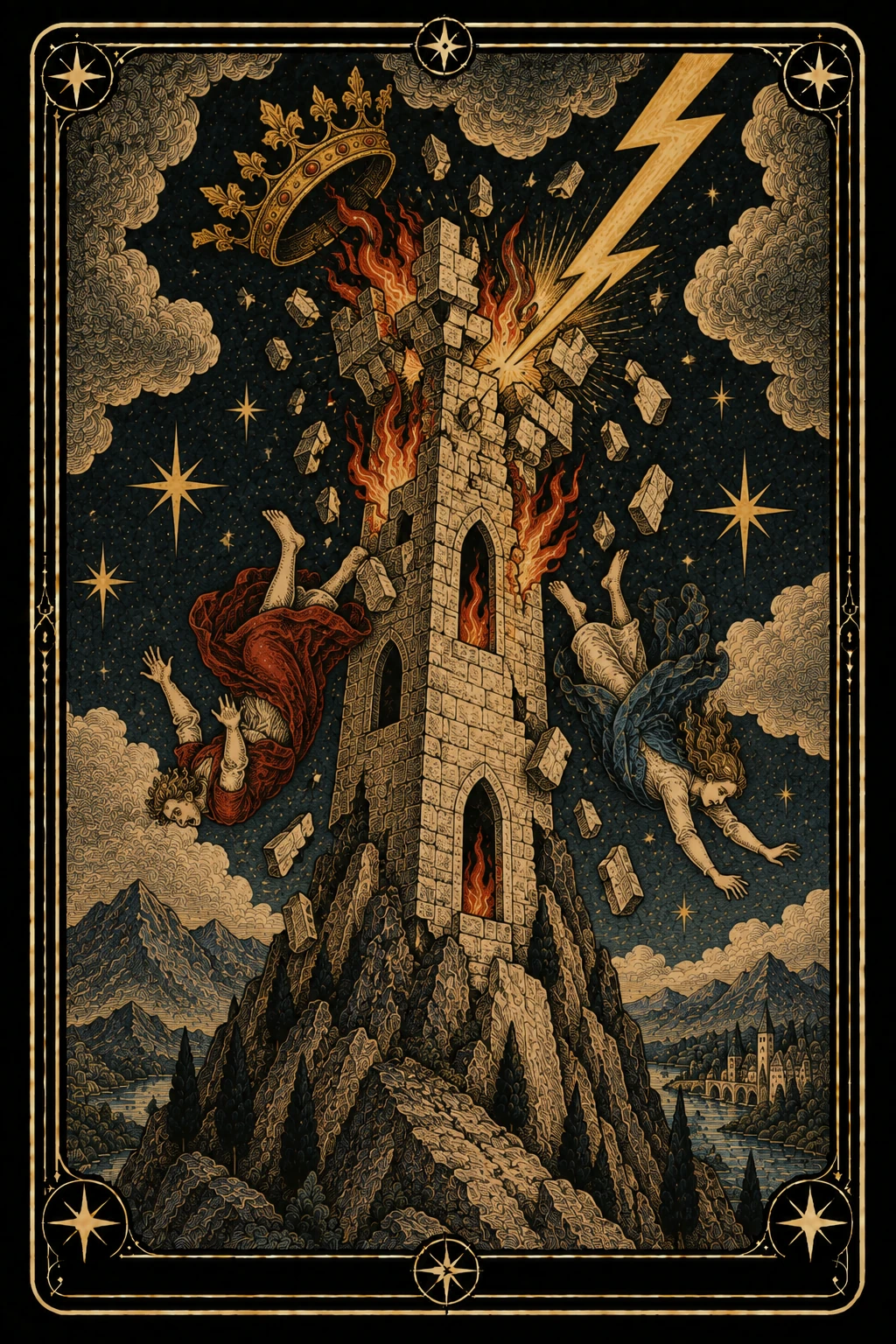
In the classical Rider–Waite tradition, lightning strikes a tower, a crown flies off, two figures fall. Fire from the windows is often linked with a sudden revealing of accumulated tension and the destruction of a previous order. The falling sparks of light around the tower are often interpreted as Yods, a traditional sign of sudden force; they should not be read as a weather event.
The falling crown is traditionally linked with the loss of previous control, status, or confidence in one’s own invulnerability. In a reading, it may matter whether the emphasis falls on the lightning, the crown, the fall, or the fact that previous confidence proved fragile.
Combinations with other cards
Next to the Star, after a crisis recovery, hope, and a gradual search for a new direction are possible, not a cancellation of what happened. With Death, the theme of a serious ending and large change grows stronger. With the Devil, a crisis can make dependence, control, or an unhealthy attachment especially obvious.
Neighboring Arcana help you understand the character of the crisis and a possible development of the situation. The Tower describes a sharp change in the current situation, not an absence of a future.
Frequently asked questions
Is the Tower always about catastrophe?
No. Often the card speaks of a sharp crisis or a revelation, but not necessarily of catastrophe and not of physical death. The particular expression depends on the question and the surrounding cards. A crisis by itself does not mean the event will necessarily turn out well.
Is this a sign of a breakup or a dismissal?
It can be, if the question is about that, but it is not guaranteed. Sometimes what is revised first is an idea of the situation, while the people or the job remain. Look at which previous ideas have stopped matching the facts.
How should I read the reversed Tower?
The reversed card can speak of an attempt to avoid or postpone a crisis, a fear of change, a gradual worsening, or an inner revision. It does not automatically mean that serious consequences will be avoided.
What advice if the situation is already chaotic?
First assess the consequences, name what is most urgent, and do not make extra sharp decisions only from emotional shock. The advice sets a direction of attention. It does not promise a fast new order.