The Devil — tarot card meaning
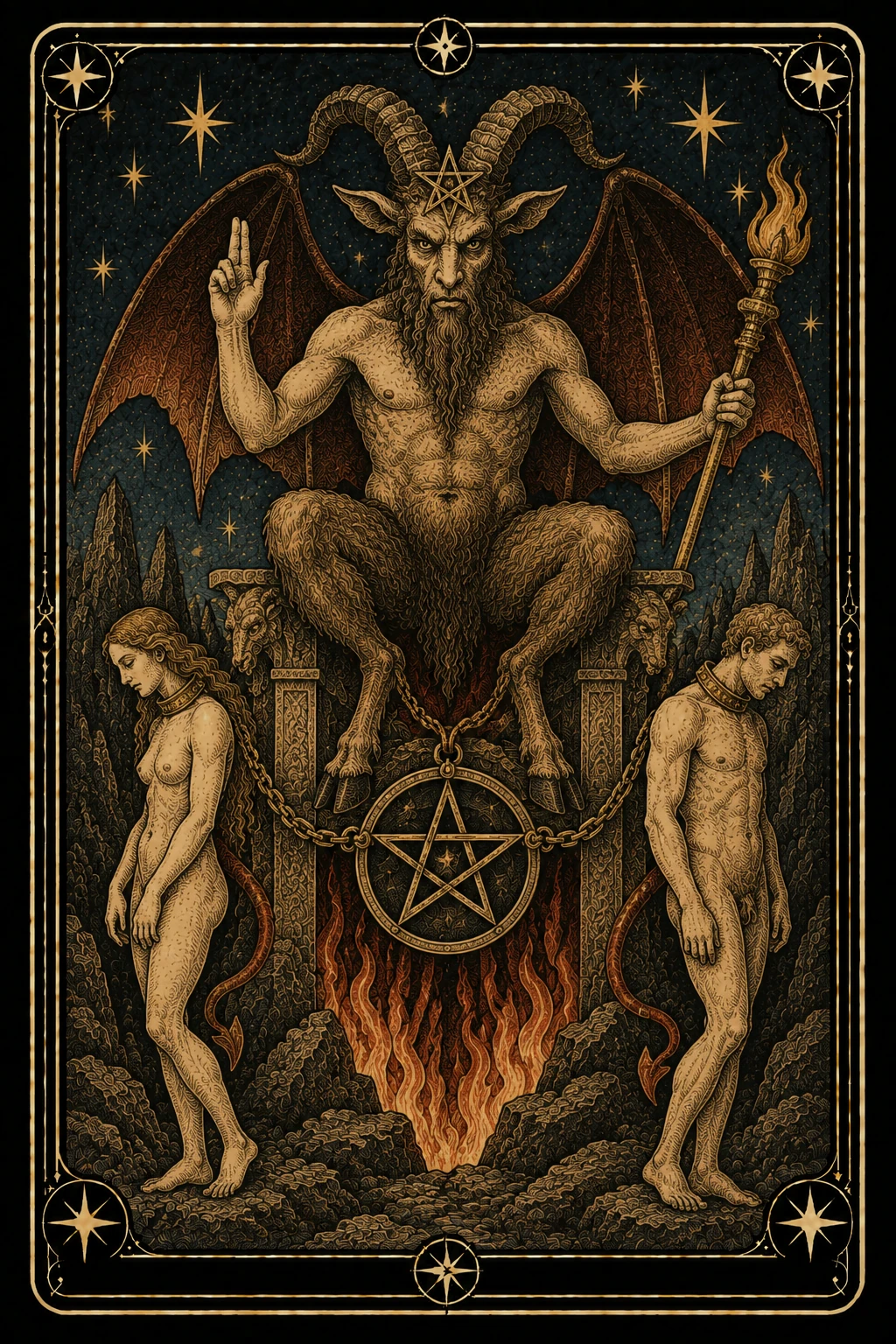
Major Arcana · XV
The Devil
The Devil is a bond that holds tighter than you want to admit. In a spread, the card more often points to attachment, temptation, material desire, shame, and the force of desire, not necessarily “evil” in a fairy-tale sense.
The card is closely connected with a bond you did not enter without playing a part yourself. The card can describe passion, a debt, work that is hard to leave, a habit that is sweet and constricting. It does not promise that the attachment will let go by itself. It asks whether you can see that a way out is still possible.
General meaning
More broadly, the Devil describes a pull where freedom exists in words, and in practice there is a strong attachment. The card can mark a period of strong desire, a shadow bargain, a relationship that is hard to leave even when you “should.”
Sometimes the Arcana points to materiality without soul: status, body, power that have replaced meaning. Reading this as a brand of vice is dangerous and flat. What matters is where you traded will for intensity.
Next to cards of light, the Devil shows the price of the shadow. Next to cards of freedom, that attachment can look comfortable and even luxurious.
Upright
Upright, the card highlights a visible, active attachment. The upright Devil often points to a strong pull, dependence, comfort that is hard to give up, physicality that rules the conversation, a fear of losing the familiar.
If the question is “why can’t I leave,” the card favors looking at the benefit of this bond, not only at the suffering. The emphasis is on naming what keeps you bound. This is not a promise that you are already free: a hint that the force of desire is the main character now.
Reversed
Reversed, the attachment either weakens or tightens through denial. The reversed Devil can describe insight, first steps out of a bond, shame that has lost its sweetness. At the other extreme is a still deeper denial: “I am in control.”
When the question concerns a situation, the reversed card often asks whether you are ready to see what is holding you, without turning it into a theatre of demonizing. It is not a guarantee of release. It is a signal that the shadow has shifted, toward an exit or toward a subtler lie.
Love and relationships
In love, upright often describes passion, jealousy, dependence, a bond that is hard to explain to parents and to yourself. In a new connection, chemistry that drowns out questions. For a couple, games of power, sex as glue, a fear of loneliness stronger than respect. For someone who is single, attachment to a fantasy or to an unavailable person.
Reversed, this can be a chance to see what is holding you, a cooling that frightens, or a still more tangled shame. It is worth distinguishing genuine desire from an attachment in which freedom of choice is already gone. The Devil does not stamp a relationship as toxic. It shows where “I can’t without you” matters more than “I choose you.”
Work and career
At work, upright often points to a golden cage: money, status, adrenaline, a boss who is hard to leave. The card can describe burnout that still sweetly feeds self-worth, questionable deals, work driven by fear.
Reversed, it points to an insight of “I no longer want this bargain,” or to a denial that the place is eating you. It is useful to ask what is holding you, and which part of freedom you have already sold.
Money and finances
In money questions the Devil is more often about the power of money over choice: debt, dependence on income, spending as a drug, deals in which you do not respect yourself. Upright, it can point to a strong material tie.
Reversed, it speaks of an attempt to leave a debt circle, shame around spending, or a still more hidden dependence. It is worth naming which freedom you are exchanging for a sum. Here the numbers are rarely neutral.
Advice
Name what is holding you, without poetry. Fear, pleasure, debt, status, the body? Look at how closed this bond actually is: often a way out exists, it simply has not been tried in a long time.
Do not demonize yourself and do not play the hero. The card suggests a small honest gesture of freedom, not a great escape in a single day. Shadow weakens when it is seen.
Symbolism
In the classical Rider–Waite tradition, a horned figure sits above two people with chains on their necks. The chains are loose: they can be taken off, but the figures look at the ground. A torch and an inverted gesture parody a blessing: energy is there, the direction is downward, into matter and instinct.
The figures’ tails are grapes and flame: pleasure and heat. Depending on the question, the emphasis may fall on the chain, the sweet fruit, the figure’s hold on the gaze, or the fact that the lock is only conditional.
Combinations with other cards
Next to the Lovers, desire meets choice: passion can become a union or an attachment without air. With the Magician, the shadow asks you not to confuse mastery with manipulation. With the Star, after a heavy attachment a breath of air is possible, if shame does not forbid hoping.
Neighboring Arcana show the price of intensity. The Devil does not erase body and matter. It asks whether you serve them, or whether they already rule in your name.
Frequently asked questions
Is the Devil always about addiction or “a bad person”?
Often about an attachment that is hard to leave: desire, debt, status, fear. This is not necessarily a villain in the spread. Look at where your freedom of choice has already weakened.
Is this a sign that the relationship is toxic?
The card can describe uneven power, jealousy, the glue of passion. Life, not one card, names toxicity. Ask whether you still have a choice, or whether your freedom of choice has already weakened.
How should I read the reversed Devil?
The reversed card can speak of insight and first steps out of attachment, or of a finer denial. Look at whether you see what is holding you, or are calling it love again.
What does the Devil mean in work and money?
A golden cage: income, status, adrenaline that hold more strongly than meaning. Reversed, a chance to name the bargain and begin to leave often appears.