The Star — tarot card meaning
Major Arcana · XVII
The Star
The Star usually appears where, after a shock, what is needed is not a new storm but quiet, steady support. In a spread, the card more often points to a hope that does not need proof every hour.
The card usually concerns gradual recovery and a renewed trust in life. The card can describe emotional relief, inspiration, a period when it is possible to breathe calmly again. It does not promise that the difficulties are already behind. It asks you to look at whether you have the strength to sustain your own recovery without having to pretend that everything is already well.
General meaning
In a reading, the Star describes a cautious renewal of hope and confidence in the future. The card can mark a period of gentle recovery after a crisis, motivation coming back, work that gives a sense of meaning rather than only external status.
Sometimes the Arcana points to a talent or a capacity that a person begins to approach with more confidence and calm. Reading this as “everything will be wonderful on its own” is naïve. What matters is a chance to regain strength gradually, if you do not demand a fast reward for the difficulties you have already been through.
Next to cards of crisis or sharp change, the Star often points to a chance to recover gradually after a hard stretch. Next to cards of uncertainty, to an orientation that does not yet remove every doubt, but already keeps you from getting fully lost.
Upright
Upright, the card highlights quiet hope and gradual recovery. The upright Star can symbolically accompany a period of self-care or strength coming back, but it does not replace a medical assessment. It often supports an open conversation without a defensive pose, a return to work that interests you again, a willingness to be vulnerable.
The emphasis is on recovery in small steps. A situation can become less anxious, and a person can gradually regain a sense of control and hope. The card does not promise a triumph.
Reversed
Reversed, it becomes hard to believe in improvement, or optimistic words do not match the real state. The reversed Star can describe emptiness, shame around tiredness, an attempt to look optimistic while exhaustion or disappointment is felt inside. Another possibility is difficulty noticing real signs of improvement because of earlier disappointment.
When the question concerns a situation, the reversed card often asks in which area of life a loss of strength or hope is felt most. It is useful to concentrate on small real actions that help restore stability, not on slogans.
Love and relationships
In love, upright often describes a restoration of trust, emotional relief after a crisis, a readiness to speak honestly and show actual feeling. For a couple, warmth and care without constant demands for proof. In a new connection, a calm mutual interest without excessive drama. For someone who is single, recovery after a previous relationship and a renewed readiness for new meetings.
Reversed, this can be disappointment, emotional tiredness, one-sided expectations, or idealizing a partner. Feelings or expectations may not be mutual. It matters to look at whether hope is confirmed by real deeds and reciprocity. The Star does not promise a partner’s return. Look at whether there is mutual interest and action on both sides.
Work and career
At work, upright often points to meaning rather than only status: a project that makes the work interesting again, recovery after burnout, an occupation in which a person sees a result and the value of their own contribution. The card can support study, creative work, helping others, renewed interest and trust in your professional field.
Reversed, it points to professional disappointment, a loss of motivation, empty corporate slogans, tiredness that is shameful to admit. It is useful to ask which tasks actually interest you again, and whether you have to keep performing enthusiasm while the work has long led to exhaustion.
Money and finances
In money questions the Star is usually more modest than its name suggests: rarely about sudden wealth. Upright, it can support a gradual restoration of a budget, a lessening of financial anxiety, regaining control over spending, calmer and more consistent planning. The card does not promise a rise in income. If the question is about earning, work that matches skills and long-term interests is possible.
Reversed, it speaks of financial anxiety, disappointment from a lack of money, emotional purchases as an attempt to improve mood, uncertainty in valuing your own work, or a fear of talking about pay. It is worth returning to a concrete budget: income, necessary expenses, debts, and an available reserve.
Advice
Bring back simple actions that actually help recovery: sleep, rest, supportive contact, a familiar rhythm, small steps for tomorrow. Do not demand that you recover overnight.
If hope has become a slogan, the card suggests returning to basic daily needs and one doable action in support of yourself. The Star speaks more of gradual recovery than of a sharp turn.
Symbolism
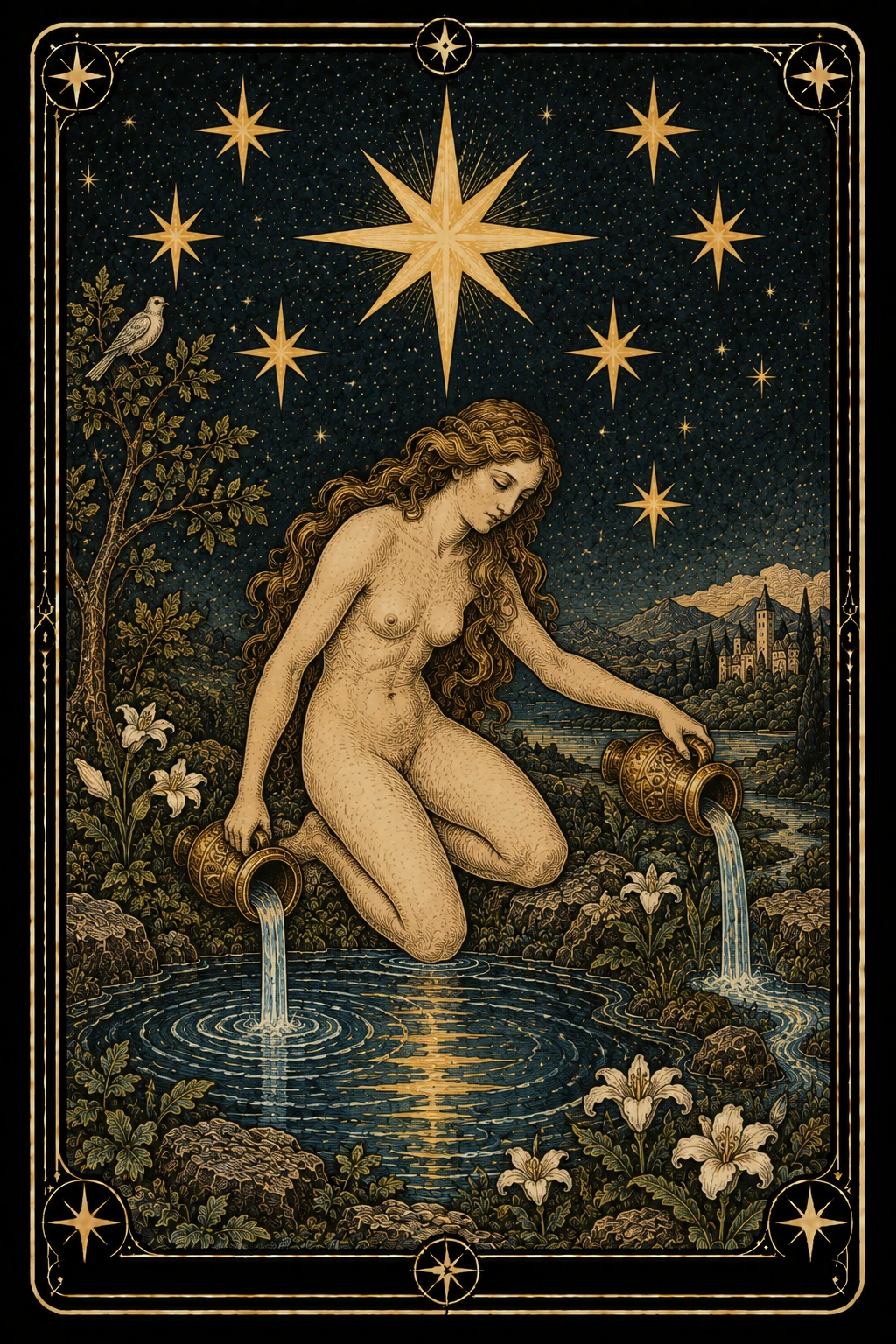
In the classical Rider–Waite tradition, a naked woman kneels at the water: her left knee is on the land and her right foot upon the pool. She pours from two jugs, one stream into the water, the other onto the earth. Above her is a large star and seven smaller ones. The bird in the tree is often linked with inspiration or spiritual knowledge, the distant landscape with perspective and a continuation of the path.
Nakedness is often read as openness, vulnerability, and no need to hide. The relevant detail depends on the question: the water, the star, the figure’s openness, or the far horizon.
Combinations with other cards
Next to the Tower, the Star can point to a period of recovery after sharp change: not a cancellation of what happened, but a chance to find your footing again. With the Moon, hope can help you live with uncertainty, but idealizing can strengthen false expectations. With the Hermit, recovery turns toward self-inquiry and less external pressure, not public optimism.
Neighboring Arcana help you understand how realistic the expectations are, and what supports recovery. The card’s positive potential needs real action and does not replace the work the situation itself requires.
Frequently asked questions
Can the Star be read as a sign that the difficulties are already behind?
Better not. It more often describes a chance of recovery, not a closed crisis. The outcome depends on actions and boundaries, not on one card.
What does the card mean in love if a partner is silent or keeps distance?
It is often read as an invitation to careful clarification, not as a promise of return. It is worth looking at whether there is reciprocity, and whether hope is confirmed by the other person’s deeds.
Does reversed always mean disappointment?
No. Often it is a slowed recovery, or a fear of believing again. Clarify in which area of life disappointment or a loss of strength is felt most.
How do I distinguish genuine hope from self-deception?
Realistic hope can live alongside small steps, and it takes facts and other people’s boundaries into account. Self-deception has a hard time with facts, deadlines, a refusal, or an absence of reciprocity from the other person.