The Chariot — tarot card meaning
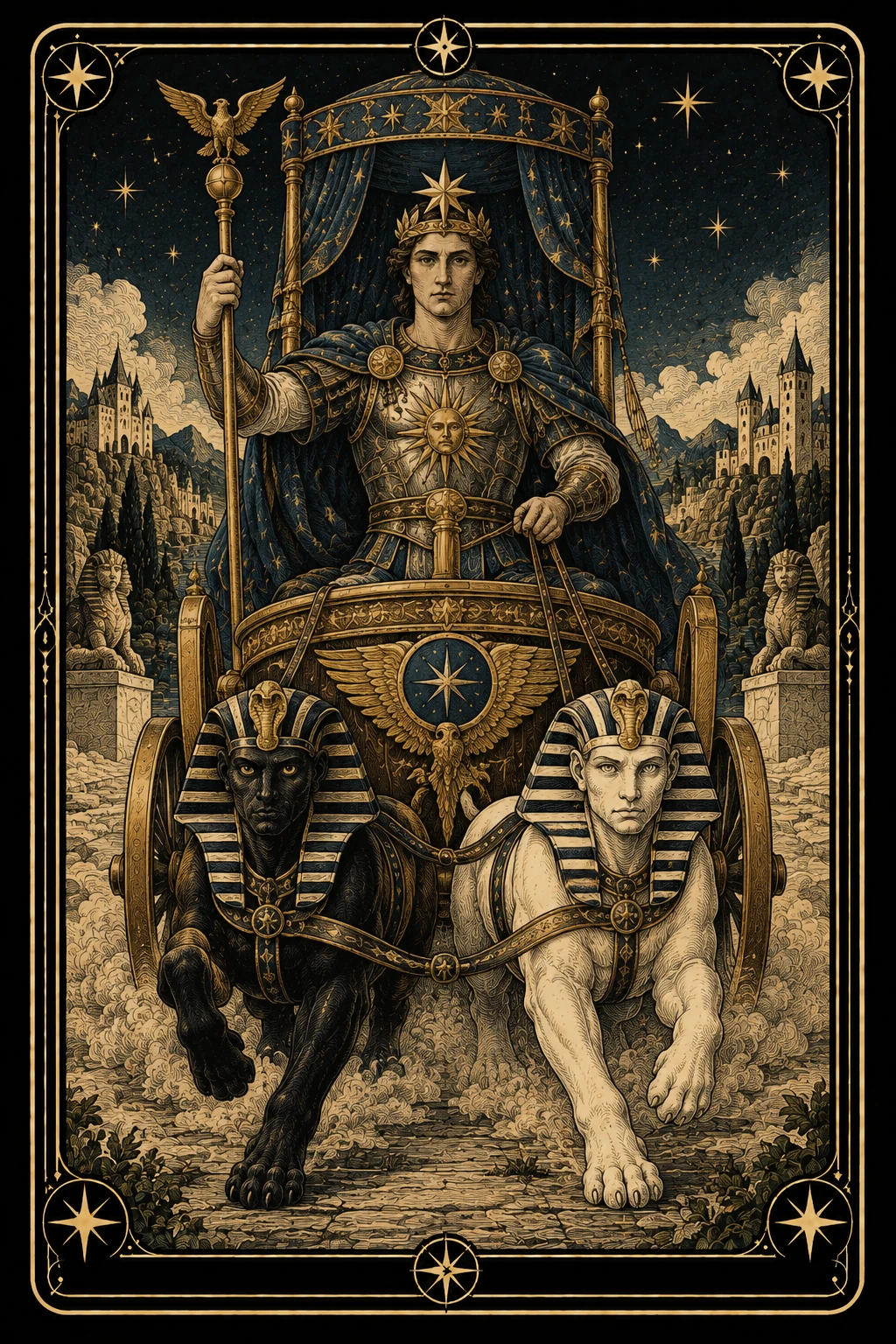
Major Arcana · VII
The Chariot
The Chariot is directed movement and the skill of steering your own effort. In a spread, the Chariot more often points to a need to name a goal and stop spreading your energy too thin when different tasks pull in different directions.
This card often centers on progress through discipline, not through rage. The card can describe a road, a contest, a move, a push toward a concrete result. It does not promise that this will be easy. It asks who is driving: you, or your contradictions.
General meaning
More broadly, the Chariot describes a situation in which passive waiting no longer helps much and a more active stance is needed. The card can mark a period of mobilization: an exam, a launch, competition, a need to organize quickly and move toward a concrete result.
Sometimes the Arcana points to a person able to align different motives and direct effort toward one goal: ambition and discipline, emotion and calculation. Reading this as “everything will succeed on its own” is risky. Results require discipline and the ability to direct your actions.
Next to cards of chaos, the Chariot underlines a need to set priorities. Next to cards of pressure, it reminds you that under strong external pressure it matters not to make a hasty decision only to get out of an unpleasant situation faster.
Upright
Upright, the card highlights resolve, concentration, and discipline. The upright Chariot often supports a trip, a contest, a wish to reach a concrete result, a way out of a drawn-out situation through steady action.
If the question is “should I act,” the card can indicate that the situation needs more resolve, and that it is not worth waiting for a moment when every doubt and obstacle has vanished. The emphasis is on moving a matter forward with enough preparation. This is not a guarantee of triumph: the result depends in large part on concentration, preparation, and consistency.
Reversed
Reversed, it becomes hard to steer one’s own actions or maintain clear priorities. The reversed Chariot can describe a conflict of priorities, haste, aggression in place of strategy, delays or a change of plans in travel if the spread concerns a journey.
Conversely, a lot of energy may go into activity that does not bring the needed result because there is no clear strategy. When the question concerns a situation, the reversed card often asks whether irritation and the urge to win immediately are starting to matter more than the task itself. It is a signal to bring back clear priorities and control of your own actions.
Love and relationships
In love, upright often describes active initiative and a wish to develop a relationship, a couple’s readiness to act together: a move, a shared project, a way out of a long pause. In a new connection this can be a clear expression of interest and fairly clear intentions. Persistence by itself does not make the situation good. For an existing couple, the card can point to a need to solve a concrete problem together or carry out a shared plan.
Reversed, this can be a struggle for influence in the relationship: partners may be so set on getting their way that they stop hearing each other, or one hurries while the other resists. For someone who is single, the card can say you are rushing the development of a connection, or concentrating too hard on the outcome of a meeting instead of the contact itself. The Chariot does not guarantee that feelings will form at the pace you want. Look at whether two people’s intentions and actions are aligned.
Work and career
At work, upright often points to a deadline, competition, a work trip, a project that needs concentration, discipline, and fast decisions. The card can accompany a fight for promotion, a tender, or a move into a new market, especially when the result depends on preparation and steady action.
Reversed, it points to conflicts inside a team, burnout from overload, priorities lost in the scramble. It is useful to ask what the real task is and what matters most now, and whether constant busyness only creates a feeling of progress without a real result.
Money and finances
In money questions the Chariot is more often about concentrating resources on one priority: closing a debt, finishing a deal if that is the question, keeping the budget from being spread too thin. Upright, it can support control of spending and sticking to a budget already set for a concrete financial task. The card is not investment advice.
Reversed, it speaks of impulsive financial decisions, spending to show status, or trying to match someone else’s level of consumption. An excessive focus on a fast result or prestige can lead to thoughtless expenses. It is worth choosing one clear financial priority: the budget, the obligations, and the main task.
Advice
Name the goal and remove secondary tasks. Align the wish to act with calculation, without letting irritation or haste decide. Fast action helps little if it is unclear what result is needed.
If you are torn between several options, settle on one clear task and do not spread your effort too thin. What matters next is consistent action, not a show of resolve.
Symbolism
In the classical Rider–Waite tradition, a warrior stands in a chariot crowned with a starry canopy. In front of the chariot are two sphinxes, black and white. They are often read as opposing forces or drives that need to be aligned and steered. Details of the armor and the heavenly symbols are traditionally linked with inner discipline and the joining of different powers.
The city behind has already been left: the path has begun. In a reading, it may matter whether the emphasis falls on the chariot, the two drives, the armor, or the road.
Combinations with other cards
Next to Strength, resolve alone is not enough: self-command matters, and not acting from irritation. With the Tower, active moves will not help if the aim or the original strategy is wrong. A crisis can require a revision of the first plan, not simply more effort. With the Lovers, the theme of aligning personal choice, relationships, and shared plans grows stronger.
Neighboring Arcana clarify the task, the obstacles, and the consequences of the chosen way of acting. The Chariot does not mean you should ignore feeling. Feeling matters, but it should not fully decide.
Frequently asked questions
What does the Chariot mean in a spread?
Often a need to name a goal and act consistently. The card points toward resolve, concentration, and movement toward a result, not a promise of an easy win.
Is this always about a trip or a move?
Sometimes, if the question is about the road. More often it is about resolve, concentration, and movement toward a result in any area of life: career, conflict, a way out of a pause. Context clarifies whether the path is literal.
How should I read the reversed Chariot?
The reversed card can speak of a lost direction, haste, a conflict of priorities, or activity without a result. Check whether a clear task is deciding your actions, or an emotional reaction.
What does the Chariot mean in love?
Alignment, or a struggle for influence in a pair. Upright, it more often points to shared plans and a readiness to act together. Reversed, to excessive pressure, different paces, or a fight for control.