Strength — tarot card meaning
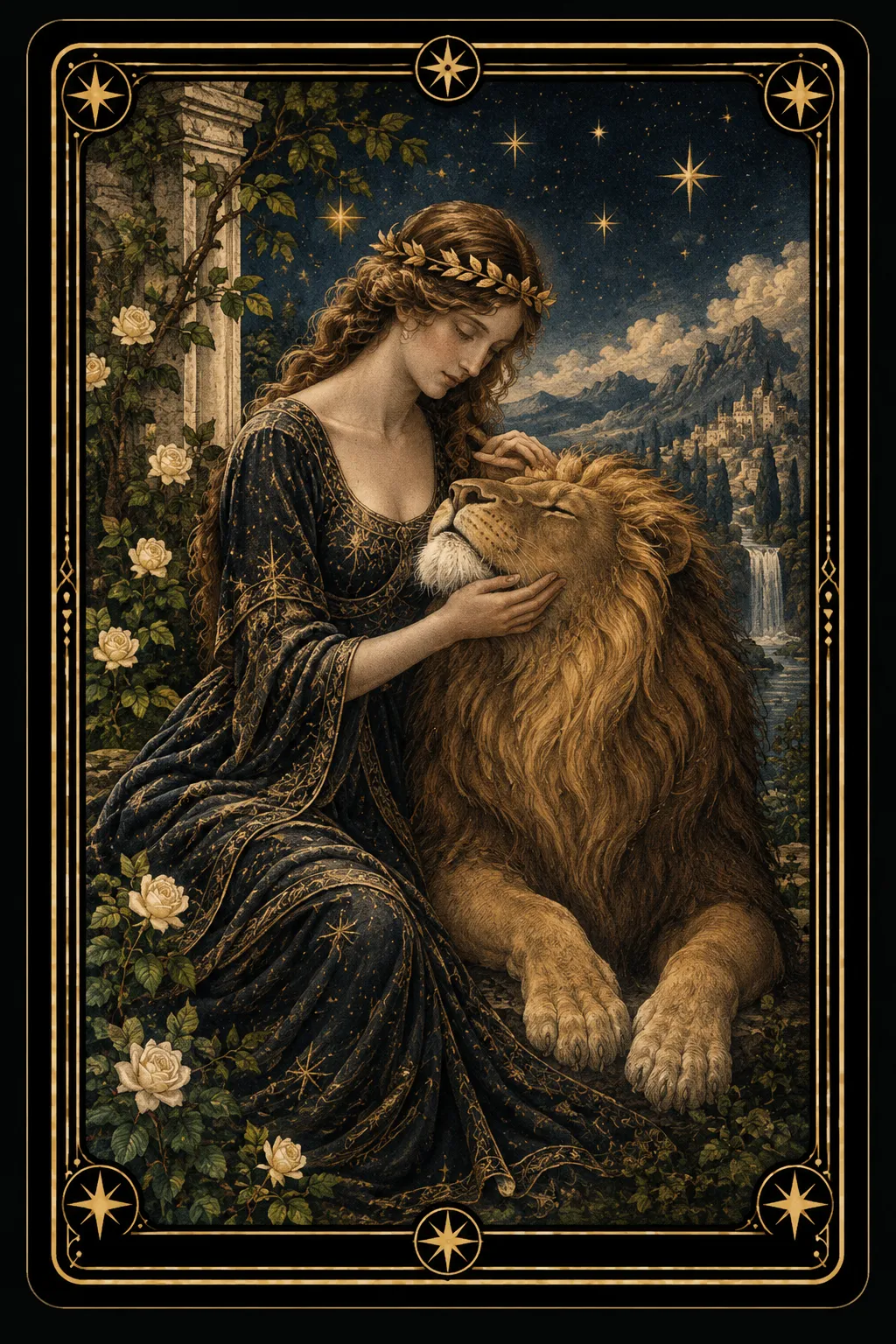
Major Arcana · VIII
Strength
Strength is about power without violence. In a spread, Strength more often points to the capacity to stay with an impulse as it really is: fear, anger, desire, tiredness, without crushing it and without handing it the reins.
At the heart of the card is the courage of gentleness. The card can describe patience, inner work, healing through presence. It does not promise that the animal inside will disappear. It asks whether you can be with it without becoming it.
General meaning
In a reading, Strength describes inner stamina. The card can mark a period when brute force will not work: tact is needed, staying power, trust in the process.
Sometimes the Arcana points to a person who influences without raising their voice, through calm presence rather than pressure. Reading that as weakness is a mistake. This is strength of a different kind. Softness is not the same as weakness.
Next to cards of conflict, Strength often suggests not answering pressure with pressure. Next to cards of fear, it reminds you that courage can be quiet.
Upright
Upright, the emphasis is on self-command and the ability to steer your reactions. Upright Strength often supports a difficult conversation without a blow-up, care that needs patience, a way out of panic, work where staying power matters more than a lunge.
If the question is “how do I get through this,” the card favors neither pushing nor running, but keeping a calm persistence. The emphasis is on getting through the situation through calm endurance. This is not a promise that it will be easy: a hint that brute force would more likely spoil everything now.
Reversed
Reversed, self-command weakens. Reversed Strength can describe an outburst, aggression, an attempt to break yourself or another person. At the other extreme is insecurity dressed as “I’m above this”: a refusal to face desire and anger at all.
In this context, the reversed card often asks where control became pressure, and where you gave up before you tried staying with it. This does not mean you are weak. It is a signal to keep dignity and boundaries without moving into aggression.
Love and relationships
In love, upright often describes tenderness that is not afraid of a partner’s character. Passion is there, but it is not used as a weapon. In a new connection this is slow trust. For a couple, a period when it matters not to win the argument, but to keep closeness. For someone who is single, the card can say: do not enter a relationship at any cost from a fear of being alone, and do not push closeness away from pride or a fear of vulnerability.
Reversed, this can be jealousy, pressure, emotional swings, or shame around desire. Care here is support, not an attempt to control or remake a partner. Strength does not promise a perfect character and does not ask you to tolerate poor treatment. It shows whether it is possible to be close without suppressing yourself or the other person.
Work and career
At work, upright often points to leadership without shouting, work with people, stamina in a long project, a profession where you cannot snap. The card can support negotiation, mentorship, a way out of burnout through rhythm rather than heroics.
Reversed, it points to toxic pressure, humiliation, or a culture where “strong” means “loud.” It is useful to ask what is driving you at work, and whether you can keep dignity without answering with pressure.
Money and finances
In money questions Strength is more often about a calm relationship with money: not panic, not greed, not showy generosity. Upright, it can support steady earning over time, discipline without self-punishment, the ability not to slip into impulsive spending.
Reversed, it speaks of impulsive financial decisions made under emotion, shame around wanting money, or excessive restriction: a fear of spending and painful control. It is worth treating money calmly and rationally, without panic, impulsiveness, or excessive control.
Advice
Do not answer fear, irritation, or pressure with the first impulse. Give yourself time to settle, then act with confidence and without aggression. If you want to snap, breathe first.
If you have long been suppressing yourself, the card suggests giving feeling a place: stamina is not the same as constantly pushing feeling down. Strength here is staying power in a difficult situation, not a victory over yourself at any cost.
Symbolism
In the classical Rider–Waite tradition, a woman leans toward a lion and closes its jaws, without a chain. Waite describes this as beneficent fortitude already subduing the animal. Above her head is the sign of infinity, often read as attention that does not snap. A wreath of flowers and white clothing are often read as a strength that does not need armor.
The lion is traditionally associated with living instinct: anger, passion, fear, vitality. The woman’s figure is not a denial of the animal, but a relation with it. The relevant detail depends on the question: the hands at the jaws, the infinity of attention, or the lion itself.
Combinations with other cards
Next to the Chariot, gentle stamina meets a willful lunge: together they can give a mature win, apart either a race or endless patience without movement. With the Devil, desire risks becoming dependence. Strength then asks whether you can stay in contact with it without putting on a chain. With the Moon, fear grows stronger. What is needed is not roughness, but clear boundaries in the fog.
Neighboring Arcana show how far a person can steer strong emotions and desires without suppressing them and without letting them rule entirely. Strength does not mean you should ignore feeling. It teaches you not to become feeling entirely.
Frequently asked questions
What does Strength mean in a spread?
Often stamina, courage, and self-command. The card points toward getting through difficulty by staying power, not by pressure.
Is Strength always about winning over other people?
No. More often it is about power over yourself: fear, anger, desire, tiredness. Influence on others here is more a result of tact than of pressure.
How should I read reversed Strength?
The reversed card can speak of an outburst, aggression, insecurity, or a refusal to face your own feelings. Ask where control became pressure, and where you are holding yourself too tightly.
What does Strength mean in love?
Tenderness that can bear another person’s character. Reversed, pressure, jealousy, or shame around desire.