Two of Swords — tarot card meaning
Minor Arcana
Two of Swords
The Two of Swords is a held pause. Not a blank mind — two claims that both have enough weight that discarding either one still feels like a lie. You can sit between them for a while. That is not a character flaw. It is what a nervous system does when a sharp yes or no would be incomplete.
Popular reading turns the blindfold into stupidity or cowardice. That is lazy. People close their eyes because the room is too loud, because both options cost someone they love, because the facts are not in yet. Difficulty begins later, when a temporary refusal to look becomes the only strategy left.
This is not the Four of Swords. The Four puts the mind down after strain so that rest can do its work. The Two keeps the mind on duty, holding two blades in balance. One card is recovery. The other is an unresolved choice that has not yet been spoken.
General meaning
Two options can both be true enough to live with for a stretch. There are arguments on both sides. The step has not been taken. Someone may close off part of what they can see in order to bear the tension — not because the world has vanished, but because looking at everything at once would force a move they are not ready to make.
That can be wisdom. Waiting for a second opinion, a second quote, or the person who holds the other half of the information is not “stuck” in any insulting sense. Exhaustion from deciding is also real.
Neighboring cards tell you whether this pause is gathering or stalling. The Two marks an unresolved choice. It does not say there is no choice, and it does not order you to decide tonight. If you hoped a card would pick for you, this one will refuse.
Upright
Upright more often describes a conscious delay. You know that a sharp answer right now would leave out something still alive. You want quiet, time, a refusal of other people’s pressure. The eyes are closed because there are too many stimuli, not because you have no mind.
This can look like sitting out a family argument, declining to sign until two offers sit on the same page, or telling a partner “not this week” without turning that into a forever. The upright Two supports more time when information is still needed, or when the cost of a cut has not been counted.
The question is whether you know why you are waiting. A pause with a date is different from a pause that has become the only way to live beside what is unresolved. The card will not shame you for the first. It will not pretend the second is the same thing.
Reversed
The balance does not hold forever. Reversed, something gives. A decision finally arrives, sometimes sharply, after a long silence that other people experienced as absence. Or the tension becomes unbearable: you still do not choose, but you can no longer pretend you are sitting calmly. Sleep thins. Irritation leaks.
Another tone is a forced choice under pressure — a deadline, an ultimatum, a gate closing. The reversed Two does not certify that the answer you lunge toward is the right one. It asks whether an honest delay has ended, or whether you simply cannot bear two truths any longer.
Neither outcome is a moral. Some people need the break in the stalemate. Some people, once pushed, pick the option that quiets the room rather than the option they can live with. Look at the quality of the ending, not only at the relief of motion.
Love and relationships
In a bond, upright often describes a stretch of “we are not deciding yet.” The future talk is postponed. An inconvenient fact is set aside so that ordinary kindness can continue. That is not always indifference. Often someone is protecting the relationship from a rupture they suspect would be premature — children, distance, money, exclusivity named too soon.
The risk is silence that replaces a meeting. Two people can be loyal and still stand on different unsaid sentences. The Two does not declare that love is over. It asks whether the quiet is making a real encounter possible, or whether it is furniture for a life that will not survive an honest look.
Reversed, the stalemate breaks. The truth surfaces anyway, or one person has already chosen while the other still holds the blindfold. Look at whether both still have a voice, and whether “I need time” still has a clock on it.
Work and career
At work the Two is a fork: two offers, two methods, loyalty to different people, a deadline that does not match what the work actually needs. Upright can describe a stage when it is better not to sign or announce a direction until the facts are laid side by side. Neutrality in a meeting can be professional rather than weak.
The card does not fill a vacancy and does not rank the two jobs for you. If one path is obviously safer and you still cannot move, the block may not be information. It may be a cost you have not wanted to name — status, a mentor, a city, a version of yourself.
Reversed, pressure forces a decision before you are ready, or you lunge from tiredness. The lunge can be correct. It can also be the option that ended the emails. Name both paths aloud, even if it is still too soon to choose.
Money and finances
In finances the Two is unresolved arithmetic: spend or save, refinance or wait, hold two scenarios without a calculation. Upright is not about profit. It is a refusal to pretend the answer is already there. Two budgets can both be livable. Pretending you have chosen when you have only worried is how people leak money through delay and impulse in the same month.
The card does not advise a concrete operation. Reversed, an impulsive step often follows a long indecision, or someone pressures you to accept terms you have not compared. Write both paths on paper, with dates and sums. While they remain only a feeling, the pause is doing the deciding for you.
Advice
Distinguish a pause that is gathering facts from a pause that is hiding a choice. If the decision is still too soon, name a time by which you are collecting information, and name what would count as enough. A blindfold with a calendar is different from a blindfold that has become a lifestyle.
If that time has long passed, protection has started to cost more than it saves. Then one honest question is needed: which truth you still do not want to see. You do not have to choose tonight. You do have to admit whether you are waiting, or refusing. If you are exhausted, recover first. If you are recovered and still will not look, that is this card.
Symbolism
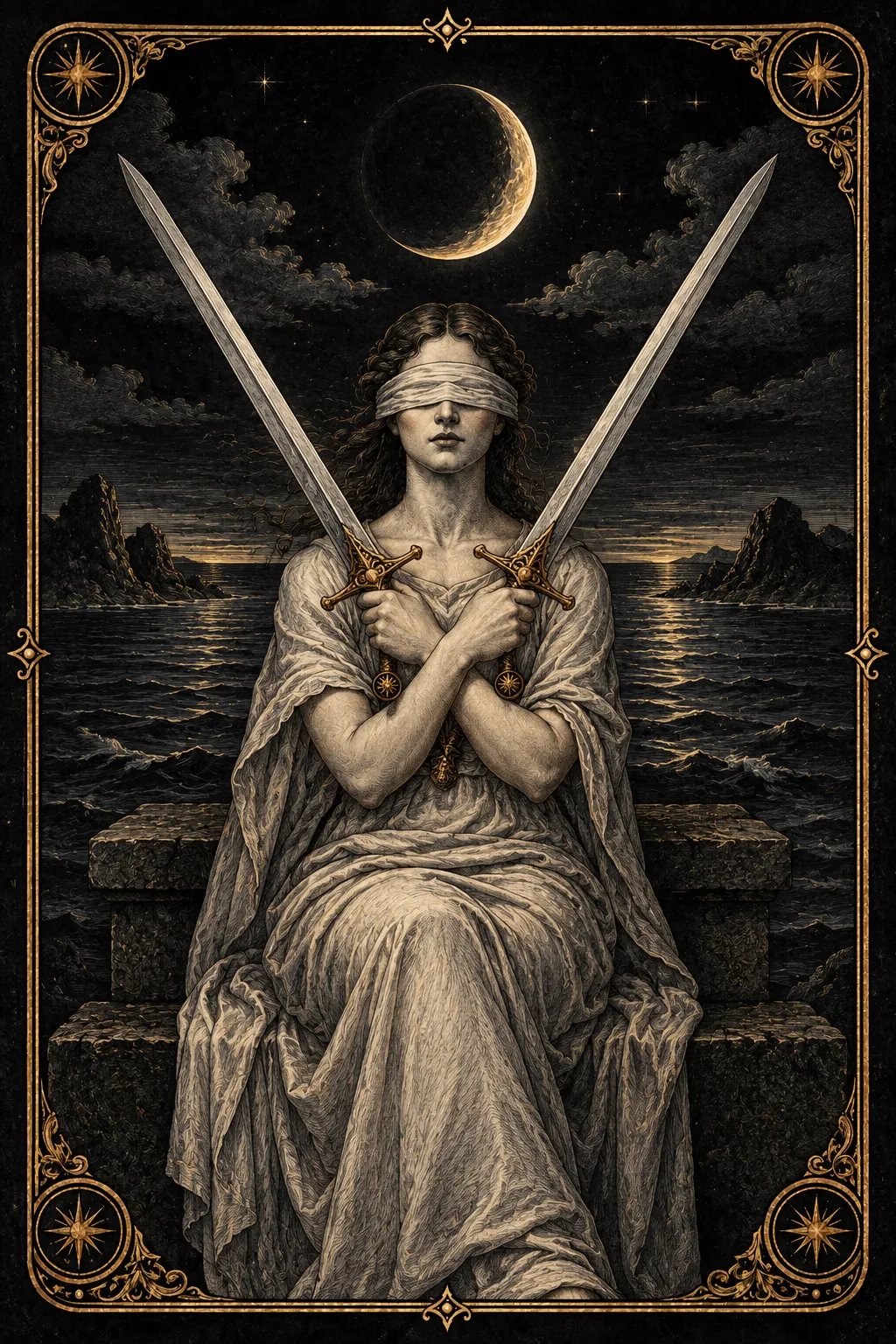
In the classical Rider–Waite image, a figure sits blindfolded on a stone bench, two long swords crossed at the chest, held in a careful balance. Behind the figure, water; above, a crescent moon. This is not sleep. It is a held stance.
Tradition links the blindfold with a refusal or inability to look, the crossed blades with equal claims, the water and moon with feeling that continues out of sight while the mind tries to stay even. The pause can be protection. It can also be a way of not seeing what would force a choice.
The traditional scene explains a pause between two forces. It does not claim that TARORIA’s drawing repeats the Rider–Waite deck. In a reading, closed sight as a way of bearing contradiction matters more than the moon as a separate prediction.
Combinations with other cards
Next to the High Priestess, the Two goes further inward. Silence can be knowledge rather than cowardice, if a person is actually listening. If they are only hiding, the same pairing looks like secrecy dressed as wisdom. Tone and neighboring cards usually give that away.
With the Hanged Man, the pause stretches. Another angle has not been found, and the choice is postponed again. That can be the right humility. It can also become a career of waiting for a revelation that will spare you a human decision. Watch whether new seeing is arriving, or only more suspension.
With Justice, neutrality is also a decision, and it has a price. Not picking a side still distributes consequences. Someone lives with the delay. The Two plus Justice does not order you to choose now. It does ask you to count who is paying for the blindfold.
Frequently asked questions
Does the Two of Swords mean I am lying to myself?
Not automatically. Often it is a conscious delay: too soon, too noisy, too costly to cut. Self-deception starts when the pause has no purpose left except not seeing. Ask whether you know what you are waiting for.
Can waiting with this card be the right move?
Yes. Upright often supports an honest delay while facts are still arriving, or while a sharp answer would be incomplete. The card does not command an immediate decision.
What if two people want different things?
That is a classic Two of Swords situation: two real claims, no clean discard. The card does not appoint a winner. It asks whether silence is protecting a future talk — or replacing it.
How do I know the pause has gone on too long?
When there is no timeline, no gathering of facts, and the tension leaks as irritability, thin sleep, or quiet contempt. Reversed often shows that strain. The “right” answer is still not guaranteed.