Three of Swords — tarot card meaning
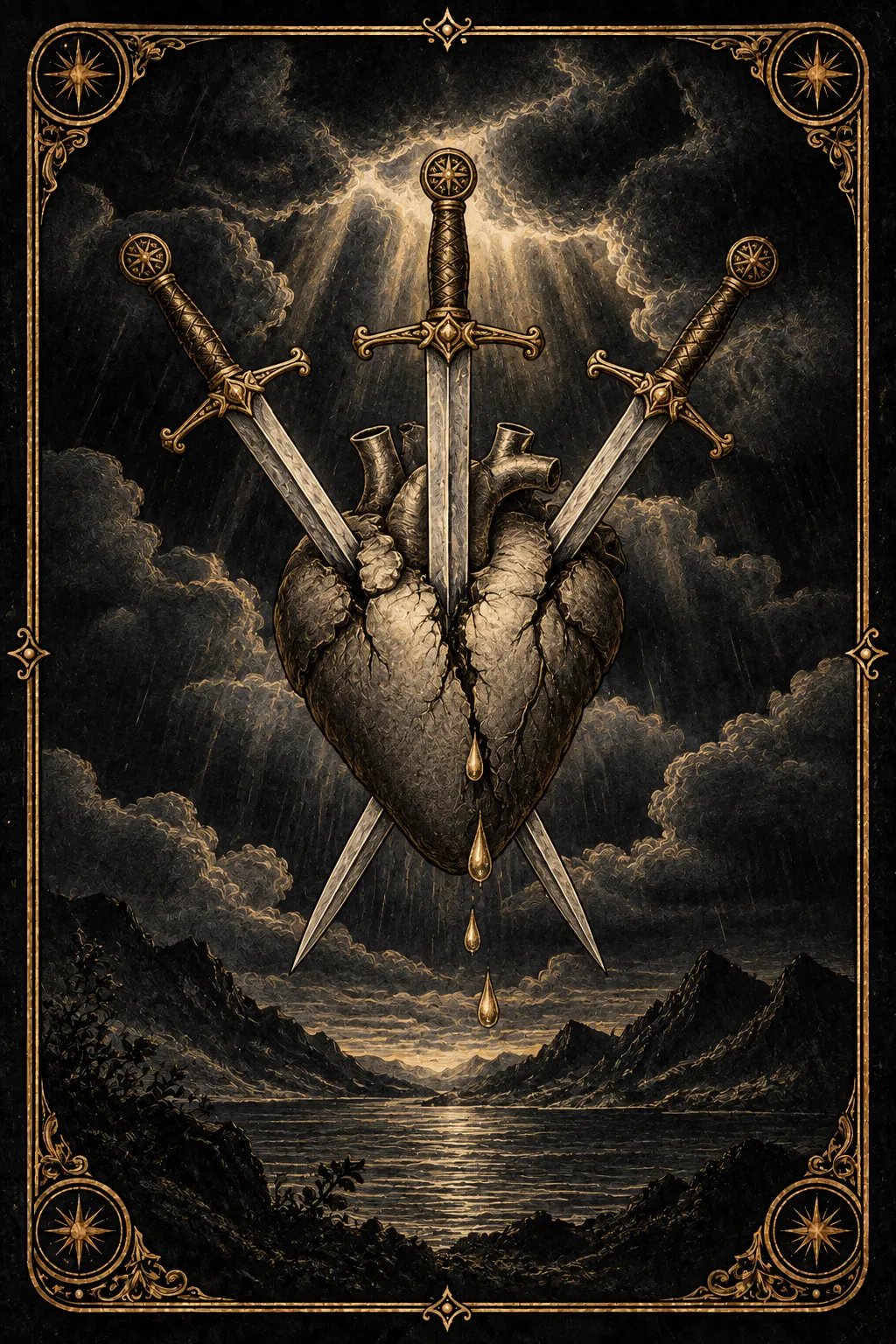
Minor Arcana
Three of Swords
The Three of Swords is the card people remember as a pierced heart, and they are not wrong about the feeling. Something has arrived that can no longer go unnoticed. A fact, a sentence, a disappointment, a broken expectation — what you could still walk around last month now sits in the middle of the room.
The internet reduced this image to cheating, triangles, and divorce paperwork. Those readings exist, and they are sometimes fair when the question and surrounding cards actually point there. They are not the law of the card. Pain happens without a third person. A job, a friendship, a family story, a self-image can take the swords as easily as a romance.
This is also not the Ten of Swords. The Ten is the end of a whole way of continuing: the pattern has run its course. The Three is the wound of recognition. You may stay. You may leave. You may change the terms. The card records that you can no longer pretend you do not know.
General meaning
Recognition is the event here. Grief, hurt, a clarity that does not comfort, the need to name what has broken. You can cry without being theatrical. You can be angry without turning the other person into a cartoon. The Three does not require a scene. It requires that the fact be allowed to exist.
This is not the end of an entire life and not an inevitable disaster. A one-time blow is different from a disappointment that has been gathering for years. Neighboring cards, and the actual question you asked, do that measuring. The Three describes the pain of realizing, not a verdict that everything is over.
A useful distinction: the Ace of Swords names. The Three of Swords feels the naming in the body. You can have understood something for months and only now be unable to keep it intellectual. That delay is human. It is also why this card can appear after a talk you yourself requested.
Upright
Upright more often speaks of honest pain. The fact is already here. You can tell the truth without decorating it. You can let the day be a hard day without converting it into a personality. Suffering does not have to perform in order to be real.
The upright Three supports specificity. What exactly hurts. Who said what. Which expectation did not match what happened. Vague agony is easy to live in forever. A named wound can be grieved, spoken, or bounded. If the question is how serious this is, the card more often points to something that can no longer be ignored than to the destruction of an entire life.
People waste this card by racing to meaning — “this happened so that I would learn.” Sometimes there is a lesson. Sometimes there is simply a loss. You are allowed to finish the feeling first.
Reversed
Hurt that never gets a sentence is still hurt. Reversed, someone minimizes, jokes, stays busy, says everything is fine in a voice that does not convince even them. Or they get stuck in one scene of injury: the same hour replayed, the same text reread, the same conclusion that nothing else in life is allowed to happen until this is unpaid.
The reversed Three does not erase the wound. It asks whether anything moves after the truth is admitted — toward living it, a conversation, a boundary — or whether you keep returning to the same pain as if looping were the same as loyalty.
Neither suppression nor rumination is a character indictment. A fact that is never named stays enormous. A fact that is named a thousand times without a next step also stays enormous. The card asks for air, not for a performance of being over it.
Love and relationships
In love, upright can describe a painful truth about the bond: mismatched wanting, sharp words, disappointment after a long hope, a conversation postponed until it arrived as a blow. Infidelity is one possible reading, not an automatic one. Consider a third person only if that is the question and neighboring cards actually lean toward rivalry or a split loyalty. A triangle is a context, not the definition of three swords.
The card does not break a relationship for you. After a hard truth, people stay and change how they are together. People also part. What the Three refuses is the story that nothing happened.
Reversed, hurt goes unnamed: resentment without a talk, a hope that it will sort itself out, a repeat of the same sting. Look at what has become visible. Love can survive a difficult fact. It does not survive a fact that is never allowed to be ordinary enough to handle.
Work and career
At work the Three often arrives as hard feedback, a refused proposal, a public disagreement, a number that spoils a pretty picture of a project. Upright can describe the moment you cannot keep working as if that picture were still true. That may be a relief if you already knew. It may be a shock if your self-respect was tied to being flawless.
The card does not predict dismissal or a ruined career. Organizations survive unpleasant facts. People do too. Name the concrete event — the comment, the metric, the no — rather than carrying a fog of “I was wounded at work.”
Reversed, a team hushes pain, or one person stays fused to a single slight from leadership. Name the fact. Then choose a response the size of the fact: a clarification, a boundary, a job search, a revision of the plan. Catastrophe language is optional. Accounting is not.
Money and finances
In money questions the Three is almost never a lucky turn. Upright can describe unpleasant clarity: the debt is larger than the story, the terms worse than hoped, a shared budget that feels shameful to discuss. The sting is often mixed with embarrassment, which is why people delay opening the statement.
The card does not guarantee a loss of capital and is not financial advice. Reversed more often shows a refusal to look at the figures because they hurt, or a looping shame that still never produces a list of numbers. Face the fact separately from the humiliation. Until the sum is named, pain is making choices in your place.
Advice
Name what exactly has become visible — as one fact, without building a whole identity around it. “This happened” is different from “I am the kind of person this happens to.” The first can be lived. The second becomes a career.
Then choose what to do with the truth: grieve, speak, set a boundary, revise an expectation. Ignoring no longer works. Catastrophe is not required either. If neighboring cards lean toward the Ten of Swords, you may be looking at the end of a whole pattern. If they do not, do not import an ending the Three has not earned.
Symbolism
In the classical Rider–Waite image, a red heart is pierced by three swords against a sky of grey cloud. Rain falls in straight lines. There is no human figure, no room, no third body standing to the side. The picture is stark on purpose: feeling, thought, weather.
Tradition reads the heart as emotion, the swords as words or realizations that have entered it, the rain as grief made visible. The popular love triangle is a later overlay. Nothing in the drawing requires a third lover. Three blades can as easily be three sentences, three losses, or the simple fact that pain rarely arrives as a single clean cut.
The traditional image explains painful recognition. It does not claim that the TARORIA card copies Rider–Waite. In a reading, the meeting of feeling with a fact matters more than rain as a prediction of misfortune.
Combinations with other cards
Next to the Tower, the Three strengthens suddenness. What was held up by the unspoken comes down quickly. The blow may be external — a disclosure, an event — rather than a slow private knowing. Even then, the card does not appoint ruin as a lifestyle. It marks the hour pretence failed.
With the Star, pain gets a little room afterward. Not instant happiness, not a cosmic reward for suffering, but a chance not to remain only in the wound. Hope here is modest: sleep, a walk, one person who can hear the fact without inflating it.
With the Moon, it is hard to distinguish what happened from hurt as it looks at 2 a.m. Neighboring cards, and morning evidence, help. Check the fact. Then feel what the fact actually weighs, rather than building a permanent story out of a night-sized feeling.
Frequently asked questions
Is the Three of Swords only about romantic heartbreak?
No. It describes painful recognition in any area: work, family, friendship, money, a self-image that did not survive contact with a fact. Romance is a common question, not the card’s only home.
Does a third person have to be involved?
No. A triangle is one contextual reading if the question and other cards actually point to rivalry or a split loyalty. The picture shows a heart and three swords, not a third lover.
Should I stay or leave after this card?
The card will not choose. It marks that a truth is now in the room. Some people stay and change the terms. Some people part. Both can be honest. Ignoring the fact is the option that no longer works well.
Can anything useful follow the Three of Swords?
Yes, though useful is not a consolation prize. After a named wound, grief can finish, a conversation can happen, a boundary can be set. That is not a guarantee of a better outcome.