Four of Swords — tarot card meaning
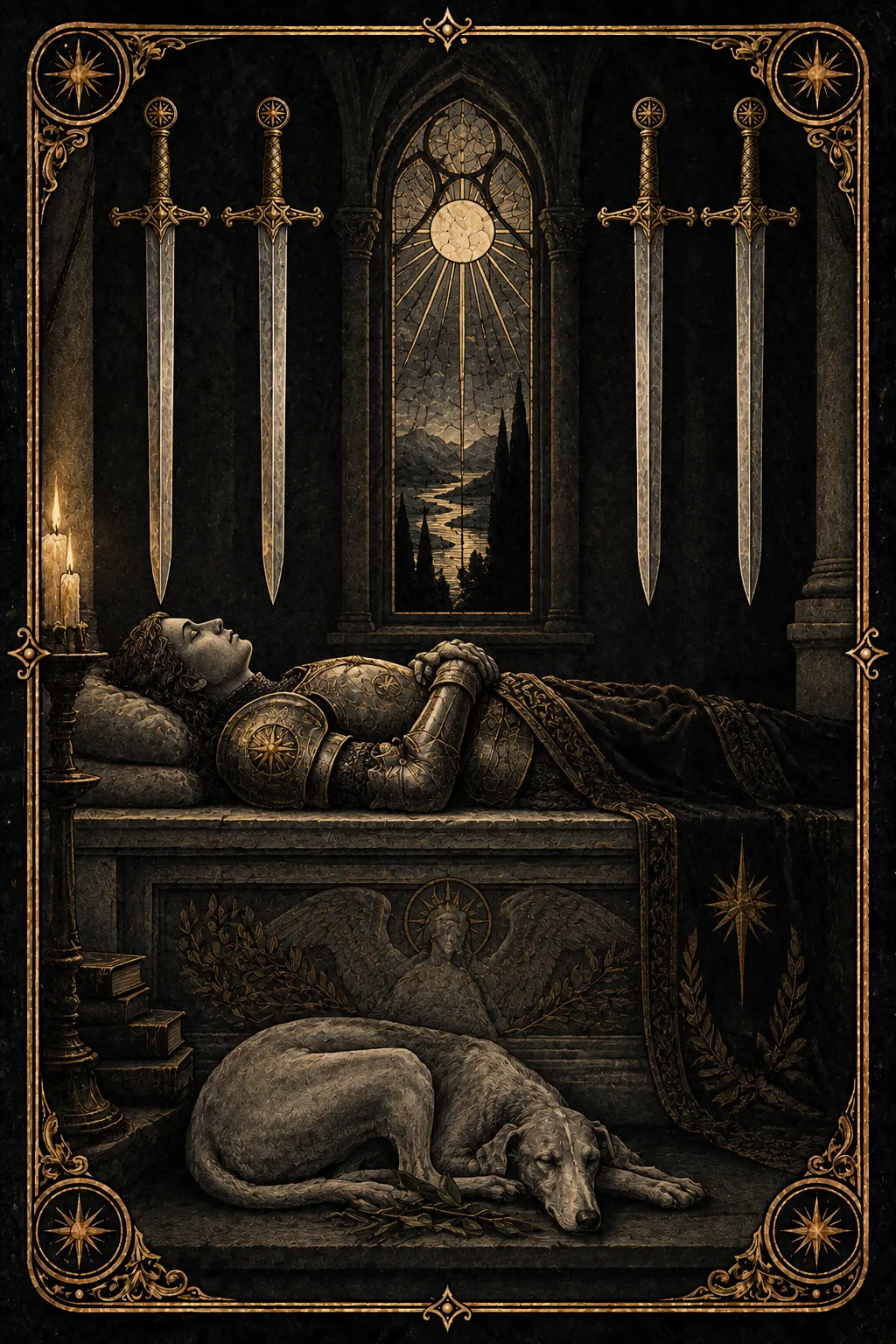
Minor Arcana
Four of Swords
The Four of Swords asks for quiet the way a fever asks for dark. Not a choice between two truths — that is the Two of Swords — but a rest after strain, or a rest before the next demand, when the head needs to stop arguing with itself. Put the argument down and leave the room.
The card is easy to medicalize. A recumbent figure looks like illness if you already fear illness. TARORIA does not read it as a diagnosis, a hospital stay, or a prediction of the body. What it describes is a pause for recovery: sleep, withdrawal, a temporary exit from the fight. Heroics are the wrong medicine here.
People who live on alert hear rest as laziness or surrender. A nervous system that has been negotiating for too long does not become wiser by pushing through one more round. It becomes noisier. The Four is permission to lower the volume until thought can be thought again.
General meaning
The mind has been on duty too long. Someone has been defending, negotiating, turning the same thought over until it has no new faces left. It is more useful now to lie down, fall silent, take on no new obligations, leave the correspondence unanswered until morning. That is a practical reduction of stimulation.
Neighboring cards show whether this is recovery after a blow or preparation for a later stretch. After the Three of Swords, quiet is often the first honest response. The Four itself does not predict disease. It describes a right to take the noise away until the mind can gather itself.
The other confusion is with the Two of Swords. Both look like not-acting. The Two is still holding two options. The Four has set the swords aside. If you are exhausted and calling it indecision, check which card you actually need. Rest will not pick the job for you.
Upright
Upright more often speaks of an honest rest for the mind. You can postpone an answer, leave a thread, take a day without decisions, walk without a podcast that continues the argument. This is not surrender. It is strength gathering in quiet, the way a muscle gathers when it is not being tested every hour.
Temporary exit is the skill. A weekend. A night. A week of reduced contact if a conflict has been running hot. What matters is whether you use the pause to recover — sleep, food, fewer inputs — or hide in it from a life that will still require a step later. Recovery has a direction back. Disappearance does not.
If you have been treating exhaustion as a moral failure, the upright Four is a correction. You do not have to earn rest by collapsing. You can take it while you still have the judgment to return.
Reversed
Quiet can fail in two directions. Reversed, you cannot stop: back into the argument, back into the feed, back into night thoughts that pretend they are work. Or you withdraw too far and confuse recovery with vanishing — no timeline, a solitude that began as medicine and became the whole house.
The reversed card does not make a diagnosis. It asks whether you return to life after the quiet, or whether quiet has already become the only way not to meet what is unresolved. One person needs to put the sword down. The other needs a door that opens outward again.
If the Nine of Swords is nearby, rest is especially needed and especially hard. Then the first move may not be a life decision at all. It may be sleep, fewer screens, and one fewer conversation that restages the fear. That is triage, not the Two of Swords’ avoidance.
Love and relationships
In a relationship, upright can describe a pause in intensity: fewer talks about the problem, more sleep, a little distance, a refusal of another round of blame at midnight. Sometimes a couple does not need a new accounting. They need nerves cool enough to hear each other. A quieter weekend is a Four of Swords gesture, not proof of dying love.
The card does not instruct anyone to leave, and it does not promise that rest will repair a broken agreement. It offers a condition under which repair, or an honest ending, might be thinkable later. Decisions made from raw fatigue tend to be either cruel or unrealistically grand.
Reversed, people cannot rest from each other, or a chill wears the costume of “I need to be alone” with no timeline. Look at whether the distance is restoring you or has already replaced closeness. A restorative withdrawal says when it will check back in. Avoidance borrows this card’s language and never does.
Work and career
At work the Four often appears after a deadline, after a fight in a meeting, at the edge of burnout language that has not yet become a medical claim. Upright can describe leave, a true weekend, a decision not to take another project this week. Intellectual load needs lowering so that the next decision is not made from fumes.
The card does not decide a dismissal, a promotion, or a career change. Those questions deserve a mind that has slept. If you use a rest card as a career oracle, you will either stay in a bad job out of numbness or quit from a Tuesday of depletion and call it destiny.
Reversed, someone will not leave combat mode — answering at 1 a.m., volunteering for the next fire — or rest lasts so long that the work quietly falls apart. Recovery has a re-entry. Disappearing from a role without a plan is a different problem.
Money and finances
In money questions the Four is rarely about money moving. Upright can describe a pause in financial decisions: not signing, not arguing about a shared bill, not rebuilding a budget at midnight on frayed nerves. Figures look different after sleep.
The card does not promise stability and does not offer investment advice. Reversed sometimes shows anxious spending to take the edge off, or a complete refusal to look at bills from tiredness. Postpone a decision until morning — not forever. A pause with a date is recovery. An unopened envelope as a lifestyle is the Two of Swords wearing pajamas.
Advice
Give the mind a chance to fall silent for a clear stretch: a night, a weekend, a pause in correspondence. Do not decide something important from the last round of strain. Put a boundary around inputs — news, group chats, the person who restages the fight — for a defined period.
Then come back to the question. Quiet is needed so you can gather yourself, not so that the rest of life shuts down. If you return and the Two of Swords is still waiting, you will at least be choosing from rest rather than from depletion. The card is not a doctor and not a command to disappear.
Symbolism
In the classical Rider–Waite image, a figure lies at rest as if on a tomb or a narrow bed, often in the pose of an effigy, hands together. Three swords hang on the wall. A fourth lies along the length of the bed or tomb. A stained-glass window, frequently read as a chapel, shows kneeling figures in colored light.
Tradition links the posture with rest after battle, the hanging swords with conflict set aside, the window with shelter and a prayerful quiet. The recumbent body is easy to over-read as illness. In TARORIA it is not a hospital scene and not a forecast of the flesh.
The traditional picture explains recovery of thought. It does not claim that TARORIA’s card is identical with Rider–Waite. In a reading, rest after strain matters, not the bed as a prediction of disease.
Combinations with other cards
Next to the Hermit, the Four strengthens a withdrawal into quiet. That is useful if solitude is a chance to be alone with yourself rather than a way of walling life off for a long season. The Hermit can make the rest wiser. He can also make it permanent. Watch for a return date.
With Temperance, recovery becomes a gentle rhythm rather than a heroic switching off. Sleep, food, fewer arguments, a little work, a little not-work. You do not have to vanish in order to stop bleeding attention.
With the Nine of Swords, rest is especially needed and hard to take while a thought is turning at night. Then the first step may be sleep and fewer stimuli. Do not ask a depleted mind to solve the Two of Swords. Sequence matters.
Frequently asked questions
Does the Four of Swords mean I should quit or walk away?
No. It describes a pause so the mind can recover, not a verdict on a job or a relationship. Big exits deserve a rested head. Use the quiet, then return to the actual question.
How is this rest different from the Two of Swords?
The Two holds two options and has not chosen. The Four sets the argument down so strain can ease. One is an unresolved choice. The other is recovery. Exhaustion can mimic indecision; they still are not the same task.
Can I do anything at all while this card is in play?
Yes. Small, low-noise actions — sleep, food, postponing a signature until morning — belong here. What it asks you not to do is make a heavy decision from the last round of strain.
What if I cannot stop even though I am exhausted?
That is a common reversed tone: combat mode with no off switch. The card still is not a diagnosis. Reduce one input, protect a night if you can, and treat return-to-life as the aim of rest.