Five of Swords — tarot card meaning
Minor Arcana
Five of Swords
A win can be loud. The hour after it is quieter, and that is where the Five of Swords actually lives. Someone has the last word. Someone else has already started walking. The point has been proved. The room has thinned.
Betrayal is the story people reach for because it is clean. This card is rarely that clean. It describes a clash in which being right mattered more than what the relationship could still hold: an argument that became a hunt, a public correction, sarcasm that landed too well. The trophy is real. So is the empty air around it.
Defense is not the same thing as pursuit. You can hold a boundary and still notice, later, that you kept swinging after the other person had already yielded. The card asks what remains once the point is won — not whether you were entitled to speak.
General meaning
Most people do not pull this card because they enjoy conflict. They pull it because a contest of will has already left a mark. Tone has overtaken content. The winner is not always the one with the better argument; it is the one who refused to stop.
This is not a court. Neighboring cards tell you whether you are looking at a single ugly hour or a habitual way of speaking. The Five of Swords itself names the residue: humiliation, withdrawn people, a sour atmosphere. It does not appoint an enemy. It describes the cost of aggressive insistence.
If you confuse this card with the Seven of Swords, you flatten both. The Seven takes a side door. The Five walks onto the field and makes a scene. Not every secret is a fight. Not every fight is a theft.
Upright
Upright, the clash is usually visible. Someone insisted. Someone left with a sense of defeat. There is a victory, and little warmth around it: colleagues go quiet, a partner stops offering the next sentence, a friend answers in shorter messages. The win did its job. The social fabric did not.
The upright Five does not forbid defending a line. It asks whether the defense has become a hunt — whether you are still collecting swords after the other person has already put theirs down. If the question is who is to blame, the card more often points to a dynamic of humiliation than to a legal verdict. Rightness can be factual and still expensive.
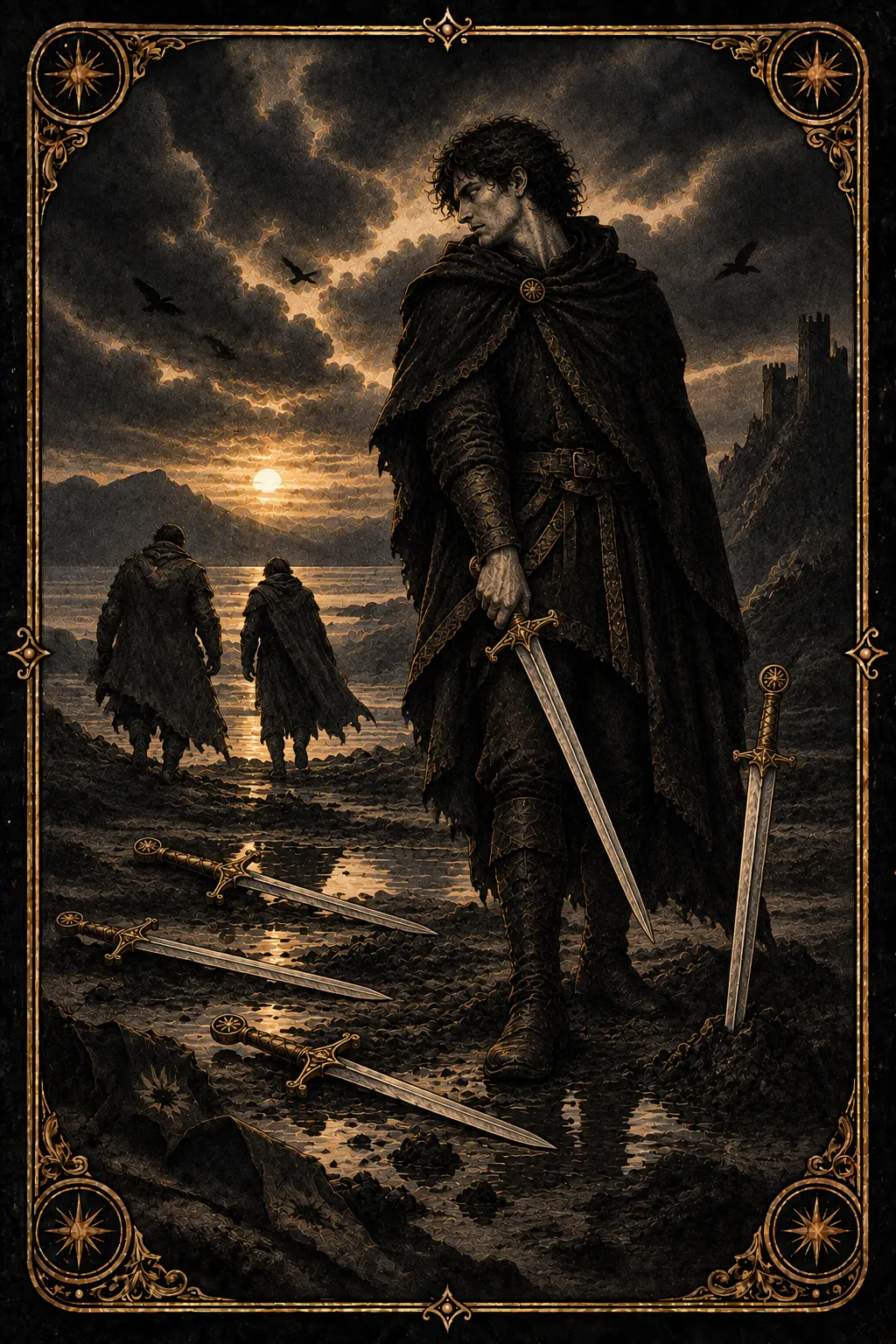
Look at who stayed in the frame. A person holding gathered blades while two others walk away is not a picture of teamwork. It is a picture of getting your way and discovering that company was part of the price.
Reversed
The shouting has often already happened. What remains is aftertaste: shame at a sentence you cannot unsay, tiredness of always needing to come out on top, a wish to stop using humiliation as a method. Sometimes the fight has only gone quiet. The same need to win now works in asides, delayed replies, a precise coldness that never raises its voice.
Reversed does not promise a truce. It asks whether you are ready to leave the logic of "I have to win," or whether the conflict has simply moved under the carpet and continues to sour the air. An apology can be real. So can a performance of peace that leaves the trophy standing between people.
If you are hoping the reversal will restore the room, it will not do that work for you. It names a fork: drop the hunt, or keep it in a form that is harder to accuse.
Love and relationships
Warmth dies by inches in a house where the sharper line always wins. Upright can describe a quarrel in which wounding more accurately mattered more than hearing the other person: sarcasm, a public slight, old faults recited when a small disagreement needed a small answer. That is not automatic infidelity, and it is not a verdict on the couple.
Reversed, people may no longer argue out loud. The victory still sits at the table. Ask whether you can talk about the actual subject without needing to destroy the other person's dignity. A bond is not held by who lands the cleaner blow. If loyalty is the question, look at neighboring cards rather than treating this one as a confession.
Work and career
A meeting can produce a winner without producing a better plan. At work this card often points to politics, authorship fights, a room in which being wrong is dangerous and being right is performed at someone else's expense. The sharpest tone takes the hour.
The card does not predict dismissal. Reversed, you may see burnout from constant clashes, or a scandal papered over without any repair of how people actually speak to each other. Trust does not automatically return with the calendar invite. An empty field after a presentation is not a promotion. It is a warning about method.
Money and finances
Bargaining can become a personality. In money questions the Five of Swords is less about a sum than about the tone of the talks: a wish not to be taken in at any cost, an argument about who contributed more, a concession extracted so it can be mentioned later. Upright is not a forecast of profit.
The card does not advise risky moves "for the win." Advantageous terms lose part of their value if, after the deal, no one wants another round with you. Separate a fair term from a wish to humiliate the other side. One is business. The other is the empty shoreline with extra swords in your hands.
Advice
Name what you actually need: a decision, a boundary, accurate information, respect — or the feeling that the other person lost. If the first list is enough, you can often speak more briefly and with less heat. The second list is a different appetite, and it tends to clear the room.
If you only want the win, notice who will still be standing beside you afterward. An empty field is rarely a reward. You can keep the point and still choose not to collect every remaining blade.
Symbolism
In the classical Rider–Waite image, a figure in the foreground gathers swords and looks toward two others who are walking away. Two blades often lie on the ground; the sky is heavy, the water behind them choppy. One departing figure may hold a head in their hands. The scene is a shoreline after a contest, not a coronation.
Tradition reads that picture as a victory nobody congratulates, and as humiliation paid as the price of an argument. The gathered swords are spoils. The departing backs are the social cost. The weather does not clear because someone won.
That traditional image explains the theme of a costly win. It does not claim that the TARORIA card copies Rider–Waite. In a reading, what is left after a clash matters more than the number of trophies as a promise of success.
Combinations with other cards
Next to the Devil, the Five of Swords strengthens a dependence on winning: argument becomes a habit, humiliation a language of closeness or power. With Justice, a question of consequences surfaces — rightness without measure has a bill as well, even when the facts were on your side. With the Tower, a conflict can expose what politeness held for years, and then the cost becomes visible all at once rather than by slow withdrawal.
Neighboring cards show whether this is defense or a hunt. How to speak without destroying what remains is a human decision, not an order encoded in the blades. The Seven of Swords nearby would shift the story toward concealment rather than open collision; keep those stories distinct.
Frequently asked questions
Does pulling the Five of Swords mean someone betrayed me?
Not by default. More often it describes conflict, an argument fought to win, and the social residue of an aggressive strategy. Betrayal is one possible shade if that is the question and surrounding cards support a double life. The card itself is about the cost of how rightness was proved.
How is the Five of Swords different from the Seven of Swords?
The Five is an open clash and its leftover: who won, who left humiliated, what the room feels like afterward. The Seven of Swords is a roundabout path — concealment, privacy, action without full openness. One is a battlefield. The other is why the front door is not being used.
If I get the Five of Swords, do I have to back down?
No. You can still defend a boundary. The card asks whether that defense has become a hunt, and what will still be standing after the victory. Yielding or insisting is your decision. The useful question is whether you need a result, or whether you need the other person to feel defeated.
What does the reversed Five of Swords usually describe after a fight?
Often the aftertaste: shame, tiredness of winning, a quieter poison instead of a shout, a wish to leave the logic of humiliation. It does not guarantee reconciliation or a restored atmosphere. Look at whether the conflict is actually leaving, or whether it has only gone underground and kept the trophy in place.