Six of Swords — tarot card meaning
Minor Arcana
Six of Swords
Nobody applauds a crossing while it is happening. The Six of Swords is that unglamorous stretch between a hard shore and a quieter one: you are already leaving the worst of the weather, and you are still sitting with what the weather did. The cargo comes with you. Relief is not the same thing as happiness.
This is not an emotional leaving in search of a new meaning. That story belongs more to the Eight of Cups, where something once loved has gone hollow and a person walks toward a different kind of fulfillment. Here the issue is conditions — less noise, less danger, more chance to exhale — even if the thoughts in the boat are still sharp.
A new city, a new desk, a week away from a brutal correspondence: any of those can fit. None of them is required. The card marks a change of weather for mind and nerves, not a destination labeled joy.
General meaning
The Six of Swords is a change of circumstance more than a change of identity. A move, a different schedule, an exit from a sharp conflict, time off after a crisis, a decision not to live inside a constant clash. The path can be quiet and unheroic. You get a slightly calmer horizon and the same head on your shoulders.
Neighboring cards will tell you what you are leaving and how stable the ground ahead might be. The card itself marks a crossing, not an arrival called happiness. If you treat it as a promise that the past will vanish mid-water, you will feel cheated when a memory still answers at 2 a.m.
The Eight of Cups is inner emptiness and a search for meaning the old cup can no longer hold. This card is a passage out of turmoil toward conditions in which thinking and sleeping might become possible. They are not the same leaving.
Upright
Upright, the boat is already in motion. You are not pretending nothing happened. You are also not remaining at the epicenter. Distance appears — geographic, practical, or simply a different tone in the same town. Someone or something may help with the crossing: a friend who drives, a professional who holds the conversation, a routine that gets you through the week without another scene.
The upright Six supports leaving a situation that is too hard on the nervous system. If the question is whether it will get easier, the card more often describes a process of easing than it promises that the past will dissolve on the way. You still carry the six swords. You just stop living on the storm shore.
A modest next bank is still a next bank. People underrate that because they wanted a festival. This card does not stage festivals. It stages passage.
Reversed
Wanting the other shore is not the same as reaching it. Reversed often points to a stuck crossing: a debt, a lease, a fear, no route, a return to the same water. Sometimes the body has already gone — new address, new job title — and the thoughts are still arguing on the old bank, replaying the last fight as if the boat never left.
The reversed Six does not order you to run. It asks what is holding you in the heavy situation, and whether you are calling movement a constant return to the same point. Formal change without a change of conditions is a known version of this card: the scenery updates, the clash travels.
If you feel ashamed that you have not "moved on," this reversal is not a moral grade. It is a map of friction. Name the friction. A crossing that stalls is still information.
Love and relationships
Two people can stay together and still leave a brutal chapter. Upright may describe fewer scandals, a change in how contact happens, a distance that lets the nerves cool. That is not an automatic breakup, and it is not a new infatuation arriving to rescue the story.
Reversed, the talks are the same, the house is the same, and the mind keeps returning to what hurt. Look at whether a calmer way of being together can be found — or whether the form of the bond itself is part of the storm. A breakup is possible when that is the question. Just as often, people remain and refuse to keep living in a mode of constant clash.
Work and career
Skills travel. Wars travel too. At work the Six of Swords often points to a change of department, project, or tone: leaving a toxic thread of messages for a clearer format, carrying competence into a quieter environment without pretending the last year did not happen.
The card does not promise a new post. Reversed, you may want a field change without yet having the resources, or you may have changed teams on paper while the same conflict style sits down at the new table. Ask what you are loading into the next boat — a craft, or an old war. A calmer workflow is a legitimate reading. It is not a prophecy of triumph.
Money and finances
A calmer month is not a windfall. In money questions the Six can touch a passage into a less chaotic rhythm: fewer stress purchases, obligations moved onto a visible schedule, an exit from a financial clash. Upright is not about sudden income. It is about reducing the weather in which money decisions get made.
The card does not guarantee profit or a lucky break on the far shore. Reversed more often shows that anxious spending habits travel with you into the next stage. It makes sense to simplify terms and sort obligations rather than waiting for a change of circumstances to solve the figures by itself.
Advice
Name which strain you are already ready to leave, and which next shore is calmer even if it is modest. Do not demand that the whole experience vanish on the water. The cargo can be carried. You do not have to live in the storm in order to respect what the storm taught you.
A crossing begins with a direction, not with a personality transplant. One practical step toward quieter conditions is more faithful to this card than a speech about becoming someone new.
Symbolism
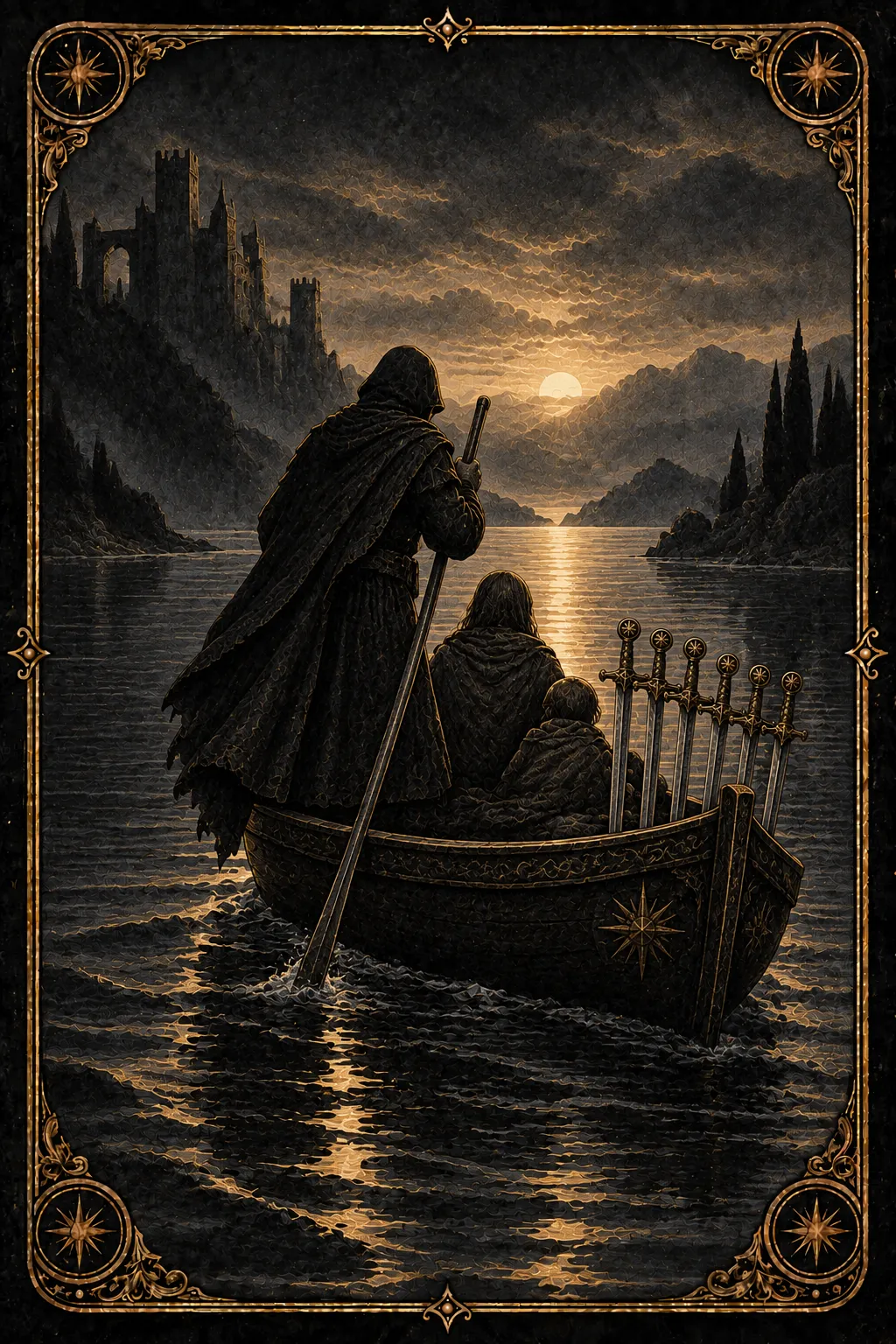
In the classical Rider–Waite tradition, a boat crosses a stretch of water. A standing figure poles the craft; a seated adult and a child ride as passengers; six swords stand upright in the hull as cargo. Ahead, land. The water is often read as more troubled near the departure and quieter toward the far bank, though the printed scene is simply a passage over water toward a farther shore.
Tradition links that image with distancing and movement away from turmoil, without an instant festival on arrival. The swords travel. The people travel. The weather of the mind does not empty itself because the boat left the dock.
The traditional picture explains the theme of passage. It does not claim that TARORIA's image copies Rider–Waite. In a reading, a change of conditions matters more than the boat as a prediction of literal travel.
Combinations with other cards
Next to the Hermit, the crossing can be inner: you go into a quieter mode of thinking even if the address stays the same. With the Chariot, movement is more decisive — it matters that speed not return you to the same clash you just left. With the Star, the shore ahead is linked with recovery after a hard period, still without a demand for instant joy.
Neighboring cards show whether this is a leaving or a treading in place. Where to go remains a person's decision. If the Eight of Cups sits nearby, ask which leaving you are actually in: a hollowed feeling, or a change of weather for the nerves.
Frequently asked questions
Does the Six of Swords always mean I will move house or travel?
Only sometimes, and only if place is the question. More often it describes passage from a heavy situation into a calmer one: distance, another tone, an exit from a sharp conflict. Travel is one possible reading, not a required story.
How do I tell the Six of Swords from the Eight of Cups?
The Eight of Cups is an emotional leaving of what is exhausted: it feels empty inside, and a person looks for another meaning. The Six of Swords is a passage from a difficult, tense situation into quieter conditions. Experience often travels in the boat. One is the exhaustion of feeling. The other is a change of environment for mind and nerves.
Is the Six of Swords a breakup card?
Not automatically. It can describe a distance that lowers the sharpness so people can think again. A breakup is possible if that is the question. Just as often, people stay and leave a mode of constant clash — fewer scenes, a different way of being in contact.
Why does the reversed Six of Swords feel like I cannot leave?
Because that is often the picture: a stuck crossing. You cannot go yet, thoughts remain on the old shore, or movement is only cosmetic. This is not an order to run. Ask what is holding you in the heavy situation — a practical bind, fear, or a habit of returning to the same water and calling it progress.