Seven of Swords — tarot card meaning
Minor Arcana
Seven of Swords
The front door is still there. Someone is not using it. The Seven of Swords asks why the direct path is idle right now: strategy, a detour, concealment, an independent tactic, action without a full announcement. The unsaid plan has a shape even when nobody names it.
Popular reading jumps straight to thief, liar, cheat. Sometimes those situations are live — if the question and neighboring cards actually lead there. Often the card is quieter than that. A person is not revealing a job search yet. A draft is not on the table. A feeling is not being offered until the ground is tested. Caution and deceit can wear similar clothes. Motive is what tells them apart.
Privacy is not automatically a crime. Avoidance is not automatically wisdom. The useful work is to tell those states apart instead of collapsing them into one accusation.
General meaning
Indirect action has a reputation problem. In a wider reading, the Seven describes a gap between what is said and what is done. Someone is keeping information, an intention, or a spare option off the table. That can be intelligence in a hard room. It can also be a habit of taking the long way around even when directness is already safe.
The card itself does not brand anyone. Neighboring cards show the ethics of the move. A Magician beside it can look like skill. The Moon can look like fog so thick that even the person taking the detour cannot name their own motive. Justice nearby tends to bring hidden terms into the light — not as spectacle, as accounting.
Hold the shades apart: privacy, strategy, self-protection, avoidance, and deception. Those are not the same card. They only look similar from across the room.
Upright
Upright often means a chosen tactic. The plan is not laid on the table. You act alone, pick a detour, say as little as possible, test the ground. In a hard environment that can be the only working method — a workplace that punishes early honesty, a family that turns a feeling into a committee meeting, a negotiation in which showing your full hand would be naïve.
The upright Seven supports the question "why the concealment," not a verdict of "you are bad." If the question is about trust, look at whether the detour is protecting something living, or whether it has already replaced relationship with a game. A spare option "just in case" can be prudence. It can also be a refusal to inhabit the life you are supposedly sharing.
Independence is part of this card's upright gift. So is the risk that independence becomes a closed circuit in which nobody is allowed to know you.
Reversed
A tactic can fail without becoming a morality play. Reversed often points to a method that has broken: a secret surfaces, the detour no longer works, someone is caught by what was left unsaid — or they themselves grow tired of carrying a double story. Sometimes the opposite appears: a readiness to speak directly, because the cost of the long way around has finally exceeded its usefulness.
Reversed does not promise exposure as a scandal. It asks whether secrecy still helps you live, or whether it already costs more than an honest conversation. A confession can be chosen. A leak can be accidental. Both are versions of a tactic that can no longer hold.
If you feel relief at the thought of being seen, that relief is data. If you feel only the panic of being caught, that is data too. The card will not sort those for you. Motive still matters when the cover comes off.
Love and relationships
Unspoken plans and infidelity get collapsed into one accusation, and that collapse does real damage. Upright can describe the unspoken, a spare plan held "just in case," an unwillingness to open a feeling until there is clarity. Infidelity is a popular reading, not an automatic one. Take it seriously only if loyalty is the actual question and neighboring cards support a double life.
Reversed may show a secret that has surfaced, tiredness of the game, or a need for a conversation that is no longer optional. Look at what a person is not saying, and why. Self-protection, avoidance, and deception can resemble one another until you ask about motive. The card points at the unused front door and asks who locked it, and for whose benefit.
Work and career
Not every draft belongs in a meeting. At work the Seven of Swords often points to strategy: not revealing an idea until it is ready, going around extra bureaucracy, acting independently and not reporting every detail too soon. Upright can describe competence in a hard environment.
The card does not promise career success or a clever win. Reversed, the detour may have been exposed, or a person can no longer stand working in the shadows. Ask whether the direct path is in fact dangerous, or whether you have simply grown used to trusting no one. Taking credit quietly and taking credit falsely are different acts. Neighboring cards, and the actual question, are what separate them.
Money and finances
Hidden terms are not automatically theft, and they are not automatically fine. In finances the Seven is linked with incomplete transparency: clauses that live in the appendix, a side arrangement, a wish not to show income, an independent maneuver in talks. Upright is not about profit from cleverness.
This card does not give investment advice and does not forecast a windfall from a smart trick. Reversed can show that the lack of clarity has come to light, or that a game of hide-and-seek with the figures has become more expensive than honest accounting. Privacy around money can be a boundary. Concealment of a term the other party needs in order to consent is a different act.
Advice
Name the motive of the detour before you judge the method: fear, calculation, habit, a genuine lack of safety in speaking directly. If the direct path is truly dangerous right now, tactics are appropriate. You are not required to be naïve in a room that punishes candor.
If the danger is imagined, concealment begins to live a life of its own. Then one direct conversation can be more useful than a whole system of roundabout maneuvers. Strategy that no longer has an enemy will invent one in order to stay employed.
Symbolism
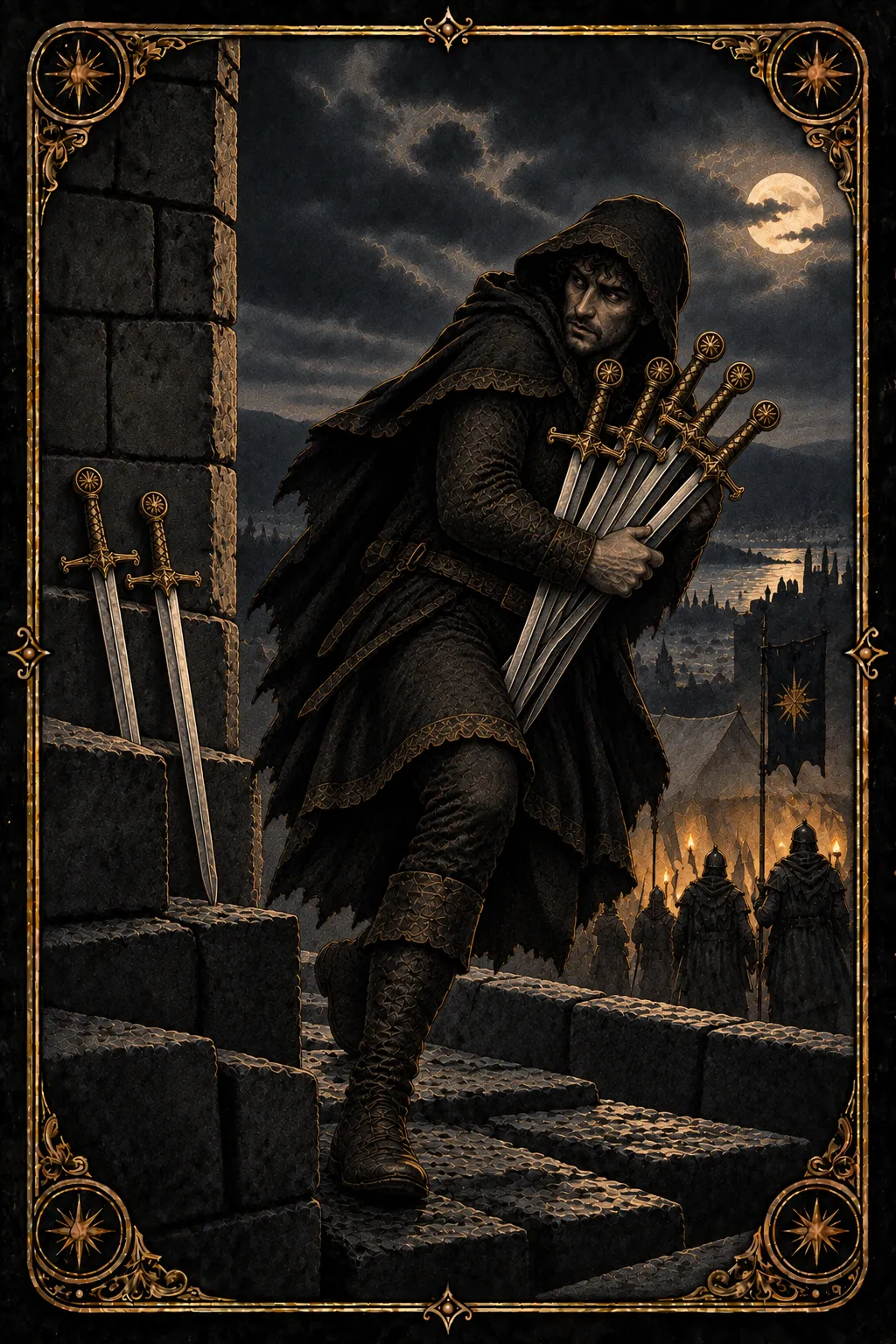
In the classical Rider–Waite tradition, a figure carries five swords away from a camp and leaves two standing in the ground. The glance is often backward, toward the tents. Distant people may be visible near the encampment. The body language is of someone leaving with more than they announced.
Tradition links that scene with taking, an unnoticed move, and a question of what a person considers their right to remove without a speech. Five blades go. Two remain. The backward look is part of the fact of the image: this is not a frontal claim.
The traditional picture explains the theme of indirect action. It does not claim that the TARORIA card copies Rider–Waite. In a reading, the gap between the open and the hidden matters more than the figure as a required thief.
Combinations with other cards
Next to the Moon, the Seven of Swords strengthens a fog of motives: it is hard to tell whether this is protection or self-deception, and hard even for the person in motion to know. With Justice, the hidden tends to become visible — not as punishment, as a need to name the terms. With the Magician, the tactic can be intelligent if skill is not confused with a right to ignore other people's boundaries.
Neighboring cards show the ethics of the move. How open to be is a person's decision, and the situation's. If the Five of Swords is nearby, you may be looking at both a detour and an open clash in the same story; keep those roles from blurring into one slur.
Frequently asked questions
Is the Seven of Swords always a liar or a thief?
No. Often it is strategy, caution, privacy, or action without full openness. Deceit is possible if that is the question and neighboring cards lead toward a double game. The card itself asks why the direct path is not being used.
Does the Seven of Swords confirm cheating in a love reading?
Not automatically. That is one of the popular love readings, not a law of the card. Just as often it describes the unspoken, a fear of opening, a spare plan held in reserve. Look at the wording of the question and the cards around it. Infidelity is a story you test, not a default stamp.
When is the Seven of Swords a reasonable strategy rather than a warning?
When the environment punishes early honesty, when a plan is unfinished, or when a head-on conflict would be unsafe or useless. Upright can describe independent action that still has integrity. The test is motive: protection and timing, or a habit of taking the long way around.
What changes when the Seven of Swords is reversed?
Often the tactic breaks. A secret surfaces, the detour stops working, tiredness of a double story appears, or a readiness to speak directly finally arrives. This is not a required scandal. Ask whether secrecy still serves you, or whether the cost of concealment has overtaken its use.