Eight of Swords — tarot card meaning
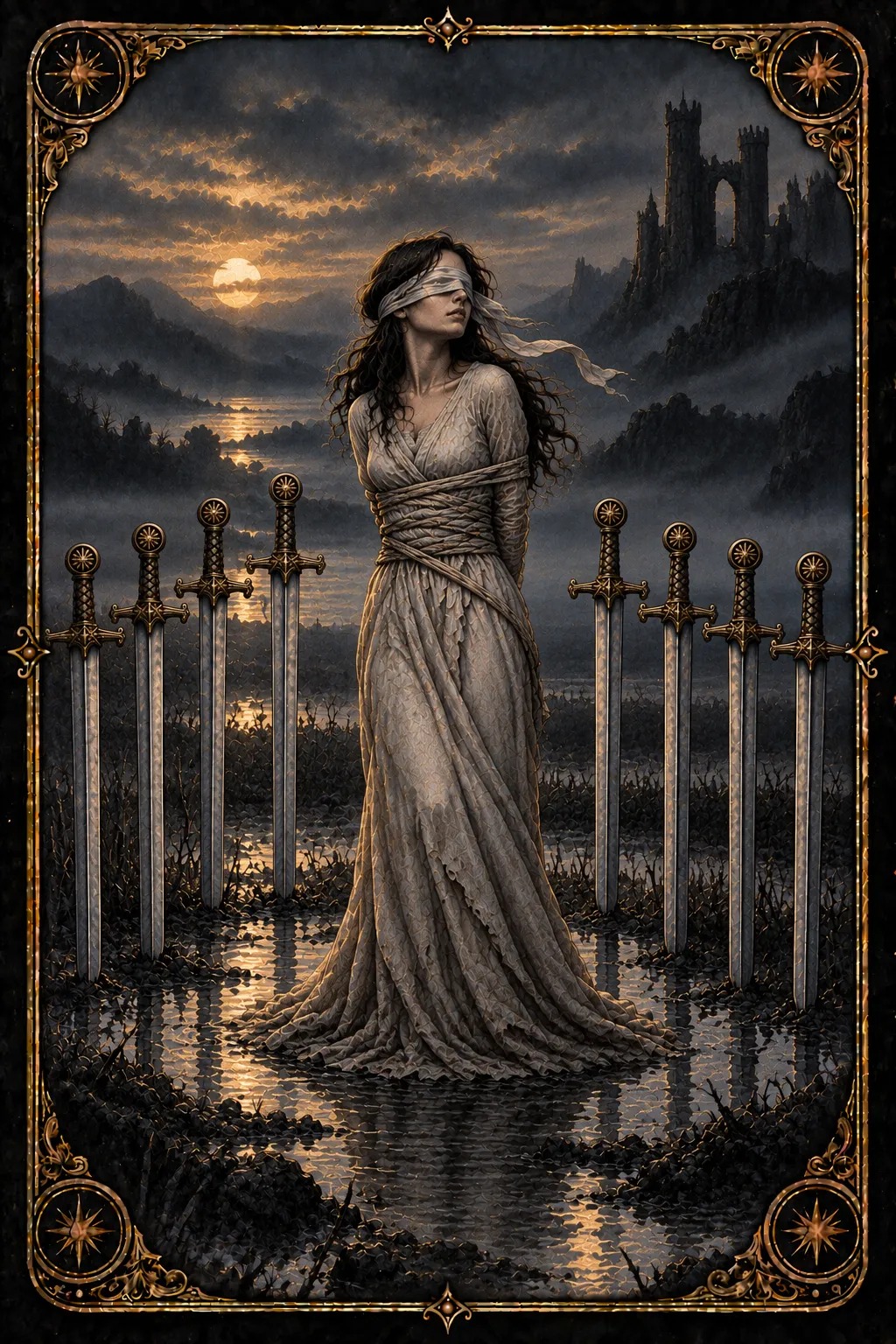
Minor Arcana
Eight of Swords
Fewer doors are visible than you hoped. The Eight of Swords describes a narrowing of options: bans, a fear of the next step, contracts, other people's power, inner "you must nots" that have sounded like law for so long they no longer feel like thoughts. You can be bound by circumstance, by panic, or by both at once.
A common reading reduces the whole card to "it's all in your head." That sentence is too cruel to be useful. Some walls belong to real conditions — money, a visa, a lease, a workplace that punishes speech, a relationship in which the cost of leaving is practical and social. Fear can make those walls feel even closer together. It does not invent every brick.
The work is an inventory, not a pep talk. Which limits are objective. Which are already being held up by fear. Which are both. The card offers that sorting.
General meaning
A narrowed range of options is not the same as an invented one. In a spread the Eight of Swords notes a sense of being bound: a contract, a debt, someone else's opinion treated as weather, anxiety, a habit of not moving without permission. You may be facing genuine limits. Fear can make those limits feel more impassable than the facts require.
Neighboring cards help distinguish a real constraint from the panic around it. The Eight itself describes being bound, not a verdict of "you did this to yourself." Justice nearby may bring terms and rights back into view. The Devil nearby can make tightness feel familiar, even protective, because a known cage can seem safer than an unnamed outside.
Do not confuse this card with the Nine of Swords. The Eight is about walls and a reduced range of movement. The Nine is rumination — looping, guilt, the night mind chewing a fact until the fact is unrecognizable. You can have both. They are still different problems.
Upright
The trap feeling is vivid. A step seems dangerous. Options are not on the page. You wait for someone to untie, permit, explain. Sometimes waiting is actually needed: the power is unequal, the exit is not ready, a sharp gesture would make the situation worse. The upright Eight does not humiliate you for pausing. It asks for an inventory.
What genuinely cannot be done this month. What feels impossible because of fear. What you have taken on from someone else's habit and called a law. Mixing those into one wall is how a real constraint becomes a total story of "there is no way through." Some barriers are stone. Some are fog. You do not have to perform bravery. You do have to stop treating every barrier as equally solid.
Reversed
A knot can loosen by a finger-width. Reversed often shows first attempts to step outside the limits: a new option appears, you ask a question, you dare a small move that yesterday seemed theatrical. Or, on the contrary, you tighten the knots yourself because a little freedom feels more frightening than the constraint you already know how to inhabit.
The reversed card does not promise an instant exit. It asks whether you are beginning to tell the walls apart — or believing even more firmly that there are zero options. If a small factual step is available — a call, a number written down, a right looked up — the reversal often sits nearer to that step than to a cinematic escape.
Love and relationships
It can be hard to say the thing, leave the room, ask for a change, or admit a want. Upright may describe a bond in which speech itself feels expensive: shame, financial dependence, a fear of a scene, an inner ban on "wanting that." This is not automatically abuse, and it is not a verdict on the couple.
Reversed can show an opening — a conversation that was impossible last season — or an even tighter grip, because the prospect of a real choice arrived and panicked the system. Look at which limits here are external, and which you already hold so as not to face a decision. If safety is in doubt, that is a practical question for living people and appropriate help, not a diagnosis this card is qualified to issue.
Work and career
A role without a voice is a real constraint. So is a contract that chokes, a team in which being wrong is dangerous, an inner ban on changing fields that began as a family's rule and now sounds like your own. Upright can describe genuine limitation at work — and a panic that makes it feel even narrower than the org chart requires.
The card does not order a resignation. Reversed may note an attempt to find a way around inside the system, or an even quieter "I can do nothing." Write the limits as a list. Fear loves fog. A list makes walls measurable: notice period, visa, a manager's actual power, your actual savings, the story you tell about all of the above. Some of those items are legal. Some are atmospheric. The Eight of Swords is interested in the difference.
Money and finances
Debts and other people's terms do not vanish because you reframe them. In money questions the Eight is linked with a feeling that there is no way forward: obligations, someone else's decision, a fear of opening the statements, a ban on spending on yourself that has hardened into identity. Upright is not a verdict of poverty. It is a picture of constriction around figures.
The card itself does not promise an exit from a crisis and does not advise a particular financial product. Reversed can show a first concrete step — clarify the sum, the term, a right — or an even greater refusal to look. Separate the legal and numerical facts from a catastrophic story of "everything is over."
Advice
Make two lists: what is limited as a fact, and what is limited by fear. Do not mash them into one wall. Even in a tight situation there is usually a small move — a call, a question, a pause, a request for a number in writing. You do not have to go straight to freedom.
It is enough to stop treating every wall as if it were equally solid. A modest, measurable step is more faithful to this card than a speech about mindset. Mindset is not the enemy. Unsorted walls are.
Symbolism
In the classical Rider–Waite tradition, a figure stands bound among eight swords planted in the ground. A blindfold covers the eyes. Water or wet ground lies underfoot. A castle or fortress sits on high ground in the distance. The body is upright, not fallen; the swords form a rough enclosure rather than a battlefield of scattered blades.
Tradition links that scene with restriction, a fear of the next step, and with bonds that can look denser at first glance than they prove on a closer look. The castle is far. The water is close. The blindfold is a fact of the image, not a diagnosis of foolishness.
The traditional picture explains the theme of being bound. It does not claim that the TARORIA card copies Rider–Waite. In a reading, a restricted view matters more than the castle as a promise of prison.
Combinations with other cards
Next to the Devil, the Eight of Swords strengthens a dependence on the ban: tightness is already familiar and can even protect you from having to choose. With the Hanged Man, a person hangs a long time in one angle and does not try another — a pause can help if it changes the view, and it can also lock in helplessness. With Justice it is useful to bring back the facts: which terms are real, which rights you have, where someone else's power actually sits.
Neighboring cards show the nature of the walls. Where to begin untying is a person's decision. If the Nine of Swords is close, expect the night mind to enlarge whatever walls the Eight has already named.
Frequently asked questions
Is the Eight of Swords saying my problem is only in my head?
No. Limits can be real: a contract, dependence, unequal force, money that does not stretch this month. The card offers to distinguish objective walls from those already held by fear. The accusation "you bound yourself" is too crude.
How is the Eight of Swords different from the Nine of Swords?
The Eight is a feeling that there are few options — being bound, a narrowed range of movement, walls that may be factual, feared, or both. The Nine of Swords is anxious rumination: guilt, looping, a night mind that keeps working even if by day the options look different. One is about walls. The other is about what thought does with a fact in the dark.
Does the Eight of Swords mean I should break out immediately?
Not necessarily, and not "run tonight." Sometimes the exit is not ready, and a sharp gesture is dangerous or simply unavailable. The card asks for an inventory of the walls and a small measurable move, not a heroic escape on command.
What should I look for when the Eight of Swords is reversed?
Often a gap in the bonds: a step, a question, another way of seeing. Or an even tighter knot from a fear of freedom. Look at whether you are beginning to tell the walls apart — or whether the belief that there are zero options has grown stronger.