Nine of Swords — tarot card meaning
Minor Arcana
Nine of Swords
Some cards describe an event. The Nine of Swords describes what the mind does with an event once the room is quiet. A remark from the afternoon returns. A pause in a message grows a story. Guilt finds the same door and walks through it again.
This is not a verdict that something terrible has already happened, and it is not a medical label. TARORIA reads the card as mental strain: consciousness returning to the same scene even when nothing new has arrived. The suffering can be honest. The story the night builds around it can still be larger than the facts.
People reach for diagnoses because the image looks like collapse. A simpler first question is enough: what, exactly, is looping?
General meaning
In a spread, the Nine often marks a gap between the size of a thing by day and the size it takes on after midnight. By ordinary hours it may have been a delayed reply, a cool tone in a meeting, a bill not yet opened, a sentence you wish you had not said. At night the same material becomes a catastrophe a person lives through alone, with no one there to say “that is one version.”
Catastrophizing is not the same as lying. The mind is trying to get ahead of pain by rehearsing the worst case until it feels familiar. Familiarity then masquerades as certainty. Fear can make an outcome feel finished when the facts have not closed.
Neighboring cards help restore proportion: what actually occurred, who was involved, whether a decision is even on the table. The Nine itself describes anxious thinking. It does not diagnose an illness, and it does not issue a fate.
Upright
Upright, the card more often names a mind that will not rest. Sleep is thin. Self-blame is easy. Genuine concern and invented disaster sit in the same chair and use the same voice. You may be accurate about the feeling — this is hard — and still be inaccurate about the conclusion: everything has already collapsed.
A useful test is almost embarrassingly practical. Write the loop in one paragraph, as it is, without improving it. In the morning, mark what happened in shared hours and what anxiety added in private. The first deserves care. The second deserves a check against a document, a calendar, another person’s actual words.
The upright Nine does not mock worry. Worry is sometimes a signal. It becomes a problem when it is the only witness. The Ten of Swords, nearby, would speak of a pattern that has truly run out. The Nine is earlier: a story of ruin told before the day has confirmed it.
Reversed
Reversed, the night does not simply vanish. Two movements are common, and they are not the same. In one, the loops thin. A person can say the fear out loud, sleep a little more, or notice that the daytime fact is smaller than the 3 a.m. version. In the other, the distress turns inward and goes unnamed. The body holds what the mouth will not. Someone performs “I’m fine” and calls the performance recovery.
Neither reading promises that fear is gone. The question is whether the strain is coming into ordinary hours — speech, a list, a conversation — or hiding where even you stop looking at it.
If the heaviness lasts longer than a bad night, that is a reason to seek ordinary human support: people you trust, practical help, care in the real world. Tarot is not healthcare. The reversed Nine is a weather report about how the loops are moving, not a prescription and not a cure.
Love and relationships
In love, upright can describe rumination about a bond rather than a verdict on it. You replay a message’s tone. You invent the conversation in which they leave. You treat jealousy as evidence when there is still no fact. Guilt says you already ruined everything, so there is nothing left to check. None of that is a forecast of a breakup, and none of it is proof of infidelity.
The reversed card can mean a little more air: you catch the story before it hardens. It can also mean shame at your own anxiety, and a quieter silence than before. Look at what happened by day — a late text, a short answer, ordinary tiredness — and what the mind built after midnight. A conversation about the actual hours is often simpler than the novel anxiety wrote overnight.
The Moon beside this card can thicken projection until a feared picture feels like a memory. That is still not a ruling on the other person’s heart.
Work and career
At work the Nine often looks like a letter reread until morning, a meeting replayed as a trial, a deadline inflated into professional death. Upright names strain of the mind, not a required failure of the project. You can be conscientious and still be wrong about scale.
The card does not predict dismissal. Reversed, it may show the loops loosening after a concrete answer arrives — or anxiety carried in silence under a competent face. Check the feared version against a document, a date, an actual reply from a colleague. If the only evidence is the night’s rehearsal, you are looking at the mind’s overtime, not yet at the job.
Money and finances
In money questions the Nine is usually about fear around a sum, not the sum itself. Upright can look like counting the same figures at 3 a.m., shame about a purchase, a story of ruin the statement has not confirmed. The account may be tight. Tight is not the same as finished.
The card does not promise a loss and does not advise investments. Reversed sometimes simply says: open the statement by day. Separate what the numbers show from a tale of collapse built in the dark. If you need help reading the figures, that is ordinary practical support, not a mystical verdict.
Anxiety loves round disasters. Budgets are made of lines. The work is to return to the lines.
Advice
Write down what is looping — one paragraph, unimproved. In the morning, separate what happened from what fear added. Anxiety does not have to be the only witness of your life.
If the strain stays heavy, talk to people. Get real-world support. The Nine of Swords can name a night of the mind. It cannot treat you, and it should not be asked to.
Symbolism
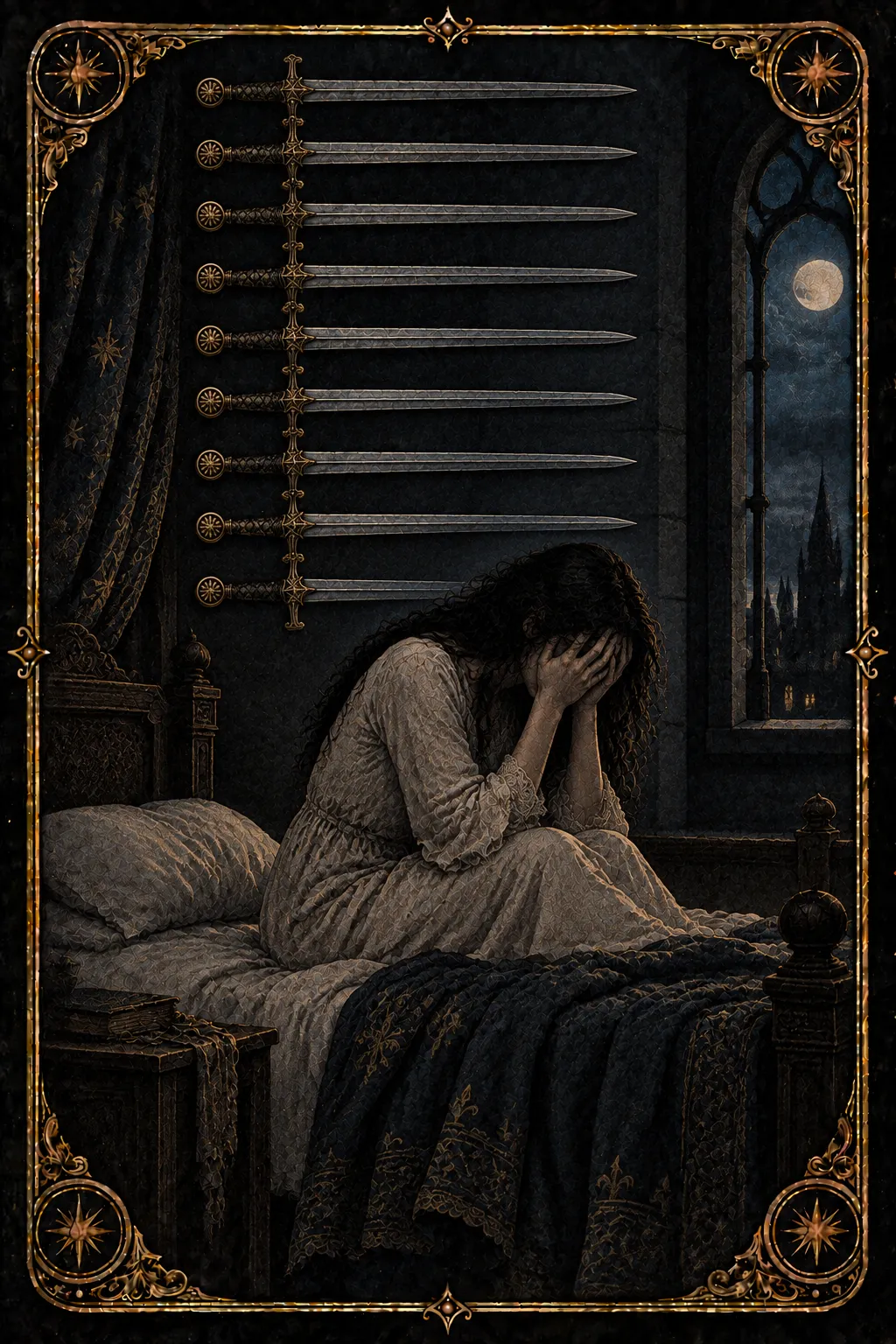
In the classical Rider–Waite image, a figure sits up in bed covering the face with both hands. Behind them, nine swords hang on a dark wall, stacked like a thought that will not stop repeating. The figure wears nightclothes. The coverlet is worked with roses and small signs. The wooden side of the bed is carved. The scene is night.
Tradition has long linked this picture with sleeplessness, guilt, and thoughts that grow longer than the dark. That is interpretation placed on visible facts: a body that cannot lie down, a face hidden from the room, blades arranged as if the mind had furnished the wall.
TARORIA does not claim that its own card copies Rider–Waite. In a reading, the loops of consciousness matter more than the number of blades as a score of suffering. Nine is a picture of recurrence, not a medical chart.
Combinations with other cards
Next to the Moon, the Nine thickens projection: the feared picture is hard to tell from a fact until daylight and another voice arrive. With the Hermit, anxiety goes into solitude. A pause can help you sort thoughts; a long isolation can make the same thoughts heavier, because no one interrupts them. With the Star, an opening toward relief appears — not instant calm, but a chance not to remain one-on-one with the loop.
The Eight of Swords nearby would speak of walls and a narrower set of options. The Nine is what the mind does with a situation in the dark, even when daytime options are wider than they feel after midnight. Neighboring cards restore proportion. What to check in the morning remains your decision.
Frequently asked questions
Can the Nine of Swords diagnose depression or an anxiety disorder?
No. TARORIA reads it as night strain: rumination, guilt, fear, a mind that will not rest. Cards do not set medical diagnoses. If the heaviness stays, that is a question of human support in ordinary life.
What is the difference between this card and the Eight of Swords?
The Eight of Swords is about walls: few options, a feeling of being bound, a narrowed range of movement. The Nine of Swords is rumination — what the mind does with a fact in the dark, looping and catastrophizing, sometimes even when daytime choices still exist. One is constraint. The other is the night’s commentary.
If I draw this card, does disaster have to follow?
No. Fear can make an outcome feel more certain than the facts support. The card shows strain of consciousness, not a guarantee that the worst will happen. It is worth checking the loops against what actually occurred in ordinary hours.
What should I look for when the Nine of Swords is reversed?
Either the loops are thinning and speech or sleep has a little more room, or the anxiety has gone quiet and into the body, unnamed. The card does not promise that fear has vanished. Ask whether the strain is coming into the day — or hiding so well you no longer admit it even to yourself.