Ten of Swords — tarot card meaning
Minor Arcana
Ten of Swords
The Ten of Swords is a limit. A way of living a story can no longer be stretched. The blow, in some form, has already landed. Continuing the old shape does not protect you. It only lengthens the pain of pretending the shape still works.
People fear this card as death. In TARORIA it is not a person’s death, and it is not the destruction of a whole life. Dramatic imagery is easy to read too literally. What the card names is exhaustion of a cycle: a role, a hope, a method, an illusion of control that has run its course.
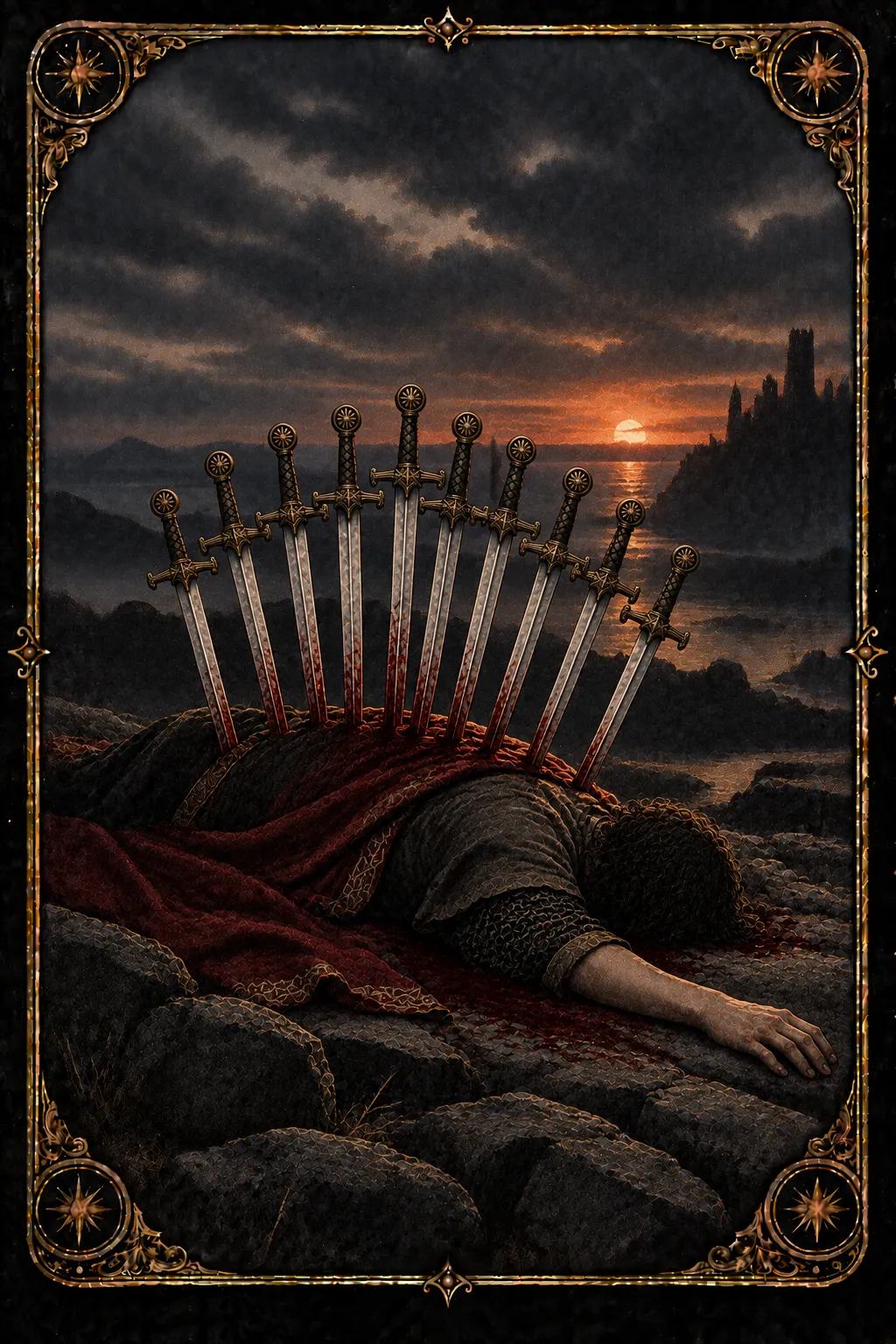
The picture looks like an ending with no remainder. Readings that stop there miss the quieter fact. Once a pattern cannot continue, something else has to begin, even if you cannot yet see what.
General meaning
In a spread, the Ten often marks the heaviest point of a particular story and, at the same time, how used up it already is. “Endure a little more in the same way” is no longer an option with integrity. The next thing is a different thing, even if the different thing is only a pause with the old costume taken off.
Neighboring cards show what exactly is ending. It may be a job title you have been inflating. It may be a hope that one more explanation will repair a bond. It may be a way of fighting that has already cost more than it can return. The Ten itself describes a limit, not a cosmic wipeout.
The Three of Swords is the wound of recognition: a truth that can no longer go unfelt. The Ten is later and wider. The whole way of continuing has failed. One is a blow of seeing. The other is the end of a method.
Upright
Upright, the card more often speaks of a clear ending. Part of you already knows, even while another part still argues. The mask does not hold. The old plan is dead as a working plan. Pain is strong because there is nothing left to cover the fact with.
Harshness here is not theatrical. It is honesty about form. If the question is whether it can be as it was, the upright Ten more often answers that “as it was” already does not work. That is not the same as saying you will never work, love, or recover money again. It is saying this version has completed itself, including the part where completion hurts.
People stay upright in this card when they keep bargaining with a finished structure. Bargaining is understandable. It does not revive the structure.
Reversed
Reversed, endings drag. A person will not let the situation finish: they reopen the same argument, put the old role back on, pretend the last blow was not the last. Sometimes the opposite appears — a first movement away from the bottom, a refusal to keep staging the same collapse.
The reversed Ten does not promise a miraculous rescue of what used to be. It asks whether you are releasing what has run its course, or returning to the very method that already led to a limit.
Drawn-out endings have a cost that the dramatic image actually understates. Living inside a finished story because emptiness frightens you is still a way of being pierced. The swords are not more numerous. You are simply staying on the ground.
Love and relationships
In love, upright can describe the end of a habitual way of being together: the illusion of mutuality, the rescuer role, the hope that “if I explain one more time.” People remain. The old agreement does not. This is not an automatic breakup, and it is not a verdict that you will never be loved again.
The reversed card often shows a farewell that will not complete — or a first refusal to run the same circle. Name the pattern that has run its course. Naming it does not erase the people. It can end the choreography that was injuring both of you.
Infidelity is not the default story. If betrayal is the question, look at the actual events and at neighboring cards. The Ten of Swords can end a story of pretending without requiring a third person in the bed.
Work and career
At work the Ten often points to a project, a role, or a belief that you can “pull a little more” with the same method. Upright can describe burnout of a particular way of working, the failure of a plan, the moment you can no longer pretend the approach functions.
The card does not decide a dismissal. Reversed, it may show someone reviving a dead task out of loyalty or fear, or a readiness to admit the ending and move into another format. Name which work story has ended. “A career in general” is usually too large, and that largeness is how the image gets mistaken for ruin.
Teams stay in this card when they keep funding a process everyone privately knows is finished. Honesty here is not disloyalty. It is the end of a costly performance.
Money and finances
In money questions the Ten can touch a way of handling money that has run its course: you can no longer distribute, wait, or plug holes this way. Upright is not the end of all means, and it is not financial death. A practice can fail while a life continues.
The card does not promise ruin and does not advise investments. Reversed more often shows a refusal to admit that the old handling does not work — or a first sober “this is already something else.” Close one exhausted practice. Do not declare the bankruptcy of an entire life because one method died.
Dawn in the traditional picture is not a stock tip. It is a reminder that a night of this story does not have to be mistaken for forever.
Advice
Admit that the old pattern is no longer continuing. You are not obliged to know the new one in the same hour.
Do not revive a finished form out of fear of emptiness. Emptiness after a limit is not eternity. It is the pause in which the old no longer gets to pretend it is alive.
Symbolism
In the classical Rider–Waite image, a figure lies face down. Ten swords are set along the back. The sky is dark, with a band of light on the horizon. Water stretches in the distance. A red cloth covers the lower body. Hills sit beyond the shore.
Visible facts first: a body on the ground, a full set of blades, night giving way to a pale edge of sky. Interpretation second: tradition has read a limit of suffering, and a hint that this particular night is already not endless. The gesture of the hand, when noticed, is sometimes taken as a blessing. That is a reading, not a requirement of the picture.
TARORIA does not claim that its card copies Rider–Waite. In a reading, the end of a way matters. The pose is not a prediction of a person’s death.
Combinations with other cards
Next to Death, the Ten strengthens an irreversible change of form: not the destruction of a person, but the end of a way of living this story. With the Tower, the ending arrives sharply and from outside. With the Sun, after the limit a right to another day appears — not instant happiness, but the fact that the night of this story does not have to last forever.
The Nine of Swords nearby would still be looping the catastrophe. The Ten says the looping has met a wall: the pattern cannot continue even as a worry, because the form itself is spent. Neighboring cards show what has run its course. What to build next is yours.
Frequently asked questions
Does the Ten of Swords predict that someone will die?
No. TARORIA does not read this card as physical death or as a catastrophic forecast about a person’s life ending. It names the limit of a situation and the exhaustion of an old pattern.
How does this card differ from the Three of Swords?
The Three of Swords is the pain of realizing: a truth that can no longer go unfelt. The Ten of Swords is the end of a whole way of continuing. One is a wound of recognition. The other is a cycle that has run out. You can have the first without yet being at the second.
Does the image mean my whole life is destroyed?
No. Dramatic imagery is often taken too literally. The card describes the end of a particular form, not the ruin of an entire life. The heaviest point often shows that the old pattern will not stand again. That is harsh, and it also ends the pretence.
What does a reversed Ten of Swords usually mean?
Often a drawn-out ending: you will not let the situation finish. Sometimes a first movement away from the bottom. It does not promise a miraculous return of “as it was.” Ask whether you are releasing what has run its course, or returning to it.