Page of Swords — tarot card meaning
Minor Arcana
Page of Swords
Before a thought is ready to become a law, it is usually a question. The Page of Swords lives in that earlier room: curiosity, observation, a mind learning how to think in public before it knows what weight its phrases carry.
People flatten the card into a spy, a gossip, a child, a young messenger, a gender. None of those assignments is automatic. What you can see in the traditional picture is a youthful-looking figure with a sword, alert in the wind. What you cannot see is a passport.
Upright, this is often genuine interest: someone is gathering. Reversed, words can outrun understanding. The work of the card is to tell those states apart without turning curiosity itself into a crime.
General meaning
In a spread, the Page describes the beginning of an intellectual thread. News arrives. An idea is not yet fit to be treated as a rule. Correspondence fills with questions. A person looks closely and has not finished looking. The mind is quick. Experience has not caught up.
Neighboring cards show whether this is research or nervous surveillance. Healthy curiosity wants to understand. Careful observation waits for a source. Anxiety-driven watching collects fragments to feed a fear. Gossip moves a half-heard sentence because movement feels like knowledge. The Page names an apprenticeship of thought, not the job of a watcher.
The Ace of Swords would be a flash of clarity already sharp enough to name. The Page is earlier still: the student holding the blade, not yet sure what it is for.
Upright
Upright more often speaks of a fresh mind. Details get noticed. Questions get asked. Formulations are practiced. Alertness does not have to be malice. There is interest in what is true, and not yet a full sense of how a sentence lands once it leaves the mouth.
If the question is what is happening, the upright Page can describe a stage of gathering, not a finished conclusion. It is too early to declare. It is the right time to watch, to ask again, to check the answer against a first-hand fact.
This card supports research. It does not support pretending you are already the Queen of Swords. The Queen has judgment. The Page has appetite. Confusing the two is how a hypothesis becomes a rumor with a straight face.
Reversed
Reversed, the Page often misses with words. Something is half-heard and fully forwarded. Suspiciousness wears the costume of diligence. A message goes out faster than it was understood. Or the mind grows lazy: a person pretends they know, and skips the check.
The reversed card does not make you an enemy. It asks whether curiosity is still serving understanding, or already feeding anxiety and gossip.
There is a difference you can hear. A real question leaves room for an answer. Surveillance has already decided what the answer must prove. Gossip does not care whether the answer is accurate, only whether the phrase travels.
Love and relationships
In love, upright can describe cautious watching, correspondence, questions instead of declarations, an intellectual spark that has not yet become closeness. This is not a forecast of a romance, and it is not a portrait of a youth. Anyone can be in this stage of mind beside another person.
The reversed card shows reading between lines where there are few lines, words that outrun feeling, an investigation conducted in the name of care. Ask whether you are interested in the person or already building a case. The difference is audible in the tone of the questions.
A Page who is learning will tolerate not knowing for a while. A Page who is frightened will call not knowing a clue.
Work and career
At work the Page is strong in learning, early analysis, news, research-and-report tasks. Upright can describe someone still finding their feet: many questions, a fresh look, not yet enough experience for final conclusions. That can be a gift in a team that has gone stale. It is a liability if the same person is asked to sign off as if they were the King of Swords.
The card does not promise a post. Reversed, it notes a leak, an inaccurate briefing, suspiciousness in a group, a phrase carried further than its source. Check before you carry. The Page is useful where information is verified first.
Intern, junior, student — those are possible life situations, not the meaning of the card. A senior person can still be the Page when they are new to a subject and honest about it.
Money and finances
In money questions the Page is linked with information, not with a sum: a rumor about a price, an incomplete statement, a wish to “find out first.” Upright is not about income arriving.
The card does not advise deals. Reversed, it can show a decision based on second-hand talk, or anxiety around a figure that has not been opened. Get a first-hand fact. Then, and only then, a financial decision has something to stand on.
People lose money in this card less often by greed than by repeating a sentence they never checked.
Advice
Ask once more, and check the answer. Curiosity is valuable while it looks for understanding, not while it hunts fuel for anxiety.
Do not declare a hypothesis a law. The Page is allowed not to know yet. The Page loses the plot when they pretend they are already a judge.
Symbolism
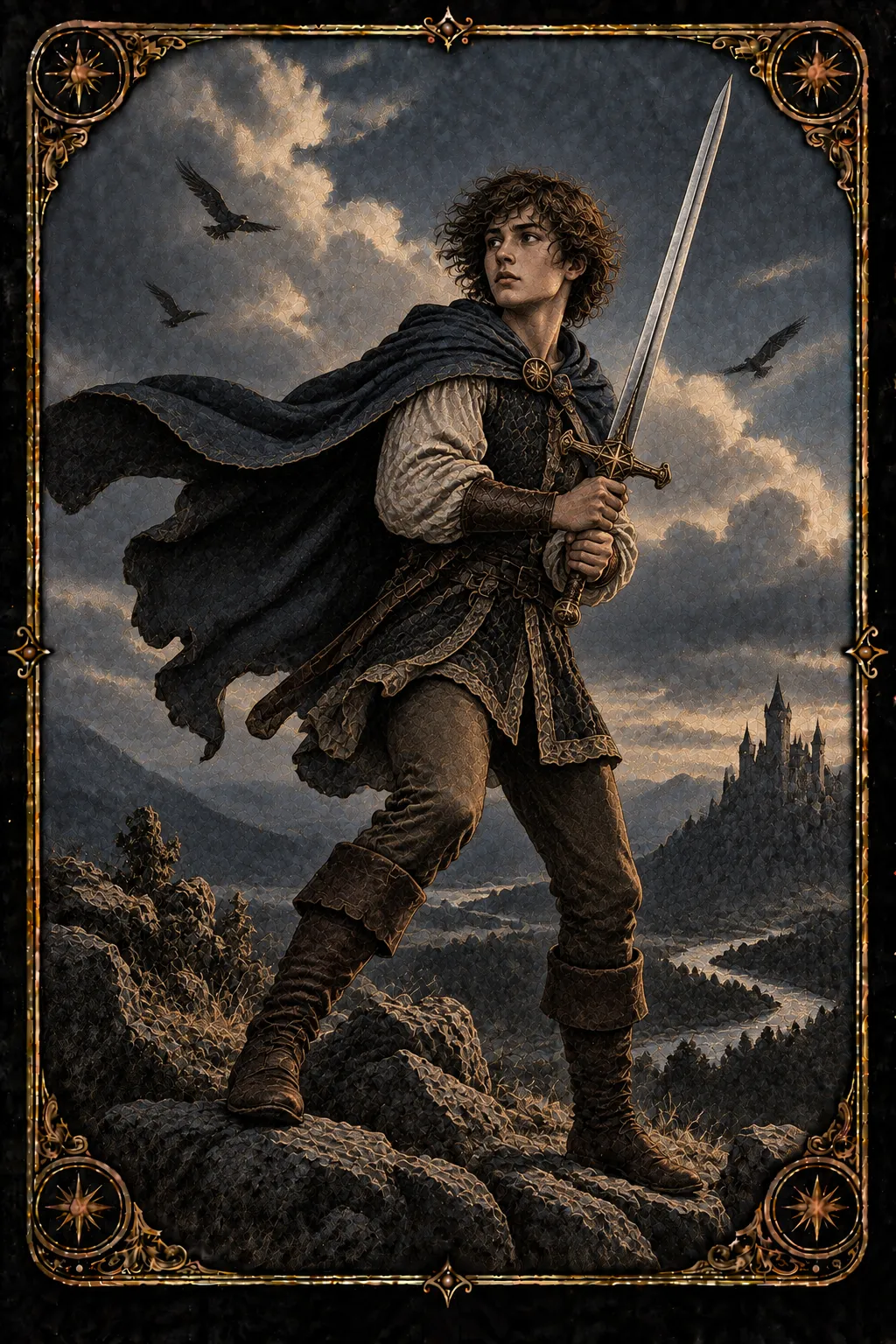
In the classical Rider–Waite image, a young-looking figure stands on uneven ground holding a sword, often with both hands. The figure looks aside rather than at the viewer. Hair, clothing, trees, and clouds suggest wind. Birds are in the sky. The blade is raised, but the body is not in a charge.
Visible facts: a standing figure, a sword, weather, birds, a turning of the head. Interpretation: tradition has read readiness, wariness, and a mind still learning, with news it is too soon to turn into a judgment. Youthful appearance is a pictorial convention. It is not an assignment of the querent’s age or gender.
TARORIA does not claim that its card copies Rider–Waite. In a reading, a mind still learning matters. The character’s apparent age is not a casting call.
Combinations with other cards
Next to the Fool, the Page strengthens freshness of mind: many questions, little armor, a real risk of a hasty word. With the Moon, observation slips toward suspicion; a fact is worth checking before a story is built. With the Magician, an idea wants to become action at once. The Page’s reminder is that understanding is still worth gathering first.
The Knight of Swords nearby would already be in motion. The Page is still gathering. Neighboring cards show whether this is research or surveillance. Which questions to ask is yours.
Frequently asked questions
Does the Page of Swords always mean a spy or a gossip?
No. More often it is a mind still learning: questions, observation, gathering, a wary curiosity. Surveillance and gossip are risks — especially reversed, or when neighboring cards thicken suspicion — not a law of the upright Page.
When is this still the Page, and when has it become the Knight of Swords?
The Page of Swords gathers and learns, and does not yet charge with an idea. The Knight of Swords is already moving: speed, directness, action after thought. One is observation. The other is a move. Look at whether it is still time to ask, or whether you are already rushing.
Do I have to read this card as a child or a young person?
No. It is a quality of mind, not a passport. A person of any age can be the Page when a student, wary intelligence is alive in the situation. The card does not assign gender.
How do I tell healthy curiosity from the reversed Page of Swords?
Healthy curiosity leaves room for an answer and checks a source. The reversed Page often shows gossip, surface information, suspiciousness, or words ahead of understanding. Intent need not be cruel. Ask whether curiosity is serving the truth, or feeding anxiety.