Knight of Swords — tarot card meaning
Minor Arcana
Knight of Swords
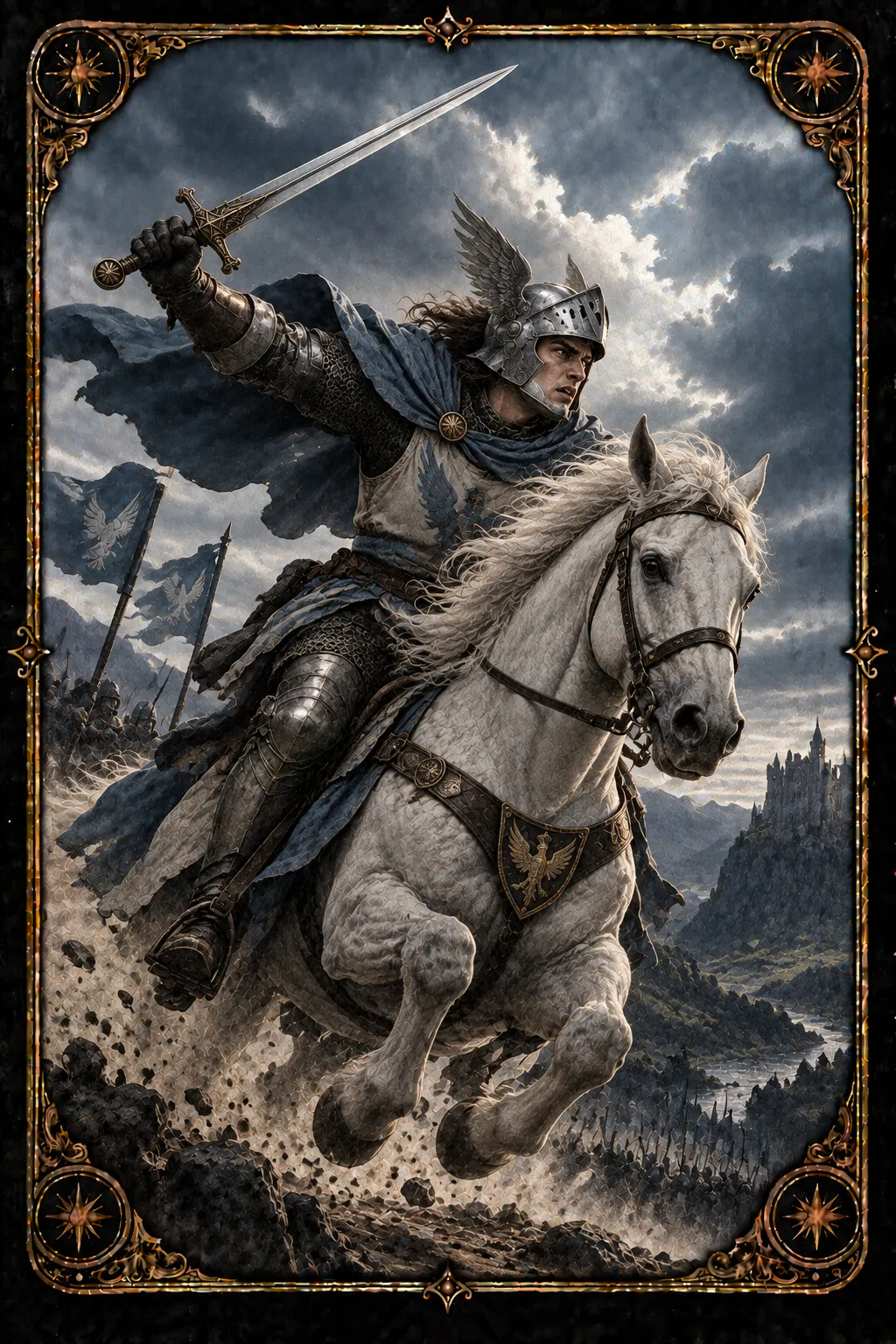
The Knight of Swords is a tempo. An idea has already become motion. Directness, speed of thought, a wish to cut through delay — that is the weather of the card, not a battlefield biography.
People turn the figure into an aggressive man on a horse. Gender is not assigned. What you can see is a rider charging with a raised sword. What you cannot see is a personality type you are obliged to pin on someone in the question.
The weak point is not courage. It is speed outrunning an understanding of consequences. Useful decisiveness and reckless haste use the same muscle. The reading has to tell them apart.
General meaning
In a spread, the Knight describes intellectual momentum. A person is no longer asking. They are going: a letter, an argument, a defense of a position, a sharp maneuver, an idea that demands a quick move. The situation picks up pace whether or not everyone in it agreed to the pace.
Neighboring cards show whether this speed is timely. Facts already gathered, a deadline that is real, a silence that has become dishonest — then directness can be a gift. A half-formed thought, another person’s pause, a document unread — then the same directness is a battering ram.
The Page of Swords was still gathering. The King of Swords will be responsible for what a decision does to other people. The Knight is the interval between those two: the charge.
Upright
Upright more often speaks of a clear resolve. You can say it directly. You can defend a thought. You can refuse to drown in endless approvals. In a jam, that is valuable.
The upright Knight weakens when directness stops hearing. Then people register the blow, not the meaning. If the question is whether it is time to act, the card can support a move — provided you still see whom you are running over on the way.
Speed is not a moral failing. Unexamined speed is a practical one. A sentence sent in the right hour can clear a room. The same sentence, an hour early, can start a fight that the facts did not require.
Reversed
The reversed Knight often rushes to no purpose: conflict for the sake of movement, words aimed at no one, an idea that was not checked in time. Or the speed has been knocked out of them. They want to lunge and cannot, and they are angry at the pause as if the pause were an insult.
The reversed card does not make you a villain. It asks whether the tempo is serving thought, or has already replaced thought with speed itself.
Anger at delay is a useful tell. If the aim is only not to remain in a pause, slowing to one breath is not cowardice. It is how directness stays honest.
Love and relationships
In love, upright can describe a direct conversation, a sharp clarification, an impulse of “let’s be honest already.” That can be relief in a bond that has been foggy. It is not a portrait of a man, and it is not a promise of passionate romance.
The reversed card shows a high-speed quarrel, words that cannot be taken back, pressure to “decide now.” Ask whether the bond needs clarity, or whether you are attacking another person’s pause. Directness without hearing becomes lonely very quickly. The other person is not a delay. They are a mind with its own tempo.
The Chariot nearby can make the will to move feel righteous. Righteousness is not the same as timing.
Work and career
At work the Knight is strong under a real deadline, in a crisis, in the defense of a project, anywhere a position must be formulated quickly. Upright can describe a decisive move if the facts are already in hand.
The card does not promise a promotion. Reversed, it notes conflict in a team because of tempo, a letter that left too soon, an idea without a check. Ask what truly cannot be postponed, and where haste will only manufacture extra conflict.
Some workplaces reward the Knight and then punish the wreckage. If you are the one who “just says it,” notice whether people still bring you information, or only bring you arguments already armored.
Money and finances
In money questions the Knight is linked with an impulsive decision: close the question quickly, answer an offer, refuse to sit in doubt. Upright is not, by itself, a lucky deal.
The card does not give financial guarantees and does not advise investments. Reversed more often shows a signature made in haste, or rage around a sum. Separate the urgency of a fact from the urgency of temperament. The first happens. The second is expensive.
A deadline on a contract is a fact. A feeling that you will look weak if you wait overnight is temperament. They are easy to confuse at speed.
Advice
Name where exactly you are rushing, and why. If the aim is clear and the facts are present, speed can be honest.
If the aim is only not to remain in a pause, take one breath. Directness is stronger when it can still hear the answer.
Symbolism
In the classical Rider–Waite image, a rider charges forward with a raised sword. Cloak and horse are in full motion. Trees bend. The sky is windy and broken with cloud. The whole design is speed: nothing in the picture is waiting.
Visible facts: a mounted figure, a lifted blade, a horse at the gallop, weather that leans the world backward. Interpretation: tradition has read an intellectual attack, the haste of an idea, a resolve not to wait. The rider’s apparent sex is a pictorial convention. It is not an assignment of a person in the question.
TARORIA does not claim that its card copies Rider–Waite. In a reading, the tempo of action matters. The rider’s gender does not.
Combinations with other cards
Next to the Chariot, the Knight strengthens a will to move: useful if a direction has already been chosen, dangerous if this is simply running. With the Tower, speed can coincide with a collapse — words and gestures have weight at once. With Temperance, the Knight meets a need to lower the tempo. You can still act directly, but without haste used as pressure.
The King of Swords nearby would ask who lives with the consequences. The Knight is still counting the charge. Neighboring cards show whether this is a gift or a battering ram. How to measure the tempo is yours.
Frequently asked questions
Is the Knight of Swords an aggressive man?
No. It is a way of acting: quickly, directly, after an idea. The card does not assign a person’s gender. Aggression is a risk when speed outruns meaning, not a required portrait of anyone in the spread.
Does this card mean I should act immediately?
Not on the card’s order. Upright can support a timely move if the facts are already there. Reversed more often points to movement in vain. Ask where you are rushing, and whether you still hear the answer.
How is the Knight of Swords different from the King of Swords?
The Knight is tempo: speed and directness of a move. The King of Swords is responsibility for a decision, a structure, and consequences other people must live with. One breaks through. The other holds a system of judgment. Look at the emphasis — pace, or the weight of a ruling.
What is the reversed Knight of Swords usually pointing at?
Often conflict for the sake of movement, words aimed at no one, speed that has been knocked out, or anger at a pause. Ill intent is not required. Ask whether the tempo is serving thought, or replacing it.