Queen of Swords — tarot card meaning
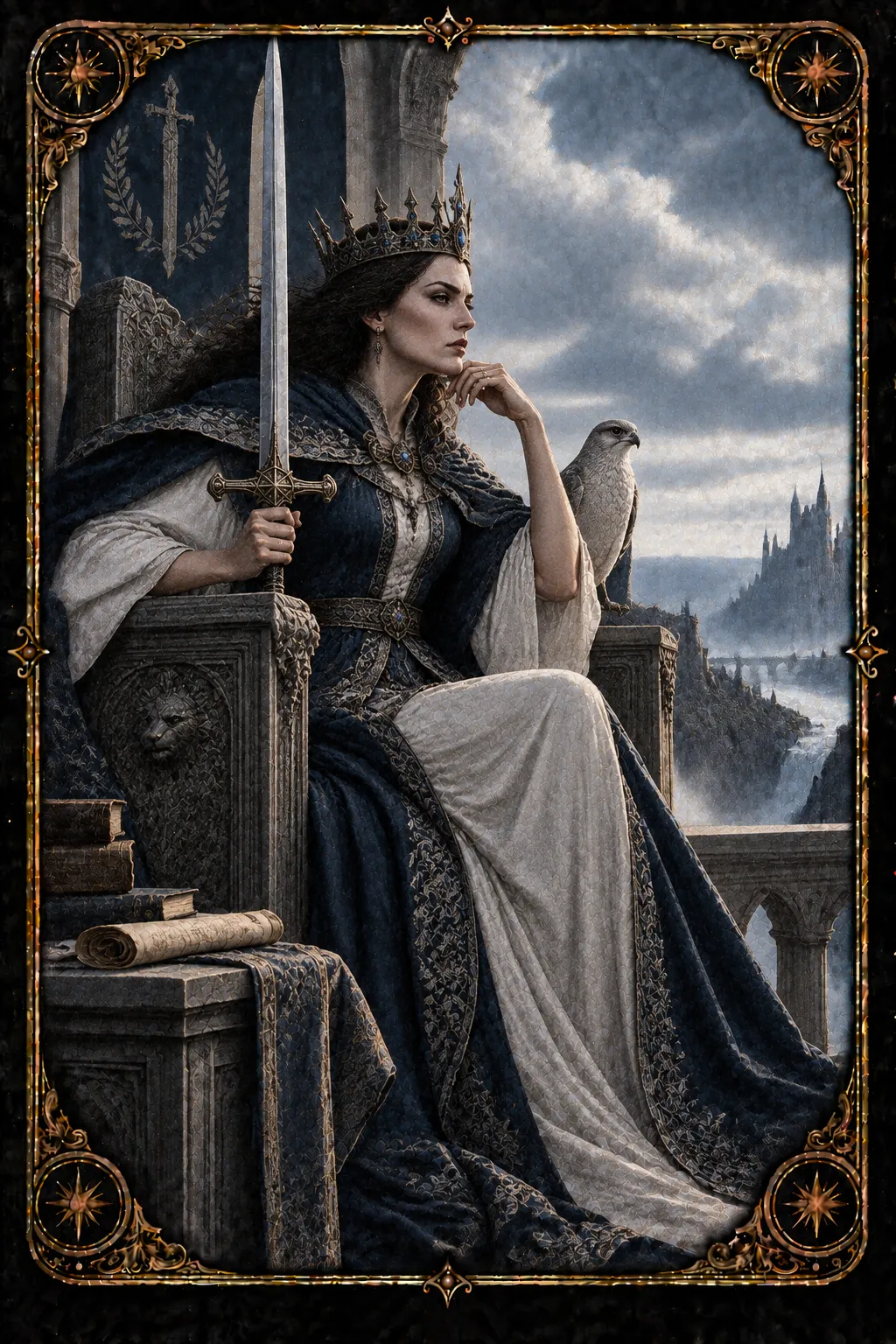
Minor Arcana
Queen of Swords
The Queen of Swords is independent judgment: a capacity to see, to name, and to keep a boundary without dissolving. Feeling is not banished. Feeling does not get to rewrite the fact.
They are often drawn as a cold woman, a widow, a divorcée, a lonely figure with a sword for a heart. That is folklore glued to a throne. The card does not assign gender. What is at issue is how you hold the truth next to the heart — whether you can be precise without becoming cruel, and warm without becoming fog.
Clarity does not require a cutting tone. People who think it does have usually been hurt by imprecision, and they are still paying that bill with other people’s faces.
General meaning
In a spread, the Queen describes a mind that is no longer a student and not an attack. You can listen and still say how it is. You can love and have a boundary. You can grieve and not lie to yourself about the cause.
The weak point is clarity that becomes armor. Precision as protection can look identical to precision as care, until you notice whether anyone is still allowed to be slightly wrong beside you. Neighboring cards show whether this is living accuracy or a chill that keeps the room empty.
The King of Swords will be about decisions other people have to live with. The Queen is more intimate: a personal boundary, a private standard, the right not to disappear inside someone else’s confusion.
Upright
Upright more often speaks of mature clarity without cruelty. A person can tell what is theirs from what has been imposed. They can formulate a boundary in one calm sentence. They are not obliged to rescue someone else’s muddle. Feeling is permitted. It does not get the last edit of the fact.
If the question is who here sees clearly, the card describes a skill, not the role of a wife, a widow, or a boss. Anyone can hold this quality. The throne in the picture is a composition, not a casting.
The upright Queen supports an honest look. Honesty here includes the part where you remain a person. A true sentence that leaves the other party with dignity is still a true sentence. A true sentence used as a blade is doing a second job.
Reversed
Reversed, the Queen’s clarity can harden, or it can go missing under the pressure of emotion. Words wound because they are being used to keep closeness at a distance. In another case the person understands perfectly and does not dare say it, so irritation gathers in the pause.
The reversed card does not make you “cruel.” It asks whether independence still helps you live, or has become a solitude in which no one any longer has a right to be imprecise beside you.
Loss of voice and excess of edge are cousins. Both refuse a living middle: being accurate and remaining reachable.
Love and relationships
In love, upright can describe a bond in which you can tell the truth, have room to be separate, and not confuse care with the disappearance of boundaries. This is not a promise of a cold marriage, and it is not a portrait of a woman without feelings.
The reversed card shows a prickly defense, or a loss of voice. Ask whether you can be alive and precise at the same time beside this person. Closeness does not have to erase judgment. Judgment does not have to erase closeness.
People project “lonely” onto this card because they cannot imagine a clear person who is also wanted. That is their superstition. The card is about the terms of seeing, not a sentence to solitude.
Work and career
At work the Queen is strong in analysis, editing, talks, any role that needs an independent assessment. Upright can describe someone who holds a standard and is not bought by noise. Teams that lack this quality drown in charm and unfinished sentences.
The card does not promise a post. Reversed, it notes a poisonous tone of “I see everything,” or an inability to say no. Ask whether your clarity is a tool of the work, or a way of letting no one near.
Being the person who can name the problem is not the same as being obliged to name it with contempt. Contempt is optional. The naming is the job.
Money and finances
In money questions the Queen is linked with a sober look at terms: not being bought by a story, reading the line, separating a wish from a figure. Upright is not about wealth arriving.
The card does not give investment advice. Reversed, it can show decisions from hurt, pride, or a fear of looking naive. Return to the concrete terms of a contract. Independence here is the capacity to assess them without the pressure of other people’s promises and your own need to seem unsurprisable.
A clear “no” about money is not coldness. It is a boundary with a number attached.
Advice
Separate the fact from the feeling without throwing the feeling away. Name a boundary in one calm sentence.
Clarity is strong while it serves the truth, not revenge for an old vulnerability. You can be precise and remain a person.
Symbolism
In the classical Rider–Waite image, a seated figure occupies a stone throne, a sword held upright in one hand, the other hand extended. The head is turned, often in profile or three-quarter view. Clouds fill the air. Butterflies are carved on the throne. A small winged figure appears in the décor. A bird appears in the sky. The landscape is open.
Visible facts: a seated figure, a raised blade, an open gesture of the free hand, air, carved insects, stone. Interpretation: tradition has read clear judgment, lived experience, independence of view. The seated figure’s apparent sex is a pictorial convention. It is not an assignment of the querent’s gender, marital status, or loneliness.
TARORIA does not claim that its card copies Rider–Waite. In a reading, independent sight matters more than the throne as a pointer to womanhood.
Combinations with other cards
Next to the High Priestess, the Queen joins inner knowledge with a right to name it aloud: a secret does not have to stay wordless. With Justice, boundaries become even clearer; words have consequences, so it matters to keep not only precision but fairness of judgment. With the Empress, a useful tension: warmth and clarity can live together if neither destroys the other.
The King of Swords nearby would shift the accent from personal boundary to a ruling others must inhabit. Neighboring cards show whether this is a gift or a chill. Where to set a boundary is yours.
Frequently asked questions
Do I have to read the Queen of Swords as a woman?
No. It is a quality: independent judgment, discernment, a skill of separating fact from feeling without denying the feeling. The card does not assign a person’s gender, and it does not mean widow, divorcée, or a sentence to loneliness.
Does clarity on this card mean cruelty or coldness?
Not necessarily. Upright more often points to clarity that still leaves room for feeling. Cold appears when precision becomes armor — especially reversed. Clarity does not require cruelty. The difference is whether someone can still be alive beside the truth.
How does the Queen of Swords differ from the King of Swords?
The Queen is personal clarity and a boundary: to see and to name, without dissolving. The King of Swords is responsibility for a system of decisions, a structure, the authority of reason that other people have to live with. One holds their own judgment. The other is answerable for how decisions are ordered. A person can show both.
What should I look for when the Queen of Swords is reversed?
Often hardness used as defense, or a loss of voice: they know, but do not speak. Ask whether independence still helps you live, or has become a solitude in which no one has a right to be imprecise.