King of Swords — tarot card meaning
Minor Arcana
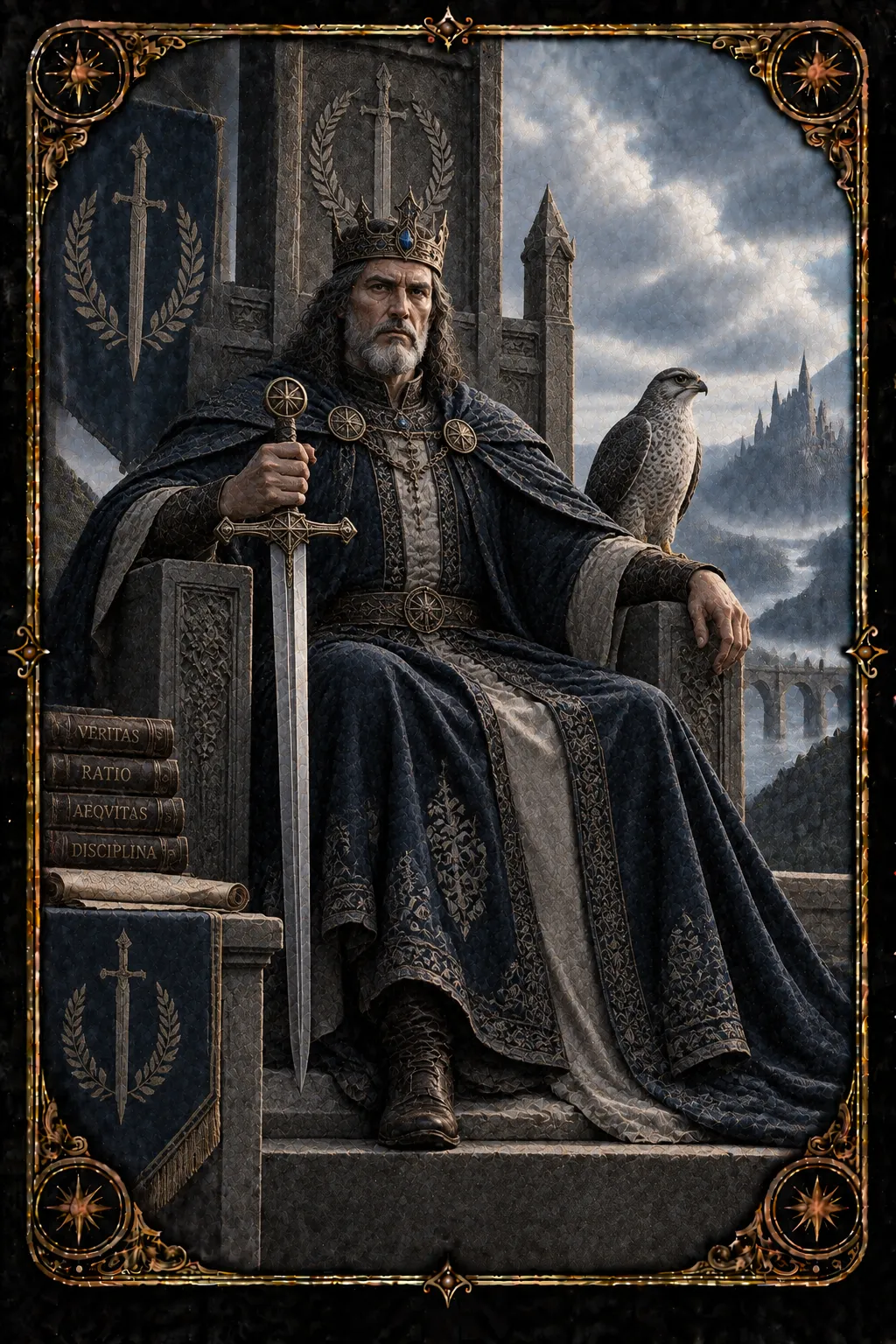
King of Swords
A private insight is one thing. A decision other people have to live with is another. The King of Swords is about the second: mature thinking, structured reasoning, the authority of reason, a capacity to carry a judgment through time.
People assign the card as a man, a lawyer, a judge, a boss. The card does not do that. Gender and profession do not follow from the title. What is at issue is how you handle decisions when other lives already depend on them.
Authority here includes responsibility for consequences. Intelligence without that responsibility is only a sharp instrument. The Ace of Swords can flash. The King has to live with what the flash became.
General meaning
In a spread, the King describes a mind that can carry reasoning through to a conclusion. You can listen, weigh, name a norm, take the outcome. This is not the Ace’s breakthrough, and it is not the Queen of Swords’ personal boundary. It is judgment applied to decisions, rules, and the people who will inhabit them.
The weak point is reason as control: dogma, intellectual superiority, a tone that wins by making other minds feel smaller. Neighboring cards show whether this is genuine maturity or the power of “I am smarter.”
Do not take the card as a promise of a legal outcome. Courts, contracts, and verdicts belong to the actual world of documents and procedures. The King can describe a quality of thought brought to those rooms. It cannot decide a case.
Upright
Upright more often speaks of a clear structure. A person can make a decision and explain why. The tone stays measured. Noise is sorted from what matters. Next to them it is clearer to others, even if it is not warmer.
The upright King supports mature clarity. If the question is whether this judgment can be leaned on, the card describes a skill, not a guarantee that it is always fair. Fairness is checked by whether reason can still hear facts that are inconvenient to it.
A good ruling is smaller than a personality. It names the facts it can actually stand on. Where the facts are thin, maturity admits the thinness instead of covering it with a confident voice.
Reversed
The reversed King often uses the mind as a club. Dogma. Nitpicking. Cold control. A refusal to change a position because it has already been said. Or, on the contrary, a collapse of structure: a person is supposed to decide and cannot, hiding in intelligent words that never arrive at an outcome.
The reversed card is not a cartoon tyrant. It asks whether reason is serving the people affected by the decision, or only the defense of being right.
Both faces — the club and the fog — abandon the same duty. A decision others must live with needs more than brilliance. It needs follow-through, and it needs ears.
Love and relationships
In love, upright can describe a couple in which decisions are spoken, boundaries are clear, arguments stay on the substance. That can be a relief. It is not a portrait of a husband-judge, and it is not a promise that logic will make feeling simple.
The reversed card shows control through “reasonableness,” a devaluing of emotion, an inability to see a conversation through to a decision. Ask whether you can be wrong beside this mind. Maturity is not always winning the argument. Sometimes it is noticing that winning would cost the bond more than the point is worth.
The Emperor nearby can thicken structure until the relationship feels like an administration. Structure can support a life together. It can also replace one.
Work and career
At work the King of Swords is strong where rules, expertise, the outcome of a meeting, and responsibility for wording are needed. Upright can describe someone who keeps decisions inside a clear frame, so other people know what they are living under.
The card does not promise a post. Reversed, it notes a manager or specialist who presses with intellect, does not hear others, or cannot make a final decision at all. Ask whether this clarity helps the people affected, or merely reinforces a sense of being right.
Titles — lawyer, judge, director — may happen to fit a life. They are not the meaning of the card. A person with no title can still be the King when they are the one carrying a ruling and its aftermath.
Money and finances
In money questions the King is linked with rules and consequences: a contract, a tax, a term, a decision that cannot be made on a mood. Upright is not about profit arriving.
The card does not give investment recommendations and does not promise a legal result. Reversed, it can show hardness for the sake of a principle, or chaos where structure is needed. Return to documents, terms, and concrete deadlines. A mature mind reads the terms first, then defends a position.
Mood is allowed. Mood is not a substitute for the clause you actually signed.
Advice
Make a decision no larger than the facts you can actually name. If there are few facts, maturity admits that. A confident tone is not a substitute.
Reason is strong while it serves clarity, not superiority. You can be precise and still leave people the right to be human.
Symbolism
In the classical Rider–Waite image, a seated figure occupies a stone throne with a sword held upright. Butterflies are carved on the throne. The gaze is more frontal than the Queen’s. Clouds and a strict horizon sit behind. Trees appear in the landscape. The seat is high.
Visible facts: a seated figure, a blade, stone, air, carved insects, an elevated place. Interpretation: tradition has read intellectual authority, reasoned judgment, and responsibility for consequences. Apparent masculinity is a pictorial convention. It is not an assignment of profession or gender to anyone in the question.
TARORIA does not claim that its card copies Rider–Waite. In a reading, responsibility for a decision matters more than the throne as a costume for a lawyer or a boss.
Combinations with other cards
Next to Justice, the King sharpens the ethics of a decision: it is not enough to be intelligent; the ruling has to be proportionate. With the Emperor, structure becomes denser — clear thinking and practical order can support each other, or become a double control. With the Fool, a system meets a new beginning. Maturity does not have to kill the new. The new does not have to despise structure.
The Ace of Swords nearby would still be the flash. The Queen of Swords nearby would still be a personal boundary. The King is the one who has to carry a decision through. Neighboring cards show whether this is service or dogma. Which rule to hold is yours.
Frequently asked questions
Does the King of Swords automatically mean a man, a lawyer, a judge, or a boss?
No. It is mature thinking and responsibility for a decision other people may have to live with. Gender and profession are not assigned by the card. Look at who is making decisions in this situation, and how far they take other people’s interests into account.
How is the King of Swords different from the Ace of Swords?
The Ace of Swords is the moment clarity appears. The King is the skill of living with decisions over time: structure, consequences, a shared responsibility. A flash of understanding and the authority of reason are different stages. In a spread, look at which emphasis is alive.
Does this card promise a legal outcome?
No. TARORIA does not read the King of Swords as a forecast of a court result, a contract winning, or a professional title arriving. It can describe a quality of judgment brought to rules and consequences. The actual outcome belongs to facts, procedures, and people’s choices.
How should I read the reversed King of Swords?
Often the mind as a club: dogma, nitpicking, a refusal to hear. Or a collapse of structure: a decision is needed and does not get made. Ask whether the mind is serving the people affected by the decision, or only the defense of being right.