Ace of Swords — tarot card meaning
Minor Arcana
Ace of Swords
People treat the Ace of Swords like a medal. A raised blade and a crown make that easy. The card is smaller and stricter than a win. It marks the hour when a thought becomes clear enough to say in one sentence: a distinction you can no longer blur, a fact that has stopped hiding behind mood.
Clarity is not public triumph, and it is not a promise that anyone else will thank you. Sometimes the named thing eases a long confusion. Sometimes it cuts a story you had been living inside because it was familiar. The Ace records the mind breaking through. It does not write what you will do with the sentence tomorrow.
Set beside the Page of Swords, this is not still gathering news. Set beside the King of Swords, this is not yet living with a decision other people must inhabit. The Ace is the flash in which the point becomes visible.
General meaning
The Ace describes an intellectual shift. You can tell a fact from a guess, a real question from looping anxiety, your own view from other people’s noise. Sometimes that arrives as a new idea you could actually test. More often it is one honest wording that changes what the conversation is allowed to be.
Cards around it show where the named thing is pointing: a decision, a conflict, a plan, a talk you have been circling. The Ace itself does not promise that the truth will comfort. It notes that confusion has stopped working as cover.
A frequent misread is to treat this as a whole new life. It is a beginning of mind, not a finished outcome. If you still need more information, look toward the Page of Swords. If the question is who will carry consequences over months, look toward the King of Swords. Here the work is to notice what has already come into focus.
Upright
Upright, the mind is usable. You can formulate without an endless loop. You can say yes or no without decorating either answer. What is happening becomes sayable, and a next step follows from that, even if the step is only to admit the fact.
Honesty of this kind does not require cruelty. Precision can be quiet. The upright Ace supports a clean sentence, not a performance of being the smartest person in the room. If someone has been waiting for permission to stop hedging, this is often that permission.
What the card will not do is guarantee a convenient answer. You may understand a job, a bond, or a family arrangement more clearly and still dislike what you understand. The upright Ace is the capacity to see the point. What you do with the named thing remains yours.
Reversed
Reversed, the thought does not quite become usable. A decision sits unfinished. Words tangle. Someone clings to one version and will not check it against a document, a date, or another person’s actual sentence. Sometimes the understanding is already there, and fear of speaking it keeps the fog in place on purpose.
Another tone is sharpness without aim: arguing in order to be right, cutting for the pleasure of cutting, a clever remark that does not clarify anything. People leave more confused than they entered, and someone calls that honesty.
The reversed Ace is not stupidity. It asks what is keeping a thought from taking a clear shape — dread of conflict, other people’s authority, a habit of leaving the truth unnamed so that nothing has to change.
Love and relationships
In a relationship, the Ace is often the moment a bond becomes speakable. A feeling is named. A boundary is put into words. The polite fiction that everything is fine stops working because someone has finally said what is happening. That can be a relief. It can also sting, because naming ends the comfort of maybe.
This is not a promise of a union and not a forecast of a split. Couples stay after a clear conversation. Couples also part. The card records the end of pretence, not the outcome. If you hoped the Ace would marry you or release you, you are asking it to do the work of the King of Swords or the Ten of Swords.
Reversed, words wound more than they clarify, or each person holds a private version and calls it protection. Look at whether a shared sentence has appeared, or whether the talk is still a duel of interpretations. One brilliant insight kept silent is not yet a relationship fact.
Work and career
At work the Ace is useful when a task or a conflict has been described in slogans. Upright, someone can finally say what the project is for, which decision is actually on the table, which number is a fact and which is a hope. An idea becomes testable rather than endlessly discussed in meetings that exist to avoid a wording.
The card does not confer a title. A clean analysis can still be ignored. If you treat the Ace as a promotion omen, you will miss the practical gift: you can now write the brief, the boundary, or the no without lying to yourself about what the work is.
Reversed, agreements stay vague on purpose, a document goes unread, or a team pretends a decision has already been made. Arguments flare with no real subject. Ask what still has not been said in a sentence a stranger could understand.
Money and finances
In money questions the Ace is about terms, not a windfall. Upright, figures, deadlines, and obligations come into view. You can tell a budget fact from the anxiety around it. A clause that had been “fine, we’ll sort it” becomes readable. That visibility can be calming or grim. Either way, it is more useful than optimism without numbers.
The card does not promise profit and is not investment advice. Reversed, people sign without reading, fight about money without a concrete sum, or postpone opening the statement because seeing would require a choice. Name the amount, the date, and who owes whom. Until those are spoken, every later step is still an argument with mist.
Advice
Put into one sentence what you have already understood. Do not decorate it. Do not soften it past recognition. If it takes a paragraph, you are still negotiating with fog.
Clarity does not always comfort. It does end the argument with confusion. After the sentence exists, you can choose a talk, a delay, a boundary, or a test from something named. If you cannot yet write the sentence, you may still be on Page of Swords ground. If you can write it and already carry how others will live with it, you are closer to the King of Swords.
Symbolism
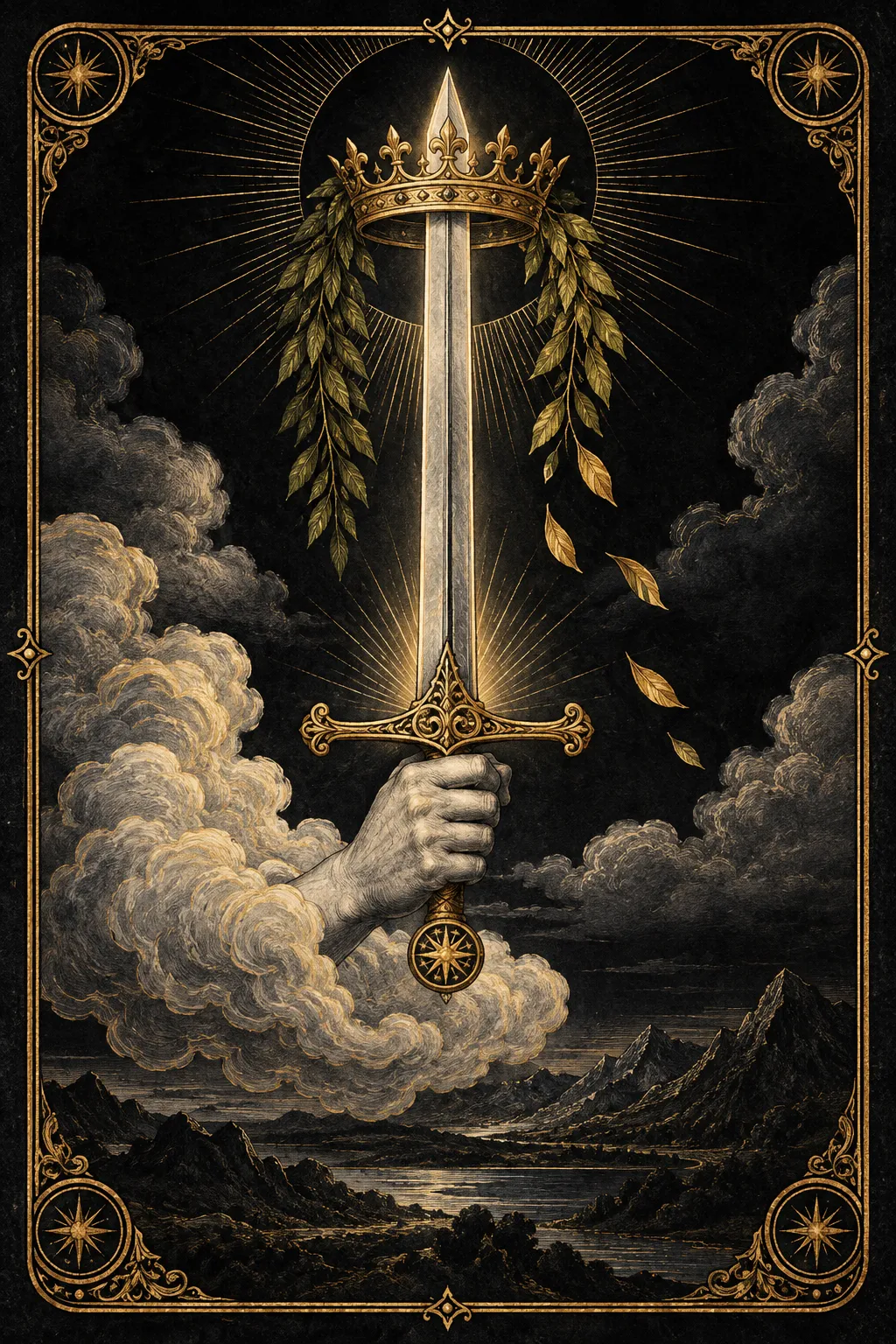
In the classical Rider–Waite image, a hand issues from a cloud and holds an upright sword. A crown sits at or just above the point of the blade. From the crown hang an olive branch and a palm branch. Below, a landscape of hills or mountains lies under a wide sky.
Tradition reads the sword as the mind’s power to divide true from false, the crown as the authority of a named idea, the olive as peace and the palm as victory. TARORIA keeps the first of those and is careful with the last. The picture shows a truth raised into view. It does not show the aftermath of winning.
This is the traditional imagery of that deck, not a claim that TARORIA’s cards copy Rider–Waite. In a reading, the moment a thought becomes nameable matters more than the crown as a trophy.
Combinations with other cards
Next to Justice, the Ace puts weight on words and facts. Evasion becomes more visible. An accounting is possible: not a courtroom drama, but a refusal to keep two ledgers. If you have been hoping a feeling would outvote a documented reality, this pairing is unkind in a useful way.
With the Magician, clarity wants to become a deed at once. That can be clean — a sentence, then an email, then a test. It can also confuse a precise thought with a step already taken. You can see the point and still not have moved.
With the Moon, a breakthrough of mind meets ambiguity. Something true is present, and so is projection. Neighboring cards, and ordinary daylight facts, have to separate those. The Ace does not automatically defeat the Moon. It only insists that a check is now possible.
Frequently asked questions
Is the Ace of Swords a yes-or-no card?
It leans toward a clear answer if the question can be named in one sentence. That is not automatically yes. Clarity can be an unmistakable no. If the situation is still fog, define the question before treating any answer as solid.
How is the Ace of Swords different from the Page of Swords?
The Page gathers: questions, observation, news it is too soon to treat as law. The Ace is the moment a thought breaks through and can be stated. One is apprenticeship of mind. The other is a named point.
Should I speak as soon as I understand?
Not on the card’s order. The Ace supports an honest wording, not a reckless announcement. Some truths need a sentence in your own notes first. Ask whether speaking would clarify — or only cut.
Why can an upright Ace of Swords still feel harsh?
Because a true sentence can end a softer story you preferred. Harshness is not required; inconvenience often is. Look at whether the cut is precise, or whether someone is using honesty as a weapon.