Three of Pentacles — tarot card meaning
Minor Arcana
Three of Pentacles
The Three of Pentacles is linked with the quality of work, with skill, and with how people do a shared task. In a spread the card more often points to learning, collaboration, feedback, a distribution of roles, and a result that depends not only on effort, but on competence.
This is labor that can be shown: a draft, a prototype, an estimate, a lesson, a shared renovation, a team project. The card’s question is whether there is enough knowledge here, enough agreement, and enough respect for another person’s contribution.
General meaning
In the broader spread, the Three of Pentacles describes a stage where enthusiasm is no longer enough. Skill is needed, clarity of tasks, and a readiness to learn from those who know more in their part of the work.
Sometimes the card speaks of a mentor, a review of mistakes, a portfolio, a professional setting in which quality is visible to other people. It is not reduced to teamwork alone: a person can hone a craft in a relatively independent task, if there are criteria and feedback. Next to cards of chaos, the Three often proposes gathering roles and standards. Next to cards of pride — not ignoring remarks.
Upright
Upright, competence, quality, and a capacity to collaborate matter. A person is ready to learn, to clarify details, to do the work so that it can be accepted, not only formally handed in.
The upright Three can accompany study, an internship, a shared project, a conversation with a specialist, an improvement of skill, a situation in which several people’s contributions add up to a clear result. Recognition is possible as a theme of the spread, but not as a promise.
Reversed
Reversed, coordination suffers. The reversed Three can describe an uneven distribution of work, ignoring feedback, a lack of skill for the current task, formal participation, a clash of professional approaches.
The work may be done worse than the conditions allowed — not because a person “has no gift,” but because roles, timelines, or criteria were unclear, and no one wanted to learn on the way. The reversed card asks where collaboration is only being performed, and where a concrete competence is missing.
Love and relationships
In love, the Three of Pentacles is rarely about sudden romance. More often a relationship needs shared effort: agreeing on household life, distributing practical tasks, learning to hear each other in everyday matters. For a couple this can be a renovation, a move, a shared schedule, care for relatives, any task in which two people have to act in concert.
Reversed, one person often carries most of the work on the relationship, agreements are not kept, people find it hard to act together. Look at whether closeness is being built through real deeds, or remains at the level of talk about how things “ought” to be.
Work and career
At work this is one of the card’s key sections. Upright can point to learning, a mentor, a team project, growth of competence, a portfolio, feedback, collaboration among specialists with different roles. It matters not only to be busy, but to do the work at a clear level of quality.
Reversed, it points to a breakdown of coordination, work in which everyone is on their own, a refusal to take feedback into account, a task for which the skill is not yet enough. A promotion or public recognition is not something the card promises. It is useful to ask what exactly needs to be learned, and with whom it makes sense to share the task.
Money and finances
In money questions the Three is linked first of all with pay for labor and with the price of skill. Upright can describe work that is worth valuing by qualification, putting time or money into learning, a shared household or work project with a common budget, a need to name the cost of your work.
Reversed, it speaks of undervaluing labor, of putting money into study without a clear aim, of a shared matter in which contribution and expenses are distributed unfairly. The card does not suggest where to invest money. It makes sense to understand which skill or result you are paying for — or want to be paid for.
Advice
Do not try to close the whole task alone if other people’s competences are needed for it. Take constructive feedback, and clarify the roles: who does, who checks, by which criteria the work is considered done.
It makes sense to raise quality, not only speed. One well-finished fragment is more useful than three raw ones.
Symbolism
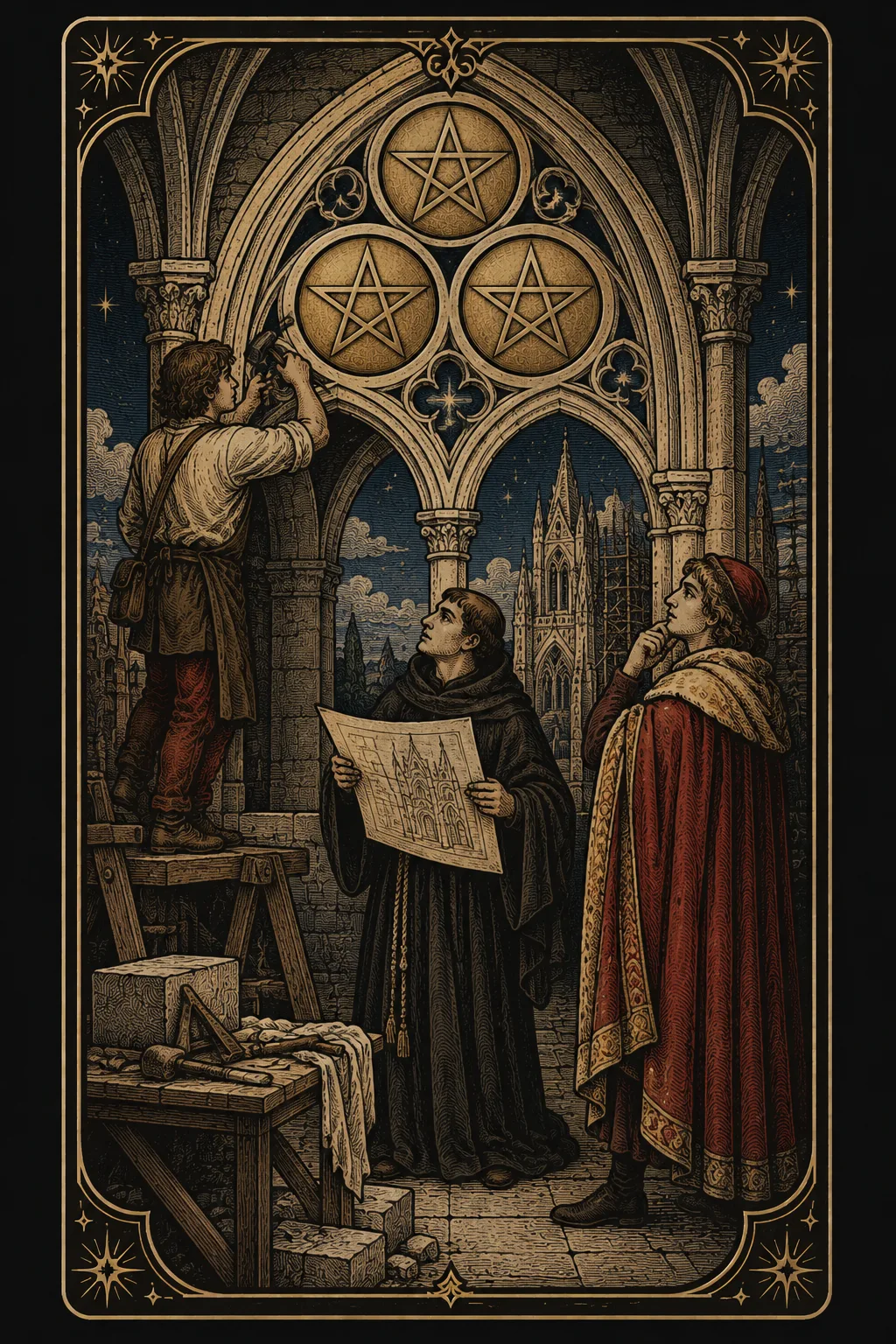
In the classical Rider–Waite image, a craftsperson works on a stone building. Two other figures stand nearby with a plan or drawing.
Tradition often reads this as a client or designer, a cleric, and an artisan agreeing a design — learning, skilled labor, and work that has to meet a standard. The architectural setting can symbolize a matter that is built gradually and needs different abilities. The traditional image explains the theme of craft. It does not claim that TARORIA’s drawing copies Rider–Waite.
Combinations with other cards
Next to the Hierophant, the combination can strengthen the theme of learning, mentorship, and a professional tradition. With the Emperor, roles, standards, and the organization of shared work come to the fore. With the Magician, skill and an idea get a chance to become a visible result, if a person is ready to finish the details rather than stop at a striking beginning.
Neighboring cards help you see whether this is study, a team, quality, or pay for labor. Recognition, if it appears in the spread, remains a possible consequence of the work, not a guarantee.
Frequently asked questions
Is the Three of Pentacles a work card?
Very often yes: skill, learning, a team, the quality of a result. But the same sense is read in any matter that needs competence and agreement — study, a renovation, a shared household, a project outside an office. Look at which labor the question is about.
Does it mean recognition?
Recognition can be a theme if neighboring cards and the question point that way. The Three itself speaks more of quality, feedback, and a visible contribution than of a prize. A promotion or praise does not follow from one card automatically.
What does the Three of Pentacles mean in love?
More often shared effort and a distribution of practical tasks, not a flare of feeling. Upright can show that a couple is learning to agree through real deeds. Reversed, one person often does most of the work on the relationship.
What does the reversed card show?
The reversed Three often describes poor coordination, an unequal contribution, ignoring remarks, a lack of skill for the current task, or formal participation. This is a reason to clarify roles and criteria, not a conclusion that a person is capable of nothing.