Four of Pentacles — tarot card meaning
Minor Arcana
Four of Pentacles
The Four of Pentacles is more often about holding resources and a need for safety. In a spread it can speak of savings, a financial cushion, caution, control of spending — and of a fear of losing what has already been reached.
In some situations it points to reasonable care. In others — to protection that has turned into constant strain: a person guards stability so tightly that they almost do not use what they already have.
General meaning
In the broader spread, the Four of Pentacles describes a wish to secure a position: not to spend a reserve, not to risk a familiar way of life, to know where money, things, and boundaries are. This can be useful after a period of chaos or uncertainty.
Difficulty begins when safety becomes the main measure of every decision. Then it is hard to share, to change work, to let a person closer, to spend even on what is needed. Next to cards of need, the Four often supports the theme of a reserve and of accounting. Next to cards of pressure — it warns that control is already getting in the way of living.
Upright
Upright, the card can show a wish to keep what has been reached, caution, accumulation, control of resources, a need for steadiness. A person does not have to be read as greedy: sometimes this is a quite understandable fear of being without ground again.
The upright Four can accompany keeping a budget, refusing optional spending, a wish not to give others control of your money or affairs, a wish to leave everything as it is. It is useful to ask whether this caution is protecting real stability, or only a habit of not letting anything go.
Reversed
Reversed, the meanings split. Sometimes this is a loosening of excessive control: a person begins to spend more freely, shares, lets go of a pattern that has long been tight. Sometimes, on the contrary, a loss of a sense of order: unplanned expenses, a weak budget, forced spending.
The reversed card is not reduced to a loss of money. Context and neighboring cards help you see whether this is a release from rigid economy, or whether financial discipline has truly slipped.
Love and relationships
In relationships, upright is often about a need for safety and caution in feeling. A person may open slowly, fear losing a partner, find it hard to show vulnerability, try to control how the bond develops. For a couple this is sometimes household closedness: it is hard to discuss what is shared, to share time, space, habits.
Possessiveness and control of a partner are not something the card excuses. Reversed, two tones are possible: either the relationship becomes less stable, or a person is trying to loosen the pressure and give more space. Which is closer, the question and neighboring cards will tell. Look at whether the caution gives a sense of ground, or gets in the way of closeness.
Work and career
At work, upright often concerns a wish to keep a place, not to risk stability, to control the process, to resist changes that seem a threat to a familiar order. This can be fitting if the conditions are already shaky.
Reversed, it points either to a fear of any professional change, or to a loss of a sense of steadiness, or to a readiness to drop excessive control and allow a new way of working. It is useful to separate reasonable caution from a refusal to develop only because any movement looks like a risk.
Money and finances
In money questions this is one of the card’s central sections. Upright can describe savings, a budget, keeping a reserve, caution, a drive toward financial safety. At the same time, excessive economy is possible, a fear of any spending, a sense that only money gives calm.
Reversed, the card can speak of unplanned expenses, weak control of a budget, or a freer relation to savings after a period of rigid economy. It makes sense to look at how far the current degree of control helps or hinders — without a ready decision to save or to spend.
Advice
Check what exactly you are trying to protect: a reserve, housing, status, a familiar order, a feeling of control. Then ask how necessary the chosen degree of caution actually is now.
Reasonable safety should help you live, not make you constantly afraid of loss. If you have already closed every risk you can close, the remaining strain may no longer be about money, but about fear.
Symbolism
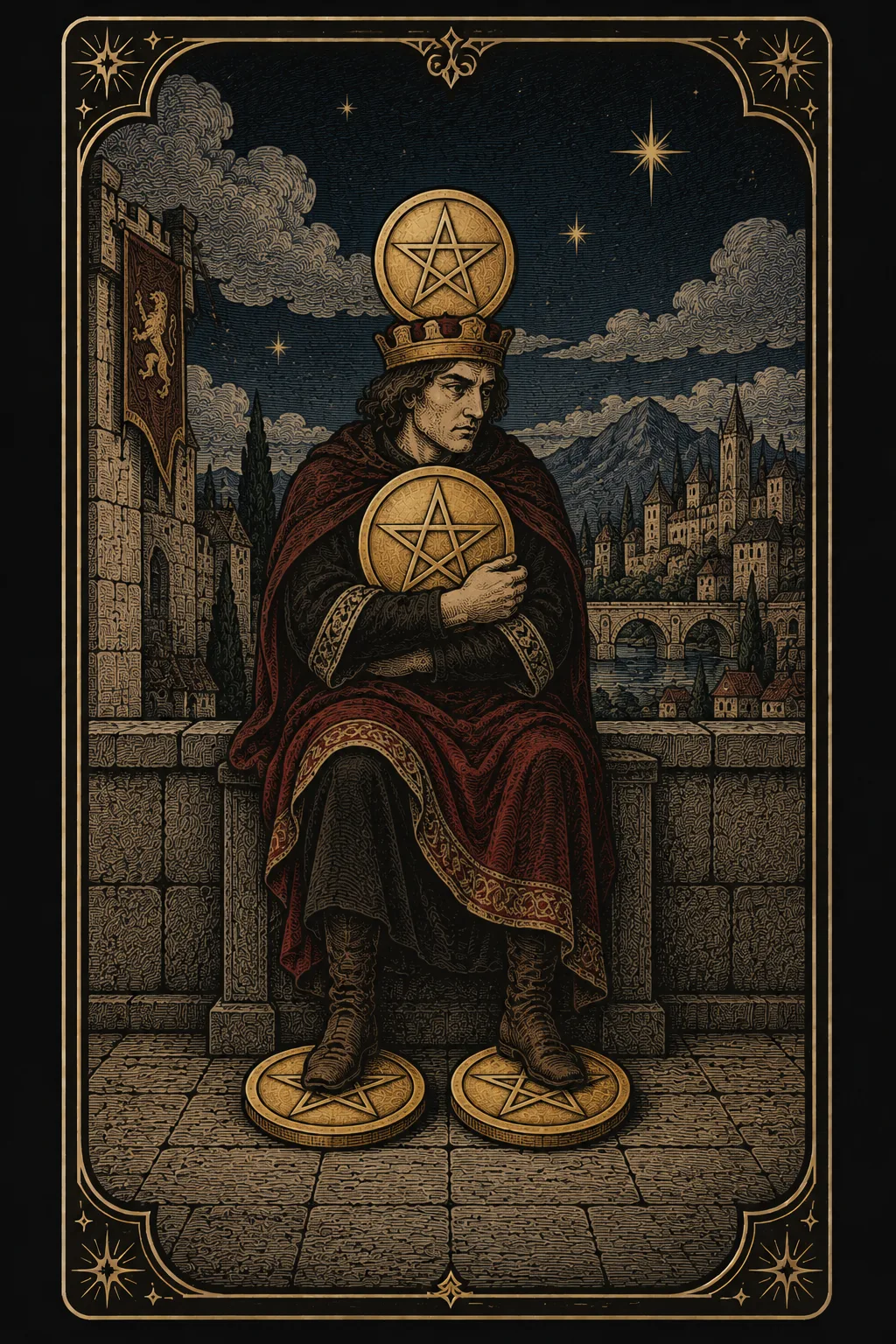
In the classical Rider–Waite image, a seated figure holds a pentacle against the chest; another rests above the crown, and two more sit under the feet. A city appears in the background.
Tradition links this pose with holding resources and with anxiety about losing them. The coins surround the body on all sides: this can symbolize both a ground to stand on and a limit on mobility. In a traditional reading the card shows the price of safety, not a verdict of greed. The traditional image explains the theme of holding. It does not claim that TARORIA’s drawing copies Rider–Waite.
Combinations with other cards
Next to the Emperor, the combination can strengthen the theme of order, accounting, and control of resources — useful or already excessive, depending on context. With the Devil, a fear of loss can become constriction: a person confuses safety with an inability to change anything. With Death, the spread can raise the question of whether it is time to let go of a pattern of protection that no longer matches the circumstances.
Neighboring cards clarify whether this is a reasonable reserve, fear, control in a relationship, or resistance to change. The decision of what to share and what to keep is not one the card makes for a person.
Frequently asked questions
Is the Four of Pentacles a card of greed?
No. Often it speaks of a need for safety, caution, and a wish to keep what has been reached. Greed can be one of the shades if a person already lets nothing go and fears any expense, but that is not the only reading, and not a required one. Look at whether the caution is protecting real steadiness, or only fear.
Does it mean savings?
It can: a reserve, a budget, a financial cushion, a refusal of optional spending. Upright is often linked with keeping money. This is a description of a tendency, not advice to save, and not a promise that a reserve is already there or will necessarily appear.
What does the card mean in relationships?
More often a need for safety, caution, difficulty being vulnerable, sometimes possessiveness. Upright does not excuse control of a partner. Reversed, both a rise in instability and an attempt to loosen the pressure are possible; the question and neighboring cards will say more precisely.
What does the reversed Four of Pentacles mean?
There are several variants: unplanned expenses, weak control of a budget, forced spending — or, on the contrary, a readiness to loosen excessive economy and to share. The reversed card is not reduced to a loss of money. Look at the context: is this a release, or a loss of ground.