Five of Pentacles — tarot card meaning
Minor Arcana
Five of Pentacles
The Five of Pentacles appears in a spread when familiar sources of stability have become less secure. This can concern money, housing, work, a circle of people — a period in which a person feels more vulnerable than usual.
The card is heavy, but it does not declare poverty, illness, or catastrophe. Often, beside the lack, another question stands: is there help that is not being taken yet, from shame, pride, or a sense that “I have to manage on my own.”
General meaning
The Five marks a chapter in which resources may be stretched, whether financially, practically, or personally — fewer than needed, or fewer than a person is used to. Sometimes this is objective: income has fallen, expenses have risen, a former steadiness has gone. Sometimes a fear of being left without a reserve sounds louder, even if the situation is still repairable.
Separately the card raises the theme of isolation. A person may walk past available support: advice, temporary help, information, a warm contact. Neighboring cards will tell what is louder now — a real deficit, anxiety, or reluctance to reach out.
Upright
Upright more often shows that things are genuinely tight now. The budget no longer covers a familiar standard of living, there is barely enough energy for what is required, the old pattern of “I do it myself” is failing.
At the same time, the card is not only about the number in a bank account. It matters whether a person sees the difference between actual lack, a fear that everything will run out, a feeling that no one will help, and embarrassment about asking for what can already be received. While those layers are mixed, any step seems humiliating or useless.
Reversed
Reversed often shifts the tone toward an exit: some stability returns, a solution is found, the pressure eases a little, a person stops carrying everything alone. This is a direction, not a promise that the hard period is already behind.
The other pole is a problem that has dragged on because it is more convenient not to name it. A person pretends they can “hold on a little longer,” and thereby leaves themselves without help longer than the circumstances allow. Look at what is closer to the question: the first signs of recovery, or a habit of ignoring what already needs attention.
Love and relationships
In close relationships the Five can describe a hard household or financial stretch that a couple is walking together — and then the drama of a breakup is not the point, but whether people feel supported by each other. Another story: loneliness inside a bond, when a person is nearby, but there is no support, and a sense of being left out appears.
Upright is not read automatically as a separation. Pressure on a couple can be financial, about housing, linked with tiredness, or with shame about asking for simple participation. Reversed, the card sometimes shows a readiness to lean on each other again, to accept help without a tally of “who owes whom,” or to emerge from a period of cold distance. Look at whether there is real contact — or whether each person is living the difficulty separately, even under one roof.
Work and career
At work, upright can speak of an unstable workload, cut income, a lack of needed tools, a sense that the place is shaky. A person feels professionally unprotected and does not always know whom to turn to inside a team.
The card does not predict dismissal. Reversed sometimes notes a search for stability: a colleague offers a lead, a temporary format is found, it becomes clearer which resources can still be asked for. If the tone is heavy, it is useful to tell a real lack of conditions from a fear that any change at once means losing the place.
Money and finances
In money questions the Five needs the calmest wording. Upright can describe a period of a limited budget, unexpected expenses, a shrinking reserve, a situation in which a familiar level of spending no longer matches the money coming in.
This is not a prediction of debt or destitution. Reversed, the card sometimes shows that the pressure eases a little: support is found, expenses can be reviewed, a working plan for the coming weeks appears. It makes sense to look at a concrete horizon — which immediate obligations need attention — and which help, delay, or information is actually available, without panic and without a promise that the reserve will restore itself.
Advice
Do not face the difficulty alone only because it is shameful or frightening to look weak. First separate the facts: which money, energy, time, or people are actually lacking.
Then check what is already available: the advice of a person who has been through something similar, a clarification of terms, temporary support, a review of required spending. Help does not have to be large. Enough is what you are able to accept now.
Symbolism
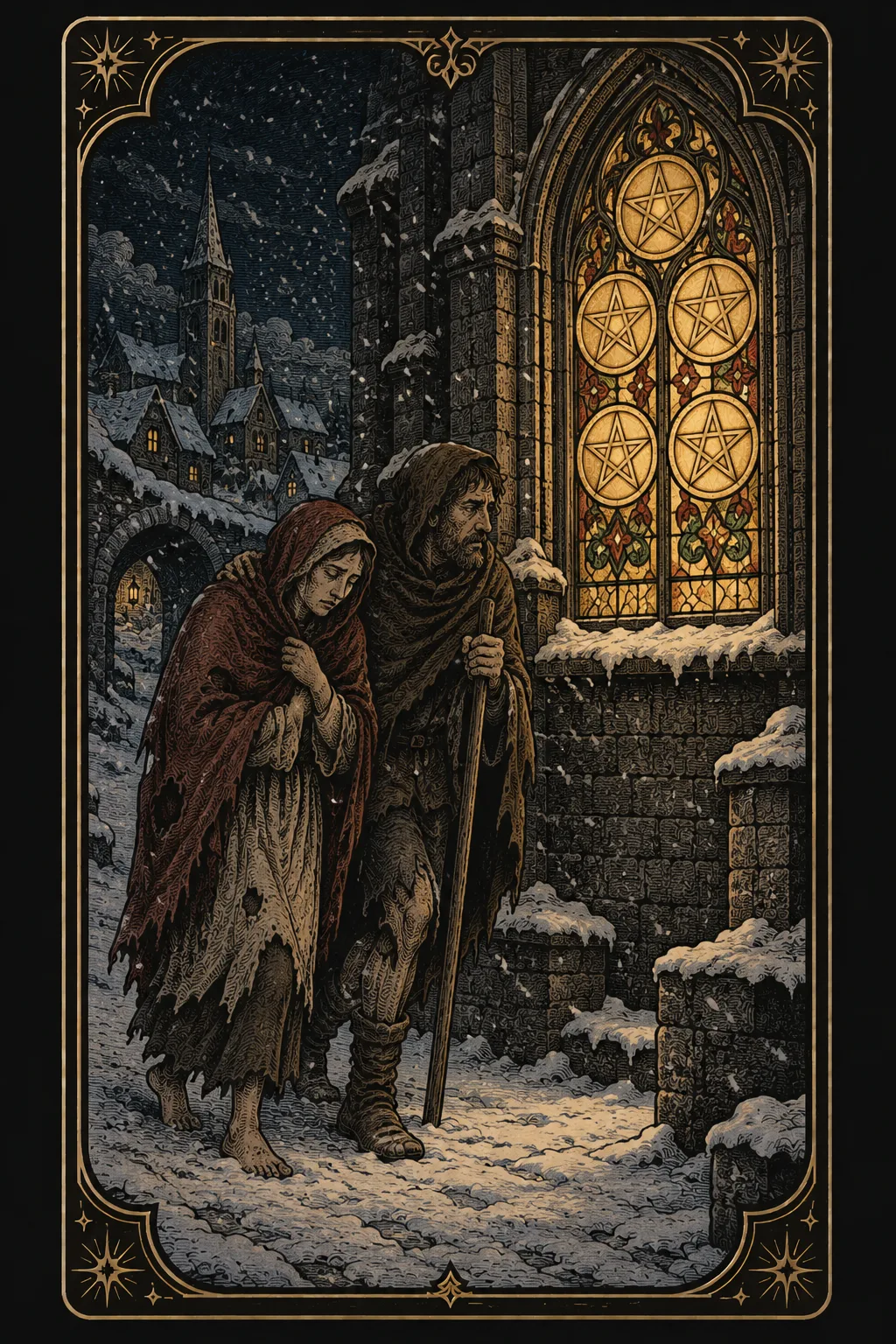
In the classical Rider–Waite image, two figures walk through snow past a church window whose stained glass shows five pentacles. One figure uses crutches.
Tradition links this scene with winter, tiredness, and closeness to a resource that is not yet being used. The figures can symbolize both material tightness and a sense of not being noticed. The window is traditionally associated with available support — a community, a home, a reserve — that exists nearby, even if a person has not yet dared to turn to it. The traditional scene explains the theme of scarcity and support. It does not claim that TARORIA’s image copies Rider–Waite.
Combinations with other cards
Next to the Star, the Five often sharpens the theme of a possible way forward: support or an exit is there, but a person may walk past while looking only at the deficit. With the Hermit, isolation grows stronger — not necessarily a wise pause, but a withdrawal into oneself precisely when contact with another person is needed. With the Moon, it is worth separating real lack from an anxious scenario in which any tomorrow already looks like a crash.
Neighboring cards help you see what is lacking and why help is not being used. The Five itself does not decide how the period ends.
Frequently asked questions
Does the Five of Pentacles predict poverty?
No. The card can show a tight period: less income than usual, sudden expenses, a sense of vulnerability. This is a description of a load, not a fate of remaining without money. Look at what is limited now, and which support is already available.
Why does the reading talk so much about help?
Because in a classical reading, beside the lack there is often a resource that is not being used: people, information, temporary support. Shame about asking sometimes holds a situation longer than the circumstances themselves. The card does not require humiliation — it proposes checking what can actually be accepted.
Does the Five of Pentacles mean a breakup?
By itself, no. In love it is more often about a hard household, loneliness inside a couple, or a lack of support. A pair can walk a period together. Reversed sometimes speaks of restoring contact. The decision to break is not one the card makes for people.
Is the reversed Five already the end of the difficulties?
Not necessarily. Often the tone is softer: some stability returns, a solution is sought, a person stops carrying everything alone. Sometimes, on the contrary, the problem drags because it is convenient not to notice it. Look at the question and neighboring cards: is this an exit, or a problem being stretched out.