Six of Pentacles — tarot card meaning
Minor Arcana
Six of Pentacles
The Six of Pentacles raises questions about exchange. Who currently has a resource, who needs it, on what terms the exchange takes place — and whether dignity remains for both sides.
The card is easy to reduce to generosity. It is more accurate to look more broadly: help, a gift, payment, a distribution of a budget, reciprocity, charity, dependence. Giving and receiving are different skills, and both can be honest or humiliating.
General meaning
In a spread, the Six shows a movement of resource between people. Someone pays, lends, offers support, shares time, attention, connections. Someone receives. While the exchange is clear and proportionate to the question, the card reads calmly.
Strain begins when the possibilities are unequal and the terms have not been named. Then support becomes a lever, gratitude becomes a debt, and a refusal to accept help becomes a defense against another person’s power. Neighboring cards clarify whether this is genuine reciprocity, or a hidden hierarchy.
Upright
Upright can show an honest transfer: a person was helped, they themselves were able to help, payment matches the contribution, the distribution looks clear. It is still important to ask how equal the sides are in the right to say no.
Even upright, the giver holds more power than the receiver. If that is conscious and without humiliation, the exchange works. If the “good” cannot be declined, or it requires an invisible price, the card’s upright position still does not make the situation healthy.
Reversed
The reversed Six is more often about a skew. Help comes with conditions, the exchange is unequal, one person constantly gives more than they receive. Money, gifts, or “I do everything for you” begin to govern closeness.
Debt is only one of the stories. Just as often it is about dependence on another person’s decision, charity for show, embarrassment about accepting support, or a habit of rescuing in order to feel needed. The reversed card asks what exactly is skewed: the volume, the terms, the dignity, or the possibility of refusing.
Love and relationships
In love the Six is almost always about reciprocity. Who gives time, attention, household help, emotional support, money — and whether the other can receive it without shame and without a sense that they can now be managed.
Upright sometimes describes care that truly warms: both invest in different forms, and it does not turn into a tally. Reversed, the card shows a bond in which one person pulls the relationship with resources and the other is used to taking — or in which a gift, paying the bills, and “I keep you” become a way of control. Look not only at who is more generous, but at whether it is possible in this couple to ask and to refuse without punishment.
Work and career
At work, upright can concern fair pay, a colleague’s help, mentorship, a budget assigned to a task, a readiness to ask for support or to give it yourself. Resource here is not only money: access to information, a senior specialist’s time, tools.
Reversed often concerns unequal load, dependence on another person’s “yes,” help that comes with unspoken obligations. A bonus and a promotion are not something the card promises. It is useful to find out what exactly is being paid or thanked for — and whether loyalty beyond the agreement is required in return.
Money and finances
In money questions the Six describes a movement of money between people: support, a return, a distribution of a shared budget, taking part in helping another, a situation in which someone temporarily helps cover another person’s shortfall. Upright can speak of a clear exchange, if the terms have been named.
The card does not assert that money will arrive. Reversed more often shows a skew: support with an invisible price, an unequal contribution to what is shared, a sense of being made dependent on another person’s generosity. It makes sense to look at the terms of the exchange, not only at the sum.
Advice
Look not only at how much you give or receive, but at the terms on which it happens. Whether it is possible to refuse. Whether gratitude later has to be repaid through obligation. Whether respect remains for the person who receives.
Help should support, not create a quiet dependence. If you are always in the role of giver, ask whether you are buying influence. If you are always the one asking, ask whether you are giving away the right to decide your own life in exchange for a sense of security.
Symbolism
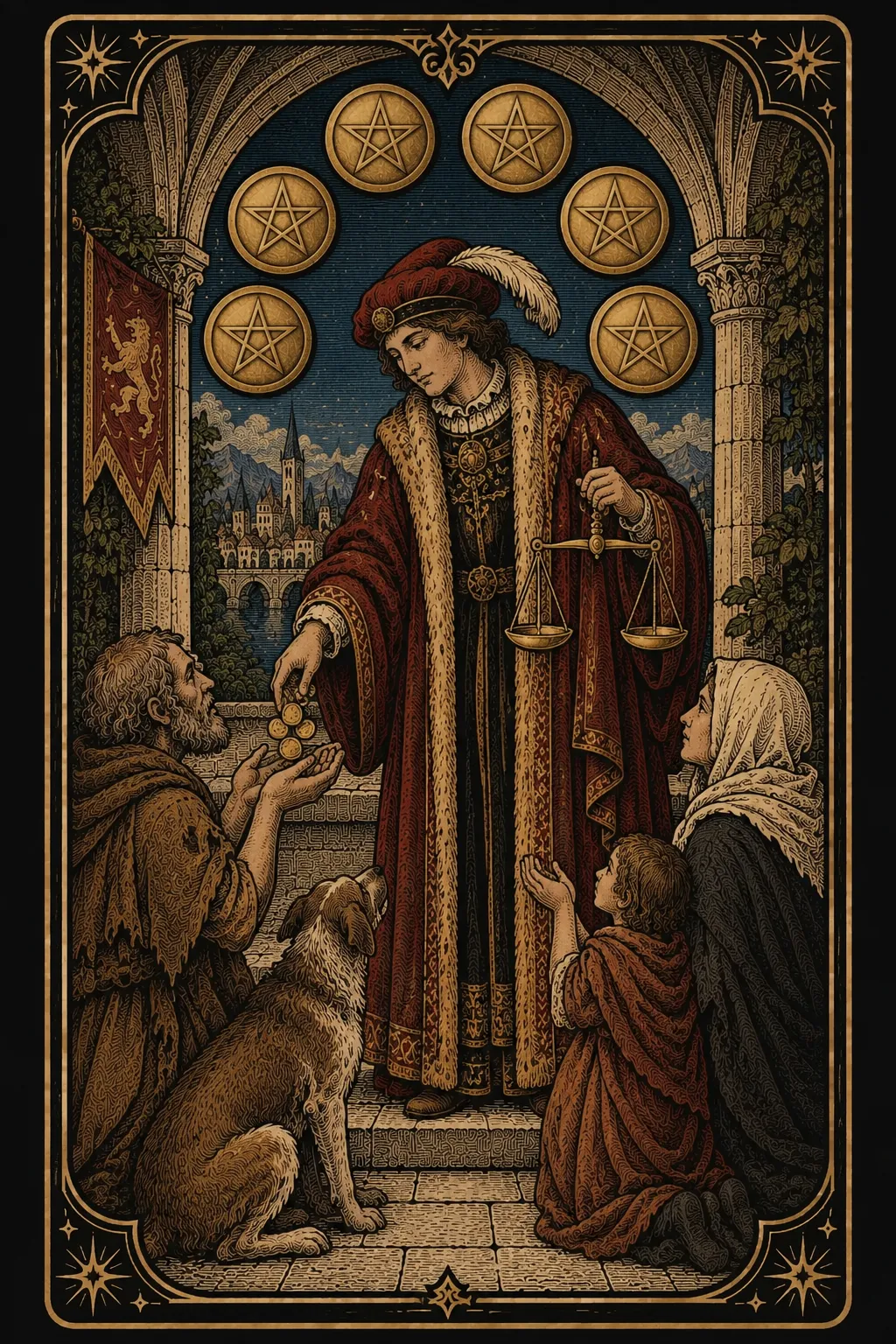
In the classical Rider–Waite image, a standing figure holds scales in one hand and gives coins with the other. Two kneeling figures receive them.
Tradition links the gesture with distributing a resource, and the scales with measure: how much to give, to whom, by what principle. The composition is usually taken as a scene of exchange, not as a portrait of a selfless saint. In a reading, it matters whether the participants of the scene are equal — and whether measure is replacing genuine participation with control. The traditional image explains the theme of giving and receiving. It does not claim that TARORIA’s drawing copies Rider–Waite.
Combinations with other cards
Next to Justice, the Six sharpens the theme of proportion: pay, contribution, the terms of help are better named aloud. With the Lovers, reciprocity of choice comes to the fore — a resource in a relationship does not replace both people’s consent. With the High Priestess, the terms of the exchange may be hidden: a person feels a debt, but cannot explain for what exactly.
Neighboring cards show whether this is an honest gesture or a hierarchy. The decision to give or to receive remains practical, not a moral verdict.
Frequently asked questions
Is the Six of Pentacles simply generosity?
No. Generosity can be one of the shades, but the card is wider: help, payment, distribution, reciprocity, dependence, the terms on which a resource is transferred. Look at who holds the resource, and whether it is possible to refuse without a loss of dignity.
How do I tell who in the spread is giving and who is receiving?
By the question and the card’s position. Sometimes you are the giver, sometimes the receiver, sometimes both in turn. Upright does not assign you the role of benefactor. What matters more is whether the terms have been named, and whether there is reciprocity — in money, time, attention, or household help.
What does the Six of Pentacles say about unequal relationships?
Especially reversed: one person invests more, a resource is used as a lever, help cannot be declined. The upright card also does not cancel the question of power — even an honest gift can create an imbalance in power. Look at whether it is possible to ask and to refuse without punishment.
Does the card mean I will be given money?
Not necessarily. It describes a movement of resource, not a guaranteed arrival of a sum. Sometimes it is about your readiness to help another, a distribution of a shared budget, or the terms of support that already exists.