Seven of Pentacles — tarot card meaning
Minor Arcana
Seven of Pentacles
The Seven of Pentacles arrives after effort has already been invested. The question is not “will I begin,” but “is what I keep investing time and effort in producing enough progress to justify continuing this way?”
The card is often called patience. Patience here is only the background. The main thing is an interim assessment: what has grown, what is stalling, and whether you are holding onto a matter only because too much has already been spent.
General meaning
If you look at the situation as a whole, the Seven describes long work, slow growth, and a pause in which progress has to be measured honestly. A person is not at zero: some progress has already been made, results — in a wide sense — are already there, but the outcome is not yet settled.
Sometimes the card supports continuing. Sometimes it shows that it is time to change the method. Neighboring cards help you tell genuine waiting from inertia.
Upright
Upright, a substantial part of the labor has already been done, and the result is still ahead. It is useful to name what has come of it: a skill, a foundation, an agreement, a saved sum, a relationship that has shifted. And separately — what has still not worked.
The upright Seven does not praise staying power automatically. It proposes deciding whether to continue by the same route, to adjust the approach, or to stop investing in an approach that is not responding to your effort.
Reversed
Reversed often concerns disappointment in the result: a great deal of effort with little to show for it. A person hurries the result, is angry at the pace, or, on the contrary, continues only because months, money, and reputation have already been invested.
Here it is easy to get stuck in the trap of past costs: it hurts to quit, though the method has long not been working. The other tone is waiting for an effect without changing the way of working itself. The reversed card does not order you to drop everything. It asks you not to confuse persistence with a refusal to look at the numbers, the timeline, and how you feel.
Love and relationships
In love the Seven asks where a bond is moving after effort already invested. There have been conversations, attempts, shared steps — and now there is a wish to understand whether there is mutual progress, or whether you are pulling the development alone.
Upright can describe a stage in which a relationship needs time, but meaningful time: it is visible that both are changing something. Reversed, the card shows tiredness: a great deal of energy is going in, but little is changing. This is not automatic advice to separate. It is a reason to name what change you are waiting for, and whether it is happening even in a small form.
Work and career
At work the card often points to a long project, study, gathering experience, a task whose result is not visible at once. Upright is a moment of interim review: what has already been done, which method gives movement, where the process creates activity without meaningful progress.
The reversed Seven can speak of professional disappointment, of growth that needs another method, not another year in the same pattern. It is useful to assess the return on labor without promising yourself a promotion, or that “it is about to break through,” if the facts do not confirm it.
Money and finances
In money questions the Seven looks back: what former financial decisions have led to, whether what was intended is accumulating, whether the expense of time and money is paying off. Upright can describe slow accumulation, or a need to check a plan against the actual result.
The card does not give investment advice and does not promise future yield. Reversed more often shows that investments — of effort or of money — are not giving a clear effect, and a person continues from habit. It makes sense to assess the effectiveness of what has already been done, rather than raising the stake out of stubbornness.
Advice
Stop and measure the interim result. Name what worked, what did not, and what you continue only because what has already been spent feels too costly to leave.
Patience is useful while the chosen method is still working. If the effort is producing no meaningful response, a change of approach is more honest than another round of waiting for it to “ripen on its own.”
Symbolism
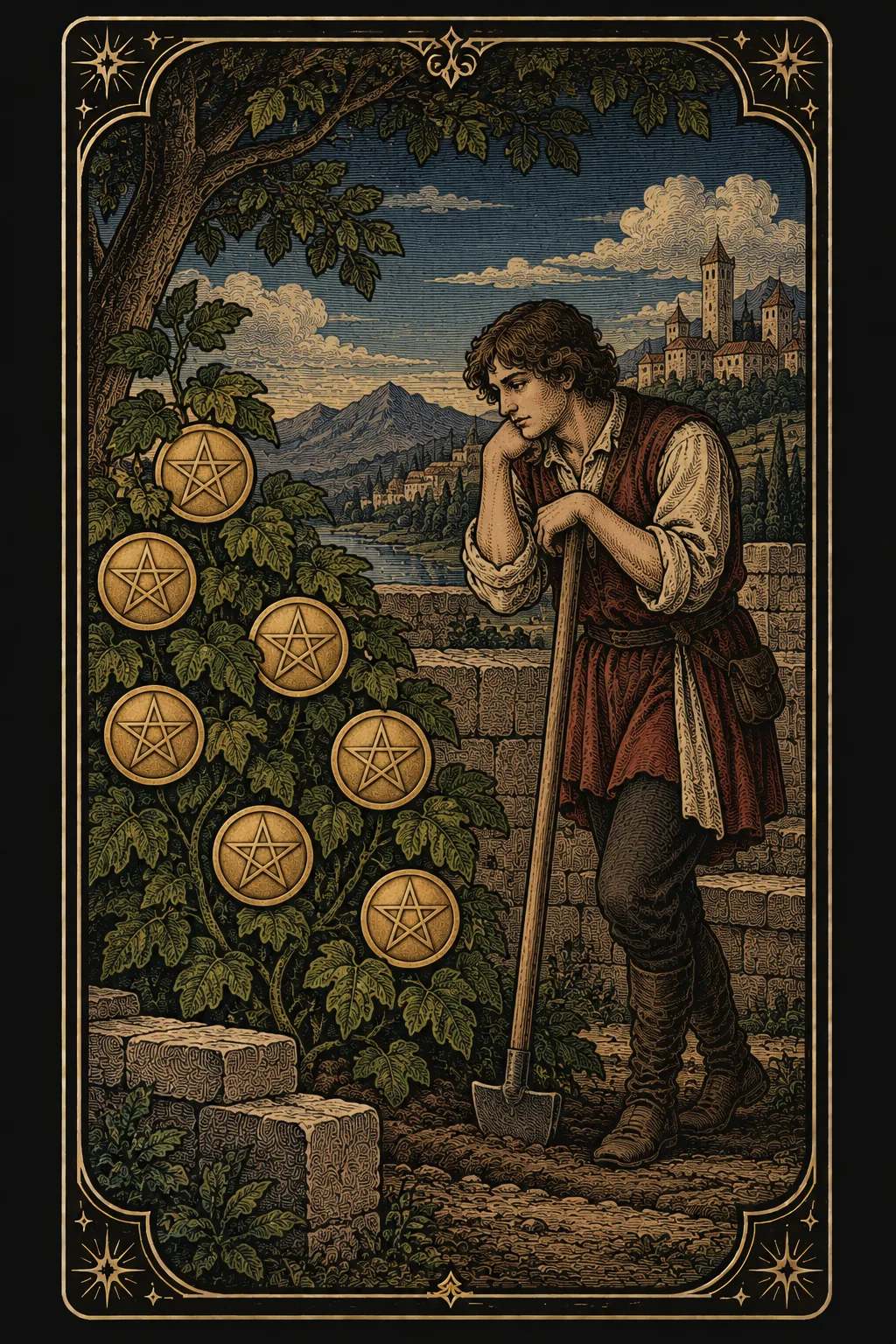
In the classical Rider–Waite image, a figure leans on a hoe and looks at a bush or vine on which pentacles are growing. The fruit has not yet been picked, but it can already be seen.
Tradition links this scene with work already done and with a pause of assessment. The pose is more contemplative than victorious. In a reading, the look at the result of investment matters, not an endless allegory of a garden. The traditional image explains the theme of review. It does not claim that TARORIA’s drawing copies Rider–Waite.
Combinations with other cards
Next to the Hanged Man, the Seven strengthens a pause: to assess what has been invested, another angle is needed, not acceleration. With Judgement, a theme of honest review appears — to name what has grown, without self-consolation. With the World, a question of the cycle arises: close a stage, carry the experience farther, or not confuse completeness with a habit of dragging the old.
Neighboring cards show whether this is genuine waiting or getting stuck. The decision to continue or to change the method is not one the card makes for a person.
Frequently asked questions
Does the Seven of Pentacles advise simply waiting?
No. Waiting can be part of the period, but the sense of the card is to assess labor already invested. Whether it is worth continuing in the same way, what has grown, what has not. Patience without checking the result easily becomes inertia.
How do I tell useful patience from getting stuck?
By the facts of an interim shift. If over a clear stretch a change is visible — a skill, a sum, an agreement, a partner’s behavior — waiting still means something. If a great deal of energy is going in and the situation is the same, the card is more about reviewing the method than about another round of simply holding on.
What does the Seven of Pentacles mean in a long project?
Often a moment of review: part of the work is done, the outcome is not yet settled. Upright proposes checking progress. Reversed, the card can speak of a weak return, impatience, or continuing only because of time already spent.
If the card is reversed, should I drop everything?
Not necessarily. The reversed Seven asks you not to keep investing in a direction only because much has already been put into it. Sometimes it is enough to change the method. The decision to stop or to continue otherwise depends on the question and the real results, not on one card.