Eight of Pentacles — tarot card meaning
Minor Arcana
Eight of Pentacles
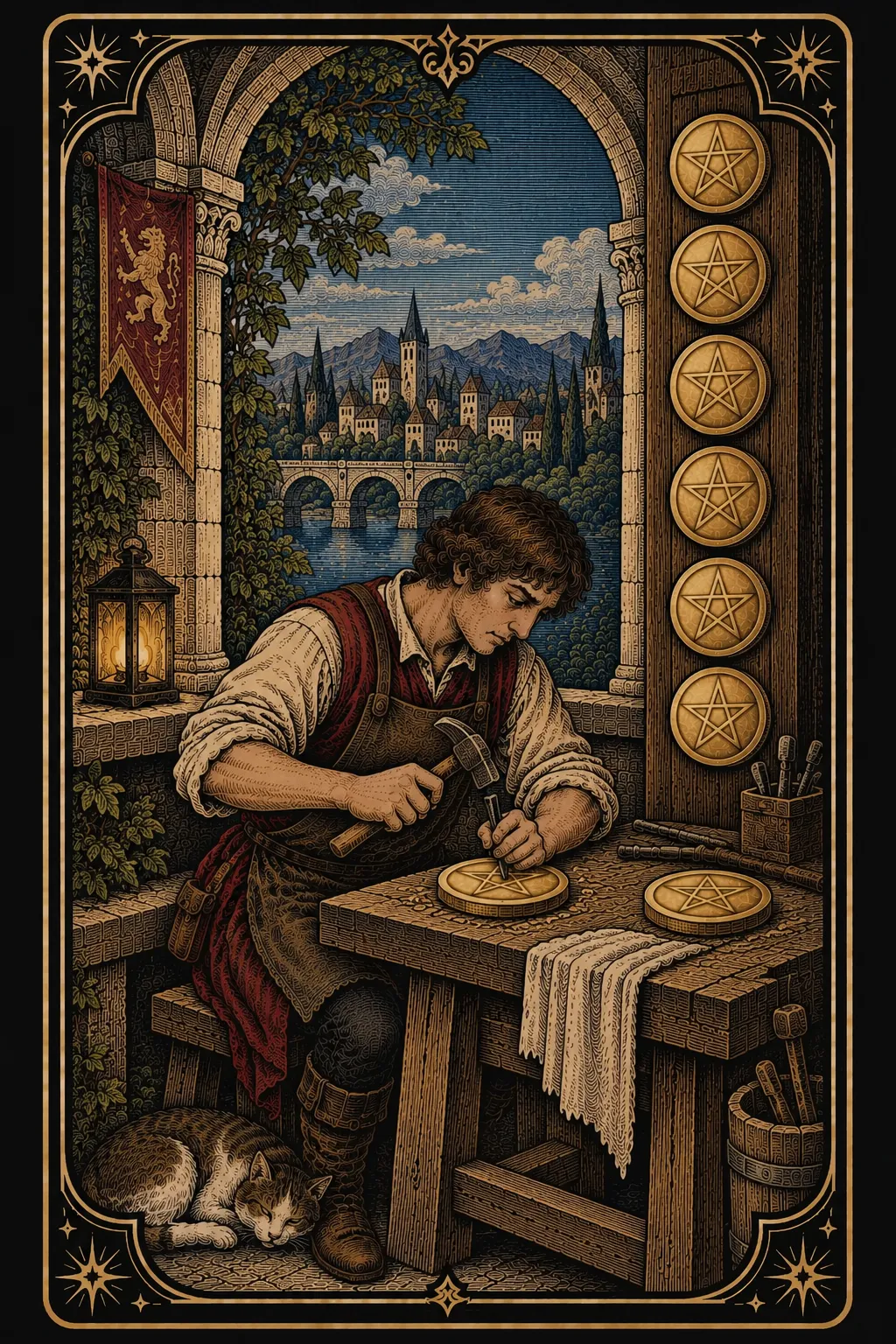
The Eight of Pentacles is read through repetition. A person takes a concrete skill and returns to it again and again, until the movement becomes more confident and the mistakes more understandable.
This is not a scene of team agreement. There is usually no distribution of roles here, and no other person’s drawing. There is individual practice: a student at a tool, a specialist at a detail, a person who improves one ability rather than trying to become better at everything at once.
General meaning
The general tone of the spread is learning by doing. A program, a language, handwork, a professional technique, a portfolio gathered study by study. Quality grows not from one fortunate evening, but from regularity.
The card respects discipline, but it does not romanticize routine. Repetition without attention becomes a stamp. Neighboring cards will tell whether this is genuine training or a mechanical circling in place.
Upright
Upright shows that a person is becoming stronger in a matter through practice. You can learn an interface, review mistakes after each attempt, polish a text, drill a gesture, gather a body of work, take a profession step by step.
The upright Eight praises not talent, but coming back: you sat down and did it again, noticed a weak place, corrected it. The result may still be modest. What matters is the chosen skill and the rhythm in which it grows.
Reversed
The reversed Eight is rarely reduced to laziness. More often a person repeats the same thing without developing: sloppy work, distraction, study without application, perfectionism that will not let you finish, or a narrow fixation on a detail at the expense of the whole.
Sometimes interest in regular practice has simply run out, and a person imitates being busy. The reversed card asks whether you are still learning from the repetitions — or already stamping a gesture that is long due to be changed.
Love and relationships
In love it is dangerous to read the Eight as “you have to grind at the relationship.” A closer sense is a readiness, day by day, to hear the person nearby a little better. To notice what tires them. To change your own repeating unsuccessful habit, rather than promising “from Monday.”
Upright can speak of attention to household small things from which warmth is made: how you say goodbye, how you share an evening, how you answer in a small quarrel. Reversed, the card shows a mechanical script — the same blow-ups, the same excuses, a partner as background while you are occupied with your ritual. Look at whether you are learning from shared experience, or reproducing the same gesture without looking at a living person.
Work and career
For work this is one of the main sections. Upright can describe raising qualification, specialization, care, regular labor, a portfolio, an internship in which quality matters more than effect. A person hones a concrete competence: code, a seam, a method, a tool, a professional language.
Career success is not something the card promises. The reversed Eight points to work on autopilot, mistakes from inattention, study that does not turn into practice, or perfectionism because of which delivery is endlessly postponed. It is useful to choose one skill and a criterion of quality, rather than improving everything at once.
Money and finances
In money questions the Eight is linked first of all with an ability for which pay can be received, and with the quality of labor. Upright can describe expenses on study, a period when income depends on regular work, a need to strengthen a skill that already affects earnings.
Growth of income is not something the card promises. Reversed more often shows that the financial return suffers from raw quality, distraction, or study that is not applied. It makes sense to look at which skill is actually linked with money now — and what in it is worth improving, without a bet on a quick rise in the sum.
Advice
Choose one concrete skill and practice it regularly. After each attempt, note what to correct next time.
Do not try to become better in every direction at once. Narrow, honest training moves farther than a vague wish to “level up as a whole.”
Symbolism
In the classical Rider–Waite image, a seated craftsperson works on a pentacle at a bench. Other pentacles hang nearby as a sequence of completed pieces.
Tradition links this scene with repeating one action and with gradual improvement. The number of coins on the card is read not as wealth, but as a series of attempts. In a reading, the rhythm of labor matters, not a romantic image of a workshop. The traditional image explains the theme of practice. It does not claim that TARORIA’s drawing copies Rider–Waite.
Combinations with other cards
Next to Strength, the Eight underlines gentle discipline: returning to practice without breaking yourself with hardness. With the Chariot, regularity gets a direction — a skill has been chosen, and attention does not scatter across ten aims. With the Sun, it becomes clearer that repetition is already giving genuine growth of quality; this is not a guarantee of recognition, but clearer feedback from the work itself.
Neighboring cards clarify whether this is study, specialization, or routine without development. The assessment of your own progress remains with the person.
Frequently asked questions
Is the Eight of Pentacles a card of team work?
Usually not. Here individual practice is in the foreground: repetition, skill, attention to quality. A shared matter and a distribution of roles are another accent of the suit. If the question is about a team, look at whether the card is simply saying “I need to do my part better.”
Does the card mean study and courses?
Often yes: qualification, a program, a language, training a technique, reviewing mistakes. Study without application is more a reversed tone. Upright supports learning that is checked at once by the work, not a collection of certificates.
What does the Eight of Pentacles say about perfectionism?
This is one of the reversed shades: a detail matters more than completion, the work is not handed over because it is “not yet perfect.” The upright card is more about care inside a living rhythm. Look at whether exactingness helps quality, or gets in the way of finishing.
If I practice, will the money grow?
The card does not promise that. It links the financial theme with skill and the quality of labor: study, regular work, an ability that already affects earnings. The return depends on conditions and application, not on one Eight.