Nine of Pentacles — tarot card meaning
Minor Arcana
Nine of Pentacles
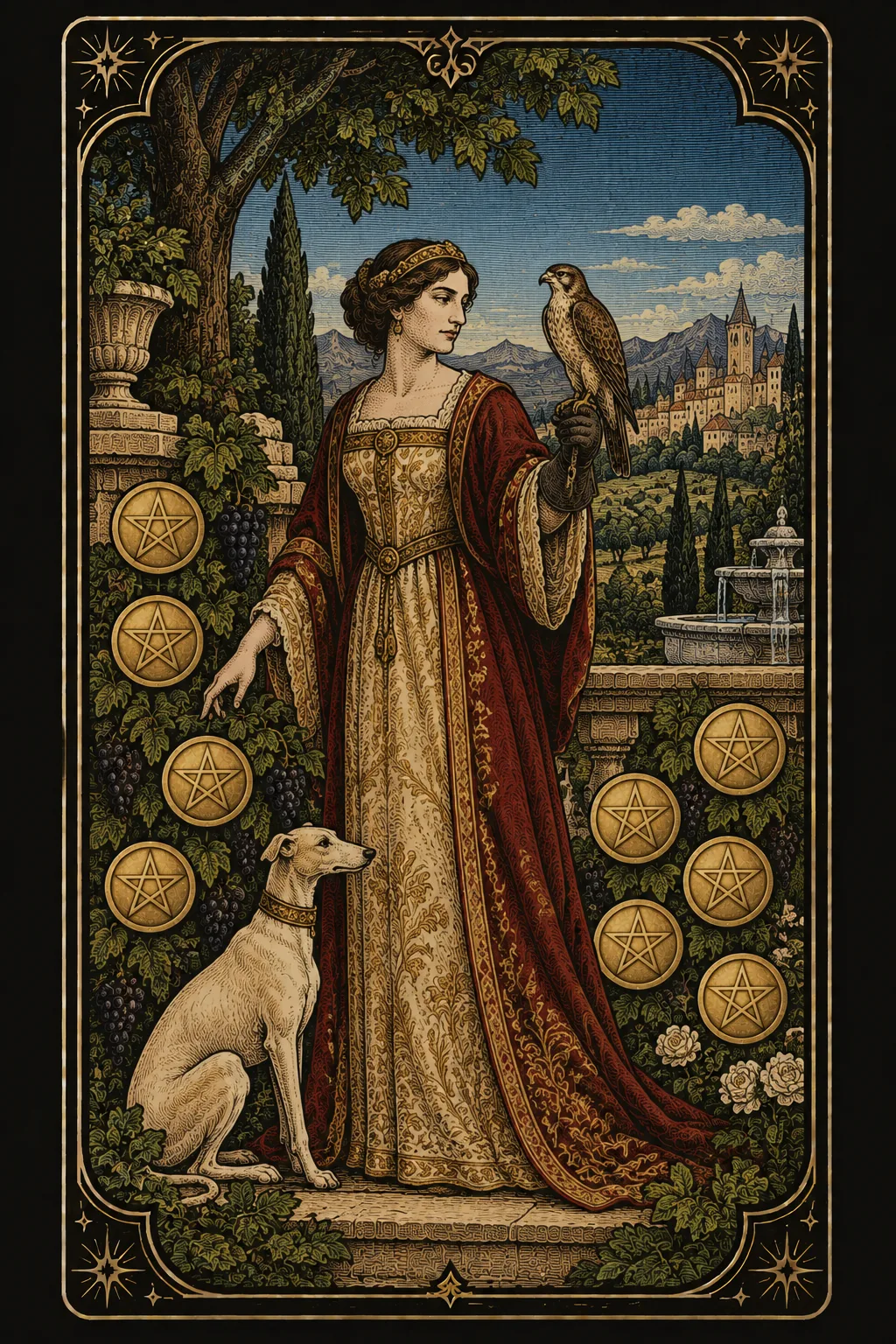
The Nine of Pentacles describes steadiness that a person has largely gathered themselves: a skill, income, housing, a rhythm, an ability to manage on their own. In a spread this is more often about “mine” — not about a family system and not about shared capital.
The image is easy to collapse into a portrait of a well-off woman in a garden. It is more accurate to look at sufficiency: a result of labor is already there, and the question is whether you know how to use it, without staging status and without postponing life “until later.”
General meaning
If you look at the situation as a whole, the Nine marks a personal footing. A person can provide themselves comfort, hold a household, manage time and money without a constant need for another person’s decision. Independence here does not have to be isolation: you can be near people and still not make them the only source of safety.
Neighboring cards will tell whether this is genuine sufficiency or a display. Sometimes the outer level of life runs ahead of the base. Sometimes the base is there and enjoyment is not: a person keeps grinding as if the result did not yet exist.
Upright
Upright more often shows independence with a foundation. Work already done has borne fruit: a skill, a reserve, housing, a rhythm in which you can breathe out. The comfort is not accidental — it was gathered by attention, discipline, a refusal of other people’s scripts.
The upright Nine supports an ability to use what is yours: to spend without guilt, to rest without a sense that you are “going soft,” to hold boundaries around time and money. Independence sounds calm if room for closeness remains nearby — it simply does not buy you the right to exist.
Reversed
Reversed often concerns a crack under a handsome surface. Comfort is there, and a sense of safety is not. Either the image of independence is held by another person’s support, debt, status spending. Or a person cannot use what they have already earned: everything goes into display, into anxiety, into the next aim.
The other tone is self-worth tied too tightly to a level of money. Until the figure or the interior “measures up,” it is as if living is not allowed. The reversed Nine does not assign ruin. It asks whose this steadiness actually is, and whether it lets you be in your life, not only to service it.
Love and relationships
In close relationships the Nine raises the theme of your own footing. A person can be warm and loyal and still not dissolve: they keep money, friends, housing, occupations, a taste for their own space. The upright sense is not equal to loneliness. Often it is precisely a capacity to be nearby without making a partner the only source of calm.
Reversed, the card shows a skew. Someone performs independence and inside holds on only to the bond. Someone will not let anyone close, confusing independence with coldness. Sometimes a relationship finances another person’s comfort, and then “my steadiness” turns out to be someone else’s display. Look at whether it is possible in this couple to keep what is yours without punishing each other for separateness.
Work and career
At work, upright can describe competence, gathered experience, a format with more autonomy: your own zone of responsibility, a clear contribution, an ability to run a matter without constant guardianship. A person is no longer a beginner in the craft — and that is felt in the quality.
A promotion and a high salary are not something the card promises. The reversed Nine sometimes notes a specialist who looks established and inside depends on another person’s approval, the status of a post, or the outer polish of a project. It is useful to tell real autonomy from a role that has to be played in order to seem “in place.”
Money and finances
In money questions the Nine looks at personal steadiness: a reserve you have gathered, an ability to allow yourself needed comfort, a calm handling of what is already there. Upright can describe a period when income and household life finally begin to match the labor invested — without a demand to look richer than you are.
Wealth is not something the card promises. Reversed more often shows spending for an image, dependence on another person’s resource behind a facade of “I do it myself,” or an inability to use a reserve from anxiety. It makes sense to ask what your comfort rests on — facts, or a need to seem successful.
Advice
Name what has already been created by your hands: a skill, a reserve, housing, a rhythm, a right to use your time as you choose. Then check whether you are using it — or postponing life again until the next aim.
Sufficiency does not begin with a new peak. It begins with permission to lean on what has already been done, without losing a taste for movement.
Symbolism
In the classical Rider–Waite image, a figure stands in a garden or vineyard among pentacles. A falcon often sits on a gloved hand. The space looks tended; the harvest is not someone else’s.
Tradition links this scene with a personal fruit of labor, and the falcon with trained attention and discipline that has not been left to chance. In a reading, the garden as “mine,” gathered by effort, matters more than an allegory of predatory power. The traditional image explains the theme of self-reliance. It does not claim that TARORIA’s drawing copies Rider–Waite.
Combinations with other cards
Next to the Empress, the Nine strengthens the theme of ripeness: a result can not only be saved, but lived — in the body, the home, the taste of everyday life. With the Hermit, independence risks shrinking into loneliness: a footing is there, and warm exchange is not. With the Devil, comfort easily sits on dependence — on status, other people’s money, a habit of buying a sense of worth.
Neighboring cards show whose this steadiness is, and whether it can be used. The Nine itself does not close the question of closeness and does not assign wealth.
Frequently asked questions
Does the Nine of Pentacles mean loneliness?
Not necessarily. Often it is about your own footing inside a life — including inside a relationship. A person can be close with a partner and not dissolve in them. Loneliness becomes a theme if independence is confused with a refusal of warmth. Look at the question and neighboring cards.
Does the card mean wealth?
No. The Nine describes personal sufficiency and an ability to use a result of labor: a reserve, comfort, autonomy. This is not a promise of large capital. Sometimes the outer level of life looks higher than the base — especially reversed.
How is the Nine of Pentacles different from the Ten?
The Nine is about “mine”: my steadiness, my skill, my income, my space. The Ten is about what is shared and long: family, property, a system that is not held by one person. Confusing them means reading personal comfort as an inheritance, or the reverse.
What does the reversed Nine show?
Often comfort without a sense of safety, dependence behind an image of independence, spending for status, or an inability to enjoy what has already been earned. This is not a verdict of losing money. Ask what your steadiness rests on, and whether you let yourself use it.