Ten of Pentacles — tarot card meaning
Minor Arcana
Ten of Pentacles
The Ten of Pentacles looks farther than personal comfort. Here appears what is held by several people and calculated for more than one season: a home, a family way of life, shared property, agreements that outlast a single stage of life.
The card is habitually reduced to a “rich family” or an inheritance. It is more accurate to read a long-term material system — with its footing, rules, and conflicts. Not every stable house is full of money. Not every tradition is worth continuing.
General meaning
In the wide frame of a spread, the Ten describes continuity. Someone has already created a structure before you. Someone is creating it now — for children, parents, a partner, a team, a future self in ten years. The resource is shared: housing, a budget, a family’s reputation, a family business, a familiar way of “this is how we do it.”
Strain begins when the system presses. The expectations of elders, a dispute over property, a contribution that is not recognized. Neighboring cards help you tell genuine ground from a facade of well-being inside which people do not agree.
Upright
Upright more often shows a working structure. There is property, or at least a clear shared order. There are people among whom roles are distributed. Gathered experience — professional or family — can be passed farther.
The upright Ten supports long-term safety as a process, not as a windfall. Results can outlast a single crisis if they are not confused with a display of wealth. Look at whom this steadiness feeds — and whether it is held only by one person who can no longer bear it.
Reversed
The reversed Ten is often about a crack in what is shared. Conflict around money and housing. A family budget that looks whole from outside and crumbles in conversation. A tradition that no longer helps, and requires silence.
Pressure of expectations is a separate story: whom to be, whom to marry, which profession to choose so as “not to let people down.” The reversed card does not predict death and does not hand out an inheritance. It asks whose this system is, and whether it is possible to live in it without breaking yourself for an image of steadiness.
Love and relationships
In love the Ten is more often about the arrangement of a shared life than about a flare of feeling. A home, household agreements, family, plans that are counted in years, not weeks. Shared resources: who pays, who keeps the household, how people relate to parents, what is considered “ours.”
Upright is not read automatically as marriage. Sometimes this is a readiness to build a long household. Reversed, the card shows a dispute over money and property, different pictures of family, pressure from relatives. Look at whether people’s horizons match — or whether one wants a home and continuity, and the other is not yet ready to carry what is shared.
Work and career
At work, upright can describe a stable organization, a family matter, a career with a long horizon, a setting in which continuity matters: mentorship, gathered professional capital, rules that hold a team.
The reversed Ten sometimes notes clannishness, conflict around “whose this place is,” a system that looks solid and inside which people pull in different directions. A position and a share in a business are not something the card promises. It is useful to ask whether you are working inside a structure that still works — or servicing a tradition that no longer feeds the work.
Money and finances
In money questions the Ten speaks of what is shared: a family budget, property, the resources of several people, planning for years. Upright can describe an order in which money and things are secured by agreement, not by the mood of one month.
An inheritance and large capital are not something the card promises. Reversed more often shows a dispute over property, a hidden hole in a shared budget, a contribution one person considers fair and another considers exploitation. It makes sense to look at whose these assets actually are, and whether the rules have been named, without fantasies of a sudden fortune.
Advice
Shift the look from the nearest result. What of what is being created today should work in several years — and for whom besides you?
If a system is already there, check whether it is living or only familiar. The long does not have to be dead. But “this is how it is done” by itself still does not make a structure fair.
Symbolism
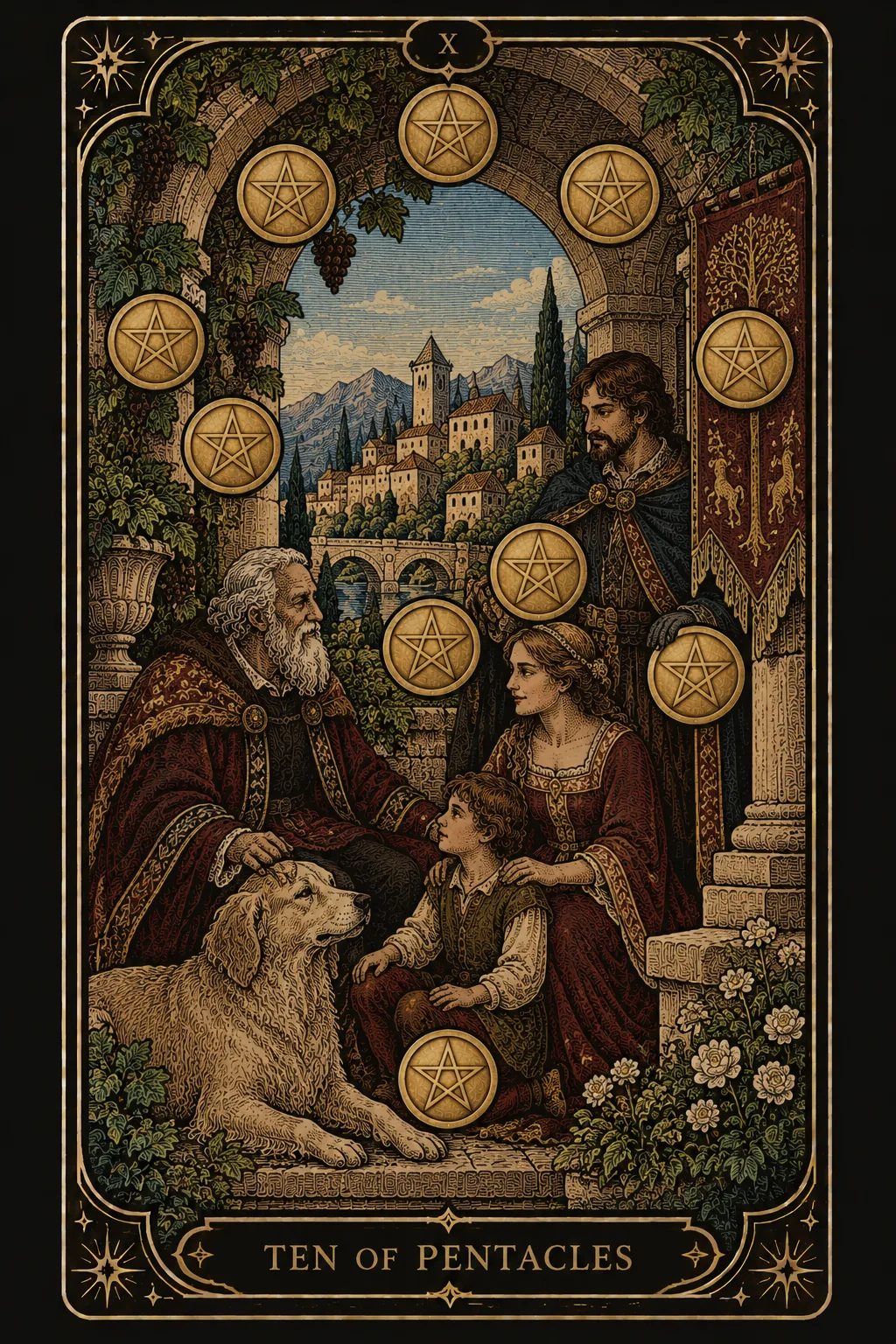
In the classical Rider–Waite image, several generations appear together: an elder, adults, a child, two dogs, the architecture of a house or archway, and ten pentacles arranged across the scene.
Tradition links this composition with the steadiness of a lineage and a place, not with a display of wealth. Dogs and a threshold are associated with a home, loyalty to a way of life, a boundary of “one’s own.” In a reading, the story of continuity matters: who enters the system, who holds it, to whom it will pass through care — not a list of valuables on a wall. The traditional scene explains the theme of family and continuity. It does not claim that TARORIA’s drawing copies Rider–Waite.
Combinations with other cards
Next to the Hierophant, the Ten sharpens the theme of tradition: family rules, a ritual of “how it should be,” which can both hold and suffocate. With the Emperor, a structure of property and roles comes forward — order is useful while it does not turn into control over everyone. With Justice, a dispute over contribution and property needs named terms, not a silent grievance.
Neighboring cards show whether this is genuine ground or the pressure of a system. The decision of what to continue and what to refuse is not one the card makes for a person.
Frequently asked questions
Does the Ten of Pentacles promise an inheritance?
No. The card can touch family resources, property, continuity, but it does not hand out capital and does not predict death. Often it is about how a shared material life is already arranged now. Look at the facts of the question, not at a story of a will.
Does it mean marriage or family?
It can describe a long-term arrangement of a shared life, a home, household agreements, a tie with relatives. This is not an automatic forecast of a wedding. Upright supports the theme of a shared way of life. Reversed — conflicts around how that life should be arranged.
Why is the Ten confused with large money?
Because the image has many pentacles and a “solid” family scene. The sense of the card is a long system, not a sum. A stable house can be modest. An outwardly rich structure can be empty if there is no agreement inside.
What does the reversed Ten of Pentacles show?
Often conflict around shared resources, a shaky family budget, a dispute over property, pressure of expectations, a tradition that has stopped helping. Outer steadiness may still remain. Look at who carries the system, and whether it is possible to breathe in it.