Page of Pentacles — tarot card meaning
Minor Arcana
Page of Pentacles
The Page of Pentacles marks a moment when practical interest becomes study. A subject has appeared — a craft, a profession, the arrangement of money, a tool — and a person begins to work out how to handle it.
This is not the Ace. The Ace offers an opening: a chance, a resource, a first sense that something is possible. The Page has already turned toward the work and is learning. Curiosity is still fresh, but without practice, that interest will remain only an intention.
General meaning
The Page more often appears where a base is needed. A course, an internship, a new specialization, a first independent experience, a beginner’s attentiveness, a plan that still needs to be tested in practice. A person is ready to ask “stupid” questions — and that is their strength, if the questions do not replace practice.
Neighboring cards clarify whether this is genuine interest or a collection of started programs. Sometimes the Page is about learning how money works: how the terms are arranged, what an obligation is, where your own budget begins.
Upright
Upright, a readiness to learn looks concrete. A person examines details, masters a tool, is not ashamed of being at the start. The first steps are still awkward, but the direction is practical: not a dream of “someday,” but an occupation you can return to tomorrow.
The upright Page supports apprenticeship without a hurry to perform expertise. Questions are fitting. Mistakes are part of the base. The main thing is that the interest not stay in the head: the skill has to be practiced, tested, and applied on a small scale.
Reversed
The reversed Page often gets stuck before practice. Endless preparation, courses without application, distraction, a wish for a result while refusing to master a boring base. It is as if the person is still “about to begin,” though the notebook is already full of notes.
Carelessness with details is the other pole: interest flared, and a beginner’s discipline did not switch on. The reversed card does not make you lazy. It asks whether you are learning the matter — or collecting a feeling that you are about to become competent.
Love and relationships
In love the Page is read from the practical side. A person is learning to be in a bond: to remember agreements, to show interest through deeds, to learn how to share the practical responsibilities of a life together. Inexperience is possible — and it does not have to be age. Sometimes an adult is learning for the first time to meet close obligations through reliable action, not through mood alone.
Upright does not promise a message and does not send a “young partner.” Reversed, the card shows interest without a step: hints, plans that are never put into action, an inability to translate sympathy into a reliable gesture. Look at whether the relationship is being learned through small, repeated actions — or whether everything remains at the level of intention.
Work and career
For work this is one of the most direct sections. An internship, first experience, a new specialization, a course, learning in practice, starting a profession from scratch or almost from scratch. Upright supports the role of a student: asking questions, examining a tool, not performing confidence beyond the facts.
The reversed Page at work often concerns study that does not turn into a task, or a beginner who already wants status without a base. The card does not guarantee a career outcome. It is useful to choose one competence and check it by doing this week, rather than collecting programs “just in case.”
Money and finances
In money questions the Page is about learning to handle money. First independent decisions, a need to understand terms before you sign, interest in how a payment, a tax, an installment, your own accounting is arranged. Upright can describe a period when financial literacy is still being developed.
The card does not give financial advice and does not promise income from study. Reversed more often shows action without examining the terms, or, on the contrary, endless study of a theme without a single step. It makes sense first to understand the rules of the concrete situation — and only then make a financial commitment that cannot easily be undone.
Advice
Stop waiting for the moment when you will know everything. Choose a base — one skill, one tool, one clear volume of practice — and begin applying it on a small scale.
Curiosity is valuable while it meets the actual work. Notes without doing quickly become a way not to begin.
Symbolism
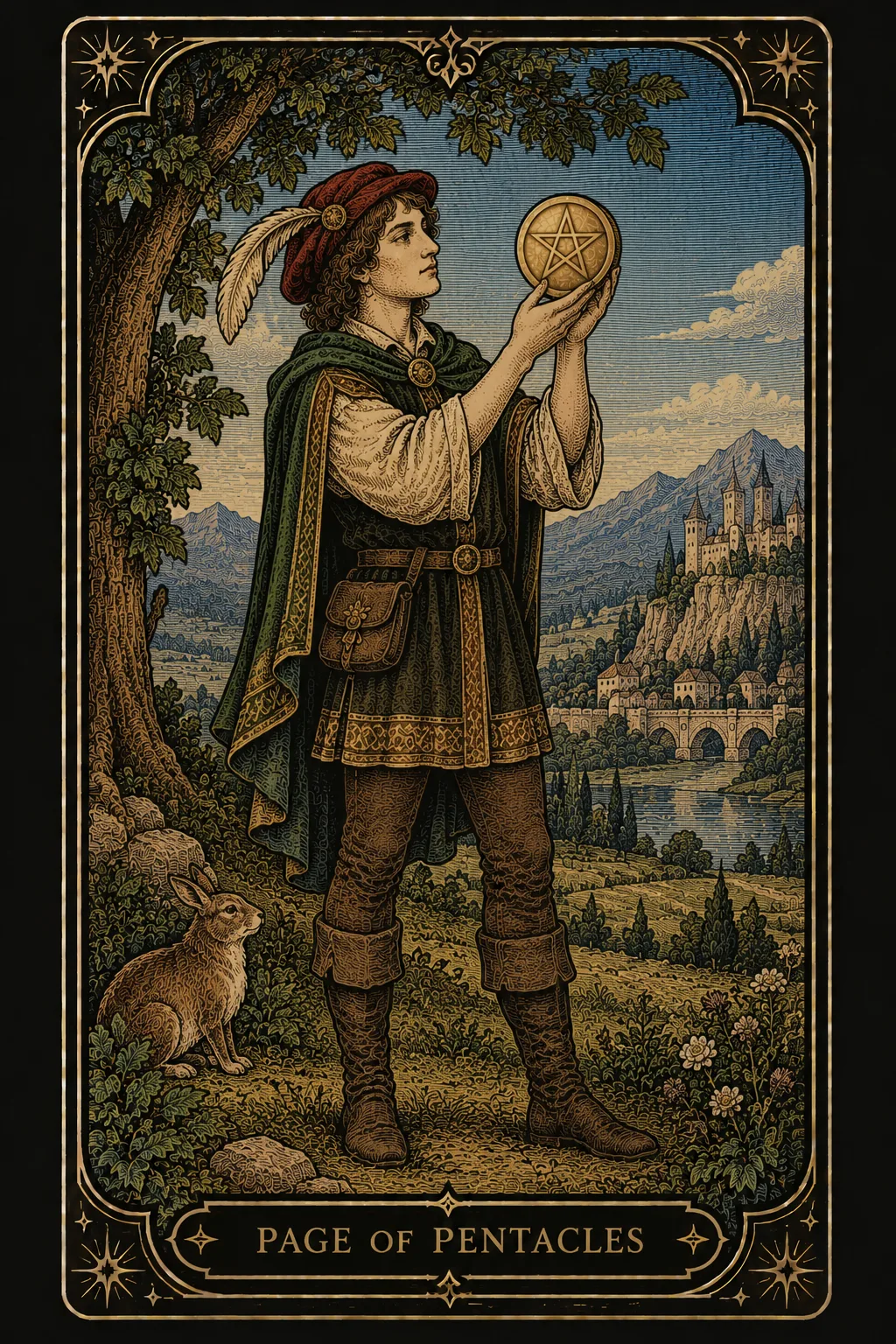
In the classical Rider–Waite image, a young-looking figure stands, looking attentively at a pentacle held in the hands, as if it were a subject of study rather than a prize. The landscape is calm; the gesture is concentrated.
Tradition links this pose with a student: interest is already there, mastery is still ahead. The age of the figure does not assign a particular person in your life. The traditional image explains the theme of learning. It does not claim that TARORIA’s drawing copies Rider–Waite.
Combinations with other cards
Next to the Magician, the Page gets a direction: interest can become a first action, if study is not replaced by a display of will. With the Fool, it is easy to begin too widely — enthusiasm is there, a base is not; it is useful to narrow the subject. With the Moon, attention scatters: courses multiply, and practice still has not settled on one area.
Neighboring cards show whether this is study or an endless “I’ll prepare a little more.” The assessment of your own readiness to act remains with the person.
Frequently asked questions
Does the Page of Pentacles mean a concrete young person?
Not necessarily. Often this is the role of a student: interest in a practical matter, first experience, attention to a base. The age and gender of the card do not assign a person in your life. Look at who is mastering a skill now — you, a partner, a colleague — rather than searching for a young person by age.
Is the Page linked with learning?
Very often yes: a course, an internship, a new profession, mastering a tool, first independent steps. Upright supports study that is checked by doing. Reversed — preparation without practice, or carelessness with the base.
How is the Page of Pentacles different from the Ace?
The Ace is the appearance of a possibility or a resource. The Page is a person beginning to learn how to handle it. A chance is not yet equal to a skill. If both are in the spread, it is useful to ask: what exactly has appeared, and who has already begun to learn it.
Why is the reversed Page so often about courses?
Because interest without application easily turns into a collection of beginnings. A person prepares, signs up, takes notes — and does not reach the tool. This is one of the characteristic tones, not the only one. Look at whether there is even small practice this week.