Knight of Pentacles — tarot card meaning
Minor Arcana
Knight of Pentacles
The Knight of Pentacles holds the pace of an obligation. A matter has already been chosen, and what decides next is not a flare of interest, but whether you return to it on time and do what was promised.
It is easy to confuse with the Eight. The Eight hones a skill through repetition. The Knight carries an obligation: a schedule, a contract, a route that cannot be dropped every time inspiration has gone. Reliability and a clear step matter here, not virtuosity of gesture.
General meaning
In a spread, consistency comes to the fore. Regular work, responsibility, method, carrying out what was agreed. The pace is calm — not because a person is weak, but because haste breaks a structure they have taken on to finish.
Neighboring cards will show whether this is genuine discipline or stagnation. Sometimes a plan has long been dead, and a person continues to execute it because “this is how it is done.” Sometimes, on the contrary, only such regularity still keeps the situation from falling apart.
Upright
Upright is more often about reliability in a matter. A person appears when they said they would. They do the volume they promised. They do not need a new stimulus every day in order to open the task. The pace may be restrained — but it can be explained: what today, what this week, where the limit is.
The upright Knight respects responsibility without a theater of heroism. Method here is a working tool. If the question is “can this person be leaned on,” the card more often describes repeating behavior, not an oath.
Reversed
The reversed Knight often gets stuck in the familiar. Routine without sense, excessive caution, stubbornness, an inability to shift a plan even when the circumstances are already different. Stability becomes a pretext for changing nothing.
The other tone is carrying out duties on autopilot: deadlines are formally closed, genuine involvement is not there. The reversed card does not brand a person with laziness. It asks whether the discipline serves an aim — or whether the aim has long been serving the schedule.
Love and relationships
In love the Knight’s reliability shows not in fine words, but in repeating deeds: writing, arriving, closing a household task, remembering an agreement. Upright can describe a bond in which a person can be counted on in ordinary days. This is not an automatic portrait of a “faithful man” and not a forecast of a wedding.
Reversed, the card shows how household life crowds out living contact. A scenario that is too predictable, a refusal of change even when it is due, a partner as an item in a schedule. Look at whether the regularity warms, or already replaces conversation. Feeling does not have to be stormy — but it should not disappear inside perfectly performed duties.
Work and career
For work this is a strong accent. Discipline, deadlines, responsibility, a process that requires returning to the same thing without drama. Upright can describe a person on whom the regular part of a matter rests: reporting, a shift, a long project with clear milestones.
The reversed Knight at work sometimes concerns stagnation under the look of stability, resistance to any new method, stubbornness of “we have always done it this way.” A promotion is not something the card promises. It is useful to check whether the chosen rhythm is still alive — and whether deadlines have become the only sense of being occupied.
Money and finances
In money questions the Knight is linked with going by plan: closing obligations, keeping a clear rhythm of payments, not replacing discipline with bursts. Upright can describe a calm handling of resources, when a person does what they agreed with themselves or with others.
Accumulation of a concrete sum is not something the card promises. Reversed more often shows either tightness — a fear of any movement of money — or formal neatness behind which there is no actual plan. It makes sense to look at the regularity of obligations, not to wait for a financial leap from the card.
Advice
Do what you agreed. And separately, at a clear interval, ask whether the plan has become an end in itself.
Reliability is alive while it serves the chosen matter. If the only argument is “that’s how it has to be,” check for whom and for what this is still needed.
Symbolism
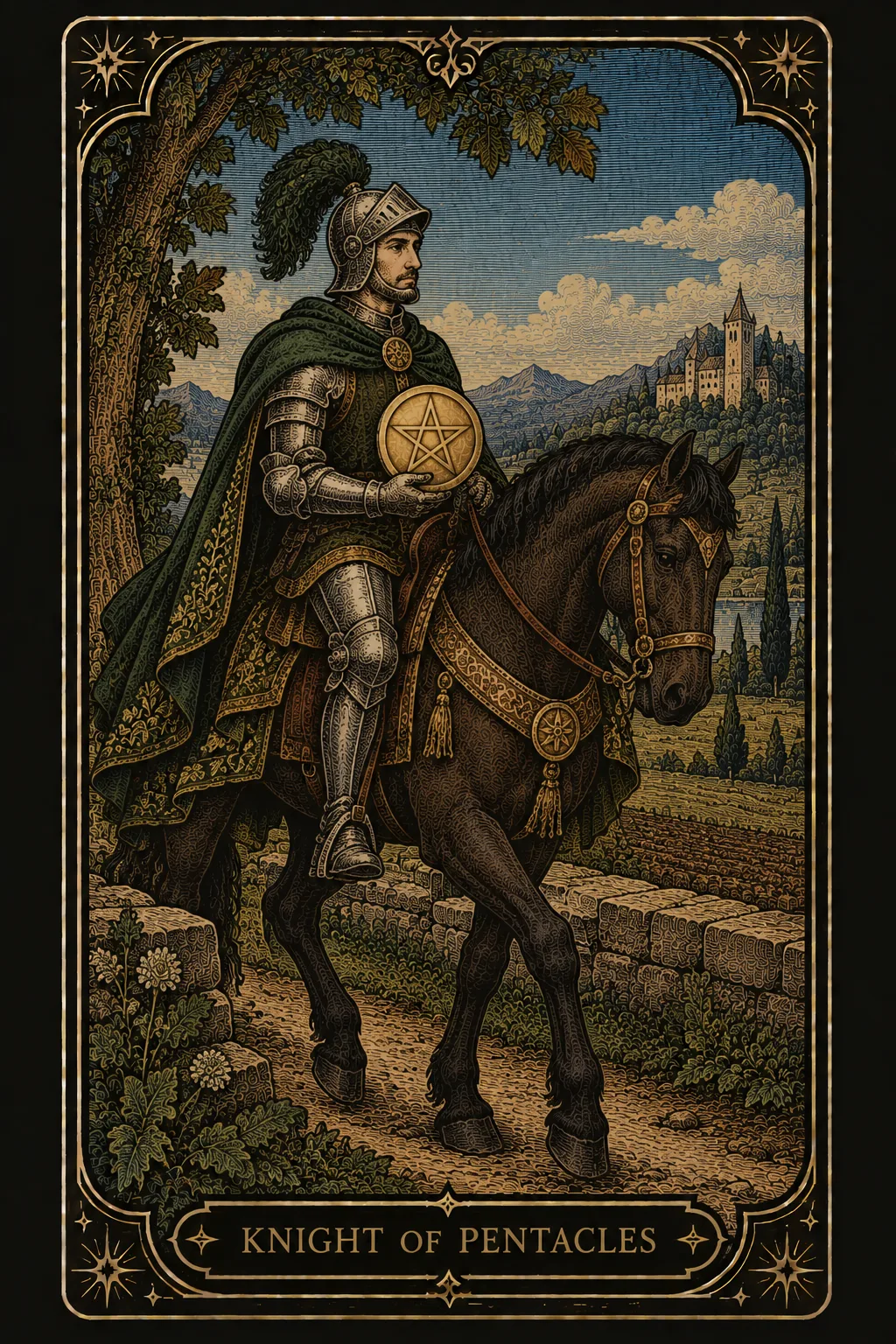
In the classical Rider–Waite image, a mounted figure sits on a heavy, nearly still horse and looks at a pentacle in the hand. Cultivated fields appear behind. Unlike the more rushing Knights of other suits, a controlled pace is visible here: there is movement, but it does not break into a gallop.
Tradition links the horse and the pause of the gesture with endurance, not with a stop of life. In a reading, the chosen rhythm of an obligation matters — without a romance of eternal slowness. The traditional image explains the theme of discipline. It does not claim that TARORIA’s drawing copies Rider–Waite.
Combinations with other cards
Next to the Chariot, the Knight argues about pace: will wants to speed up, earth wants to hold the route; together they can give movement without a break, apart — a race or standing discipline. With Temperance, regularity becomes softer: the same volume, less violence against yourself. With the Hanged Man, a plan risks hanging — a pause is useful while this is a survey, not a refusal to shift when a shift is already needed.
Neighboring cards clarify whether this is an obligation or a habit. The decision of what to carry out farther remains practical.
Frequently asked questions
Why is the Knight of Pentacles considered slow?
Because in the tradition the figure does not break from the spot: the pace is controlled, the horse is calm, the look is on the matter. Slowness here is not a sentence and not a virtue by itself. It is about a rhythm that can be held. If the question needs speed, neighboring cards will show whether such endurance is fitting.
How is the Knight different from the Eight of Pentacles?
The Eight perfects a skill through practice. The Knight carries an obligation: deadlines, a contract, regular carrying-out of what was promised. You can virtuously make a detail and still break agreements — or the reverse. Look at what the question is about: the quality of an ability, or whether the process can be leaned on.
Does the card mean a faithful partner?
No, not automatically. Upright can describe reliability in deeds: a person does what they said. Gender and the role of “husband” are not assigned by the card. Reversed sometimes shows household life without living contact. Look at deeds in your question, not at a label of faithfulness.
What does the reversed Knight of Pentacles show?
Often routine without sense, excessive caution, stubbornness, stagnation under the look of stability. A person continues a plan because that is how it is done. This is not necessarily laziness. Ask whether the discipline serves an aim, or has already replaced it.