Two of Pentacles — tarot card meaning
Minor Arcana
Two of Pentacles
The Two of Pentacles usually describes a situation in which several practical demands have to be juggled at once. In a spread this can be work and study, a changing schedule, several payments in one month, children and deadlines, a move running alongside a main job.
The card is linked with flexibility and with distributing limited resources: time, energy, money, attention. The question is not an abstract gift for “doing everything at once,” but which loads are competing now, and which of them can still be carried.
General meaning
In the broader spread, the Two of Pentacles points to a movable period: priorities shift, the rhythm is uneven, you have to adapt. A person can manage if they see what matters today, and what can wait.
Sometimes the card speaks of temporary financial unevenness, or of a household that has not yet settled: a side job plus the main work, repairs alongside ordinary duties, freelance with irregular tasks. Next to cards of strain, the Two often warns that flexibility is already close to overload. Next to cards of order — that it makes sense to set payments, deadlines, and roles more clearly.
Upright
Upright, a person is usually still managing through flexibility, but the situation needs attention. Several matters can be kept up if you do not pretend they are all equally urgent.
The upright Two can accompany combining projects, an uneven schedule, a need to switch quickly, planning a week so that there is enough for work and for home. Adaptation matters more now than a rigid plan.
Reversed
Reversed, combining becomes harder. The reversed Two can describe overload, too many obligations, a budget that no longer adds up, chaotic switching between tasks, tiredness from constant maneuvering.
Priorities may be set wrongly: the urgent crowds out the important, and the secondary fills the whole day. The reversed card does not mean a total collapse. It more often shows that the current set of demands can no longer be carried without loss — and it is time to let something go for a while.
Love and relationships
In love, upright is often about finding time for each other. A relationship has to sit beside work, study, children, distance, shifts, or other duties. For a couple this can be a need to renegotiate household life and meetings when the rhythm of life has changed.
Reversed, a partner may get only leftover attention: after deadlines, trips, and household tasks, almost nothing remains for closeness. The load creates tension even if the feeling has not gone. The card itself does not point to a third person. Look at whether the bond has a real place in the schedule — or exists only in promises of “later.”
Work and career
At work, upright often concerns several projects at once, combining duties, a changing schedule, tight deadlines. A person may be useful precisely through flexibility — if it is still clear which task is the main one this week.
Reversed, it points to scattering: too many roles, constant urgent requests, an inability to take a task through to the end. It is useful to ask which obligations you took on automatically, and which of them can be moved, delegated, or set down for a time.
Money and finances
In money questions the Two is especially concrete: income and expenses have to be matched, payments spread across dates, several obligations in one period taken into account. Upright can describe an unstable income that can still be distributed, or a limited budget that needs flexible planning.
Reversed, it speaks of payments stacking on one another, spending without regard to dates, a budget that stops adding up because there are too many small obligations. The card does not advise risky moves “in order to even things out.” It makes sense to write down the sums and dates — and see what you can actually carry now.
Advice
Name two or three priorities that really have to be held, and name what you can let go of for a time. Flexibility helps while you can still see the limits of your energy and your budget.
If everything seems equally urgent, make a simple order: what cannot move, what can be postponed, what is not yours at all. Otherwise constant switching itself becomes the main work.
Symbolism
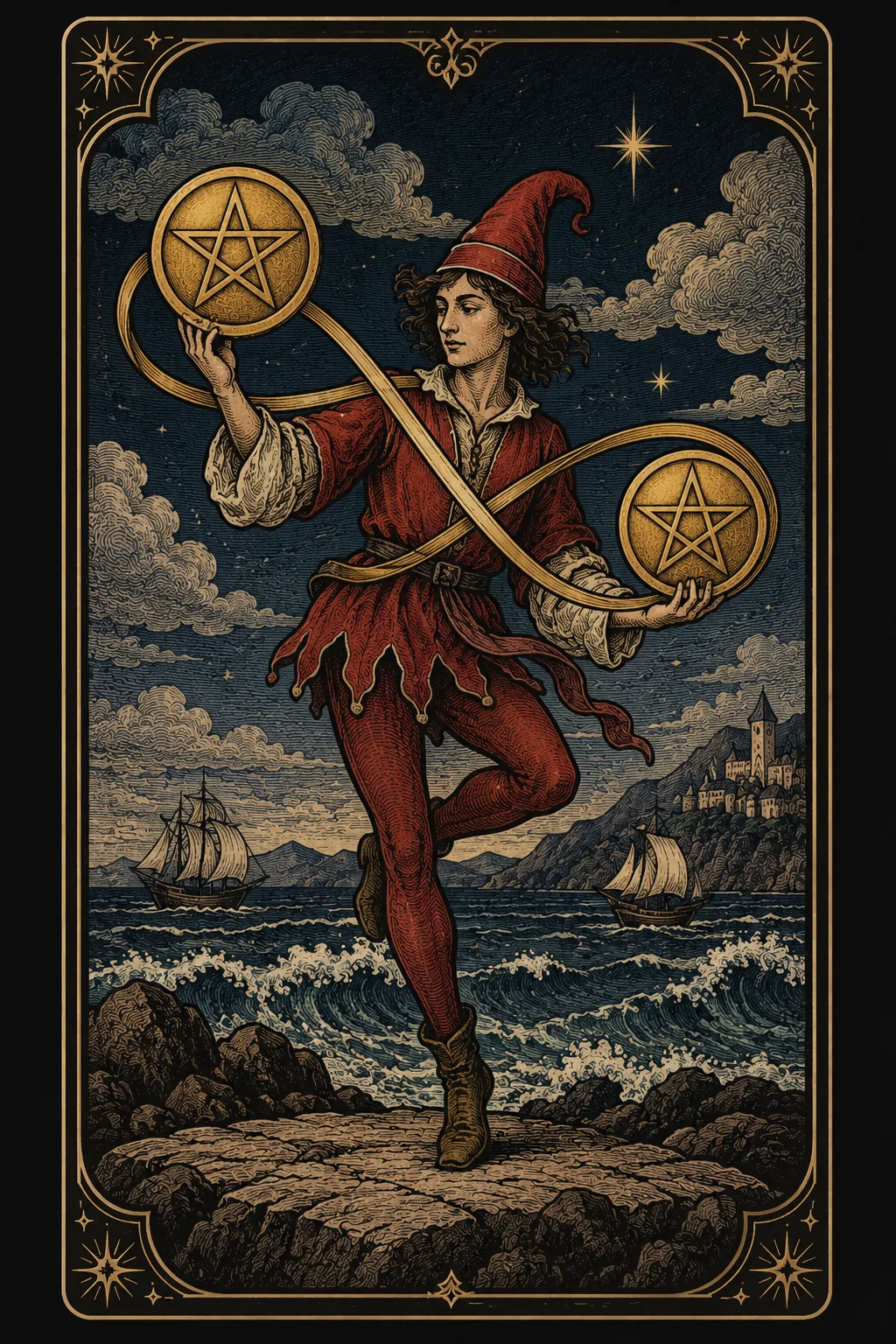
In the classical Rider–Waite image, a figure juggles two pentacles joined by a ribbon in the shape of an infinity loop. Ships ride waves in the background.
Tradition links this scene with a need to keep coordinating two streams of tasks, money, or duties, and with changing outer conditions that have to be adapted to. In a traditional reading this is more a skill of juggling several demands than a promise that the load will always stay light. The traditional image explains the theme of juggling. It does not claim that TARORIA’s drawing copies Rider–Waite.
Combinations with other cards
Next to Temperance, the combination can strengthen the theme of a calmer distribution of energy, if a person is ready to lower extra haste. With the Wheel of Fortune, outer conditions may change more often than usual — then a flexible plan matters more than a rigid timetable. With the Tower, a familiar order of tasks can break sharply: the question is no longer the art of combining, but which load can still be kept at all.
Neighboring cards clarify which spheres are competing: work and home, several projects, payments and deadlines. The decision of what to keep remains with the person.
Frequently asked questions
Does the Two of Pentacles speak of a lack of money?
Not necessarily. Often it is about distributing money already there: several payments, uneven income, a limited budget. Lack can be the theme if that is the question, but the card is equally read as a load of time and duties. Look at what is actually short: money, hours in the day, or clear priorities.
What does the card mean at work?
More often combining projects, a changing schedule, several roles at once. Upright can show that a person is still managing through flexibility. Reversed, typical notes are overload, scattering, and an inability to finish tasks.
What does the Two of Pentacles mean in relationships?
Usually finding time for each other against a backdrop of work, study, children, or other duties. For a couple this is a change of rhythm and a need to renegotiate meetings and household life. Reversed, the card often shows that closeness is left with only leftover attention. By itself it does not mean a third person.
How should I read the reversed position?
The reversed Two more often speaks of overload, a budget that no longer adds up, chaotic switching between tasks, and tiredness from constant maneuvering. This is a signal to narrow the list of obligations, not a verdict that nothing can already be mended.