Ten of Cups — tarot card meaning
Minor Arcana
Ten of Cups
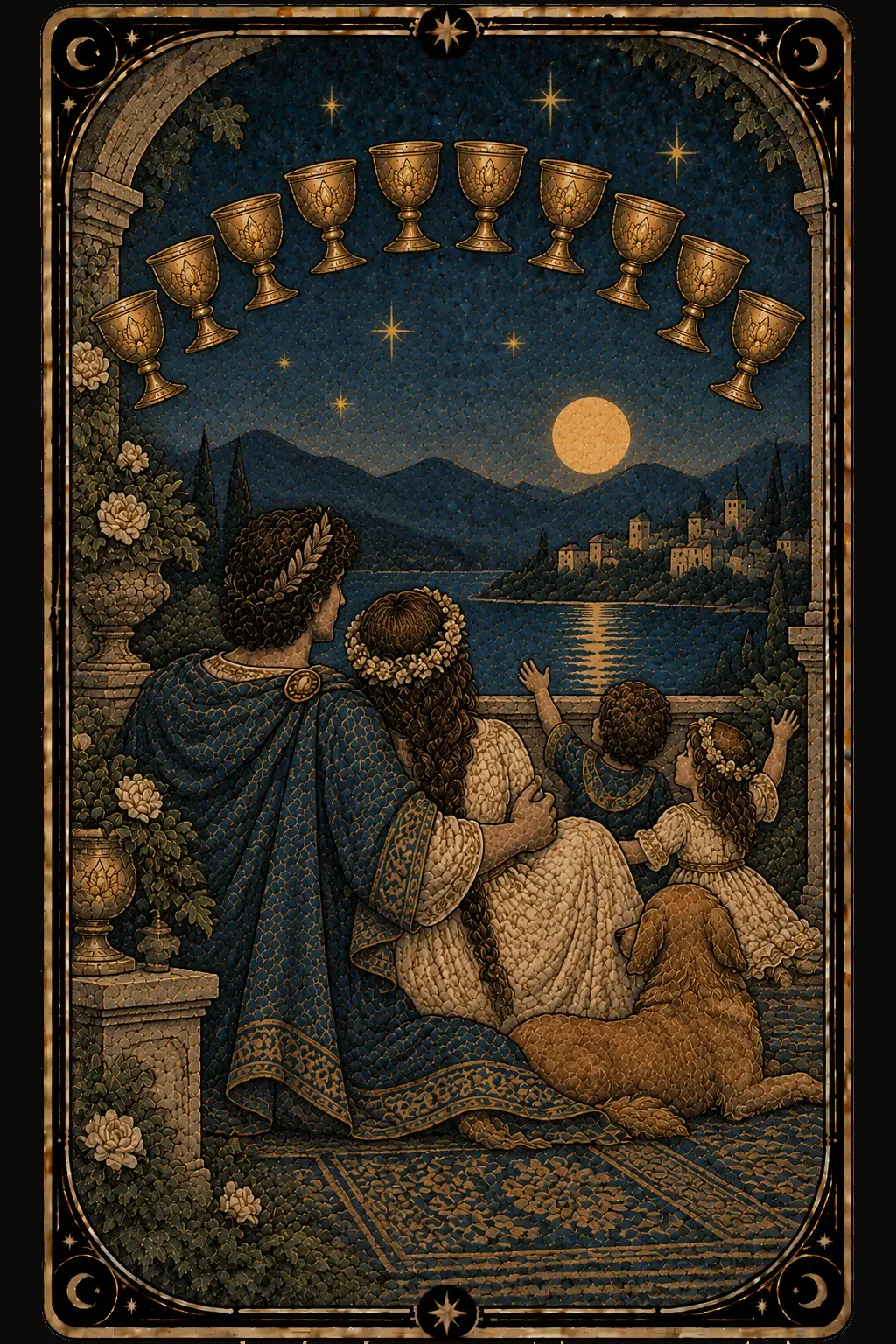
The Ten of Cups holds a feeling of home among people. Emotional community, belonging, a shared life, the joy of being one another’s own — not necessarily in a classical picture of a family with a rainbow.
People wait for the card as a promise of a wedding and an ideal hearth. It is more accurate to read the quality of we: is there the warmth of a shared life in which a person is not alone. The shape of that we can differ. The card does not issue an ideal.
General meaning
In the broader picture, the Ten describes an emotional system of closeness. Someone is nearby with whom daily life and joy are shared, with whom you can be seen. This is a couple, a family, chosen kin, a stable circle in which the heart breathes out.
Tension begins when the picture of a family matters more than the actual people inside it. Neighboring cards will show whether this is a home or a shop window of happiness. The Ten itself notes a need for community, not a concrete passport story.
Upright
Upright more often speaks of a genuine we. People are glad to be together, there is a sense of home, shared joys, belonging without humiliation. Emotional safety holds on mutual warmth, not only on a roof overhead.
The upright Ten does not promise that it will always be this way. It describes a quality of a bond that is already there, or that a person sincerely strives toward. If the question is whether there is family in an emotional sense, the card is more about a climate of closeness than about a stamp.
Reversed
Reversed often points to a crack in a shared happiness. There is a family, and little warmth. Different pictures of home. Pressure that we must look good. A person is nearby and alone.
The reversed Ten does not predict a collapse. It asks whose rainbow this is — of everyone standing in it, or only of the one holding the photograph. Sometimes the community can still be revived. Sometimes the picture has long not matched what people feel.
Love and relationships
In love, upright can describe a wish or an experience of a shared life: home as an emotional place, daily life as two, acceptance into a circle of close people, a sense that you are one story. This is not an automatic marriage and not an ideal family.
The reversed card shows a conflict of expectations about how we ought to look, cold inside an outwardly well-off couple, pressure from relatives. Look at whether there is a mutual sense of home — or whether one person is building a hearth and the other does not live in it with the heart.
Work and career
At work the Ten of Cups is more about a human environment than about a career. Upright can describe a team where there is a sense of our own, work that does not tear you from close people, agreement between professional life and home life.
The reversed card notes a rift: work eats closeness, a team plays family and does not hold on a hard day. The card does not promise success. It is useful to ask whether the work feeds the life you share — or requires it as a sacrifice for a picture of well-being.
Money and finances
In money questions the Ten sometimes touches a household as a whole: joint spending on a life in which people are warm, not only correct. Upright is not about capital, but about the emotional meaning of money in a close circle.
The card does not promise inheritance or wealth. Reversed, it can show that disputes about means break a sense of home, or that well-being is staged while inside there is a lack of warmth. It is worth looking at whether money serves the community — or the community serves a shop window of prosperity.
Advice
Ask where you are truly warm among people — not where you are supposed to be a family. If the community is there, protect what is alive in it, not the photograph.
If there is a picture of happiness and no home, name the gap aloud. An ideal does not replace belonging.
Symbolism
In the classical Rider–Waite image, two adults stand with arms raised; two children dance nearby. A house sits in the landscape. Above them, a rainbow holds ten cups.
Tradition links this scene with the emotional fullness of a kin and with the joy of being together. The traditional image explains the theme of community. It does not claim that TARORIA’s image copies Rider–Waite. In a reading, a sense of we under one sky matters more than the rainbow as a promise of a fairy tale.
Combinations with other cards
Next to the World, the Ten strengthens a sense of closeness that has come together as a whole: a stage in which we has found its shape. With the Hierophant, community can become tradition and rule — a living home, or an obligation to look like a family. With the Empress, the warmth becomes care, body, a daily life in which people are raised, not displayed.
Neighboring cards show whether this is a genuine we or a shop window. Which form of closeness to choose is the person’s decision.
Frequently asked questions
Does the Ten of Cups promise a wedding or a family?
No. The card describes emotional community, a sense of home, belonging. Family and a shared life are possible themes of the question. A stamp, an ideal hearth, and a wedding are not issued by the card.
How is it different from the Ten of Pentacles?
The Ten of Pentacles is about a material system: property, succession, a shared resource. The Ten of Cups is about an emotional we, warmth, belonging. You can have a house and not feel home. You can be close without much property.
Does the card mean a happy marriage?
It can describe a period or a striving toward a warm shared life. This is not a certificate of happiness and not a forecast of an ideal relationship. Reversed is precisely about a crack in a picture of shared well-being.
What does the reversed Ten of Cups show?
Often a rift in community: little warmth with an outer family, different pictures of home, pressure that we must look good, loneliness beside people. Look at whose rainbow this is — of everyone inside, or only of the photograph.