Page of Cups — tarot card meaning
Minor Arcana
Page of Cups
The Page of Cups brings a first emotional impulse. Emotional curiosity, sensitivity, a message of feeling, a readiness to be surprised by your own response, which has not yet become a story.
People wait for the card as a message from a particular young man. It is more accurate to read a beginner’s stance in the world of feeling: someone — you, a partner, a new part of you — is only learning to hold a cup without spilling it from the first excitement.
General meaning
The Page sits where a feeling is still tender and not yet settled. Interest has appeared, a dream, a creative nudge, a wish to say something warm, an openness to the unexpected. This is not a mature union and not a strategy. It is the beginning of learning to express feeling openly.
Neighboring cards will clarify whether this is a genuine impulse or a naive hope that everything will happen by itself. The Page itself notes sensitivity, not the identity of whoever sent a message.
Upright
Upright more often speaks of a fresh emotional gesture. A person can be surprised, inspired, show liking without a heavy script, hear their heart in a small thing. Curiosity is not yet cynical.
The upright Page supports a beginner’s tenderness: you may still be learning what to do with what you feel and still be sincere. The main thing is that the impulse not remain only a dream — even a small sign to yourself or another already changes something.
Reversed
The reversed Page often points to an immaturity of feeling or a muffling of it. Touchiness, fantasies instead of a gesture, emotional swings, a rumor that cannot be trusted, a fear of your own response.
Sometimes a person pretends to be open and in fact is playing at sensitivity. The reversed card does not make you a child. It asks whether you are learning to feel — or only waiting for a feeling to arrive fully formed and safe.
Love and relationships
In love, upright can describe a shy liking, a first warm sign, a readiness to be surprised by a person, tenderness without a large plan. This is not a promise of a message and not a portrait of a young admirer.
The reversed card shows an immature emotional tone: hurt feelings, hints instead of words, idealization, an inability to hold even a small feeling. Look at whether there is genuine curiosity toward the other person — or only an expectation that you will be emotionally entertained, as at the start of a fairy tale.
Work and career
At work the Page of Cups is more often about a human and creative impulse: an idea that touches, a wish to do the work with soul, sensitivity to a team’s atmosphere, first steps in a role where people matter, not only a function.
The reversed card notes sensitivity to criticism, an inability to separate work from the personal, inspiration without follow-through. It does not promise a new position. It is useful to give the impulse a small form — a sketch, a conversation, a trial — before it melts.
Money and finances
In money questions, the Page is rarely about the amount itself. Sometimes it is naivety in financial gestures from liking, a wish to spend on a beautiful feeling, a message about money that it is too soon to trust as a fact.
The card does not promise a transfer and does not give money advice. Reversed more often shows decisions from hurt or from a fairy tale that everything will work out because I am good. It is worth separating a warm impulse from a commitment that cannot easily be undone.
Advice
Treat your response as serious and light at once: it is real, but it is still learning to walk. Give it a small honest form — a word, a gesture, a note, a question.
Do not wait for a feeling to arrive fully formed and safe. Learning to feel begins with an awkward first step, not with a ready-made story.
Symbolism
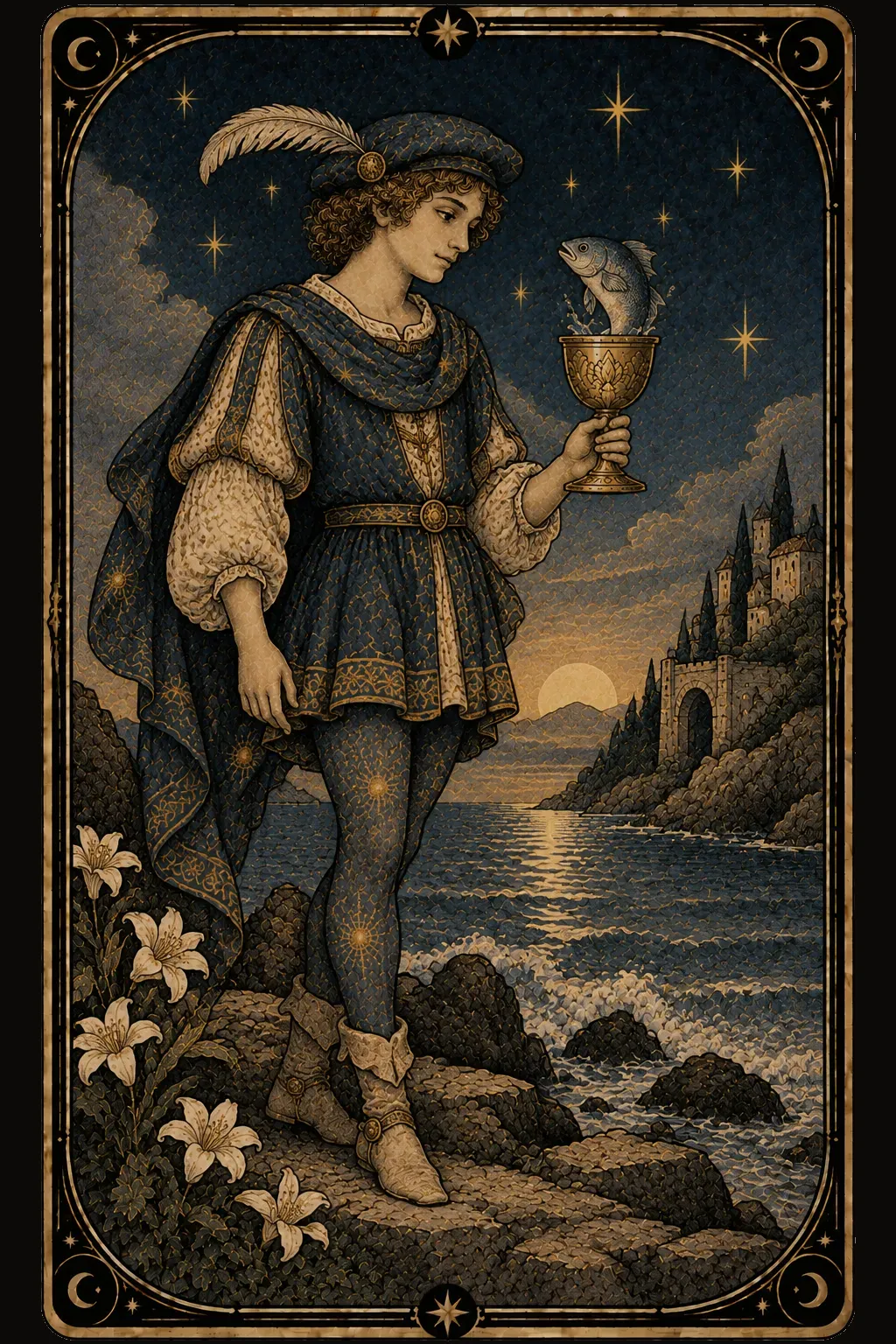
In the classical Rider–Waite image, a young-looking figure holds a cup. A fish emerges from the cup, and the figure looks at it. Water and a shoreline appear behind.
Tradition links this scene with a message of the heart and with attention to an impulse that has barely appeared. The traditional motif explains the theme of a first response. It does not claim that the TARORIA card is drawn from Rider–Waite. The age of the figure does not assign a particular young person in your life.
Combinations with other cards
Next to the Fool, the Page strengthens the freshness and fearlessness of a beginner — a feeling still without a map. With the High Priestess, the impulse is more inner: a dream, a hint, a quiet response that is not yet ready to be made public. With the Star, the tenderness is linked with trust after a dry stretch: you can be surprised by warmth again without demanding a home of it at once.
Neighboring cards show whether this is a genuine gesture or a fairy tale. Whom to address it to is the person’s decision.
Frequently asked questions
Does the Page of Cups mean a message or a letter?
Not necessarily. Sometimes there is a tone of a message: a sign, a gesture, news of a feeling. The card does not promise a message and does not assign a sender. More often it is about a first emotional impulse — yours, or in the atmosphere of the question.
Is this a particular young man?
No, not automatically. The Page is a beginner’s role in feeling. The card does not assign a person’s age or gender. Look at who is now learning to be sensitive and sincere — you, a partner, a new part of you.
How is the Page of Cups different from the Ace?
The Ace is the appearance of emotional space and of a feeling as such. The Page is already trying to handle it: curiosity, a gesture, a message, learning to express feeling openly. An impulse plus a beginner’s attention, not only a full cup of potential.
What does the reversed Page of Cups show?
Often an immature tone: hurt feelings, fantasies without a gesture, mood swings, a fear of your own response, a play at sensitivity. Ask whether you are learning to feel — or waiting for a fully formed, risk-free feeling without awkwardness.