Nine of Cups — tarot card meaning
Minor Arcana
Nine of Cups
The Nine of Cups describes a moment when a person is well — not necessarily loudly and not necessarily forever. Satisfaction, pleasure, a sense that what you wanted is already here in some form, a capacity to notice what has been received.
The card is called a wish card, and people immediately wait for a dream to be granted. It is more accurate to read fulfillment: a skill of being in your pleasure without postponing joy until an ideal finale. A wish can meet a fact. The card does not guarantee that.
General meaning
In a spread, the Nine notes a sense of having enough. A person is not in a deficit of warmth, recognition, bodily comfort, small joys, pride in how they have arranged a life that feels good. Sometimes it is an evening when you can breathe out. Sometimes it is a more stable agreement with yourself.
Neighboring cards will show whether this is genuine contentment or a pose of I have everything. The Nine itself does not close the future. It asks whether you know how to be in the good while it lasts.
Upright
Upright more often speaks of sincere pleasure. A wish has met reality at some scale: closeness, recognition, quiet, a celebration for yourself, a sense that it is enough. A person can allow themselves joy without justification.
The upright Nine grows smaller when contentment becomes a shop window. Then it matters whether you are enjoying — or demonstrating that you are enjoying. The difference is felt in the body: one relaxes, the other holds the back as a picture.
Reversed
Reversed often points to a break in pleasure. A wish did not match, joy is not felt, a person cannot receive the good, satiety, a dependence on outer confirmations that you are happy. Sometimes a wish is fulfilled and there is no taste.
The reversed Nine does not write joy off. It asks what is missing for what has been received to become real — and whether you are waiting for one picture to close a whole life.
Love and relationships
In love, upright can describe a period when there is warmth nearby, a sense of being wanted, pleasure in being together, a sense that in this bond you are well. This is not a promise of an ideal union and not a forecast of a wedding.
The reversed card shows dissatisfaction: closeness is there, and little response; a wish is not named; a person does not know how to receive love, only how to win it. Look at whether what you wanted from the relationship matches what is actually happening — without a discount of at least it is stable and without a demand that a partner fill all the cups at once.
Work and career
At work the Nine can speak of moral satisfaction: the work brings taste, you are valued, a stage wants to be marked. Sometimes — of a right to enjoy a result without devaluing it with the next goal.
The reversed card notes empty success, work that looks enviable and does not warm, a dependence on praise. The card does not gift a post. It is useful to ask whether there is pleasure in the process itself — or only in the picture of status.
Money and finances
In money questions, upright is sometimes linked with a possibility of allowing yourself joy: not luxury for a shop window, but a spend that truly brings pleasure, if the budget can hold it. This is not a promise of wealth and not advice to reward yourself at any cost.
Reversed more often shows that purchases do not give taste, or a wish to close emptiness with spending. It is worth separating emotional fullness from a sum: what you want to feel — and whether that feeling can be received otherwise than through a spend.
Advice
Notice what is already there and what truly brings pleasure — not what is supposed to make you glad. Allow yourself to be in that, without demanding that the moment solve a whole life.
If there is no joy at a formally full table, name which cup is missing. Sometimes the wish is different, and it simply was not spoken.
Symbolism
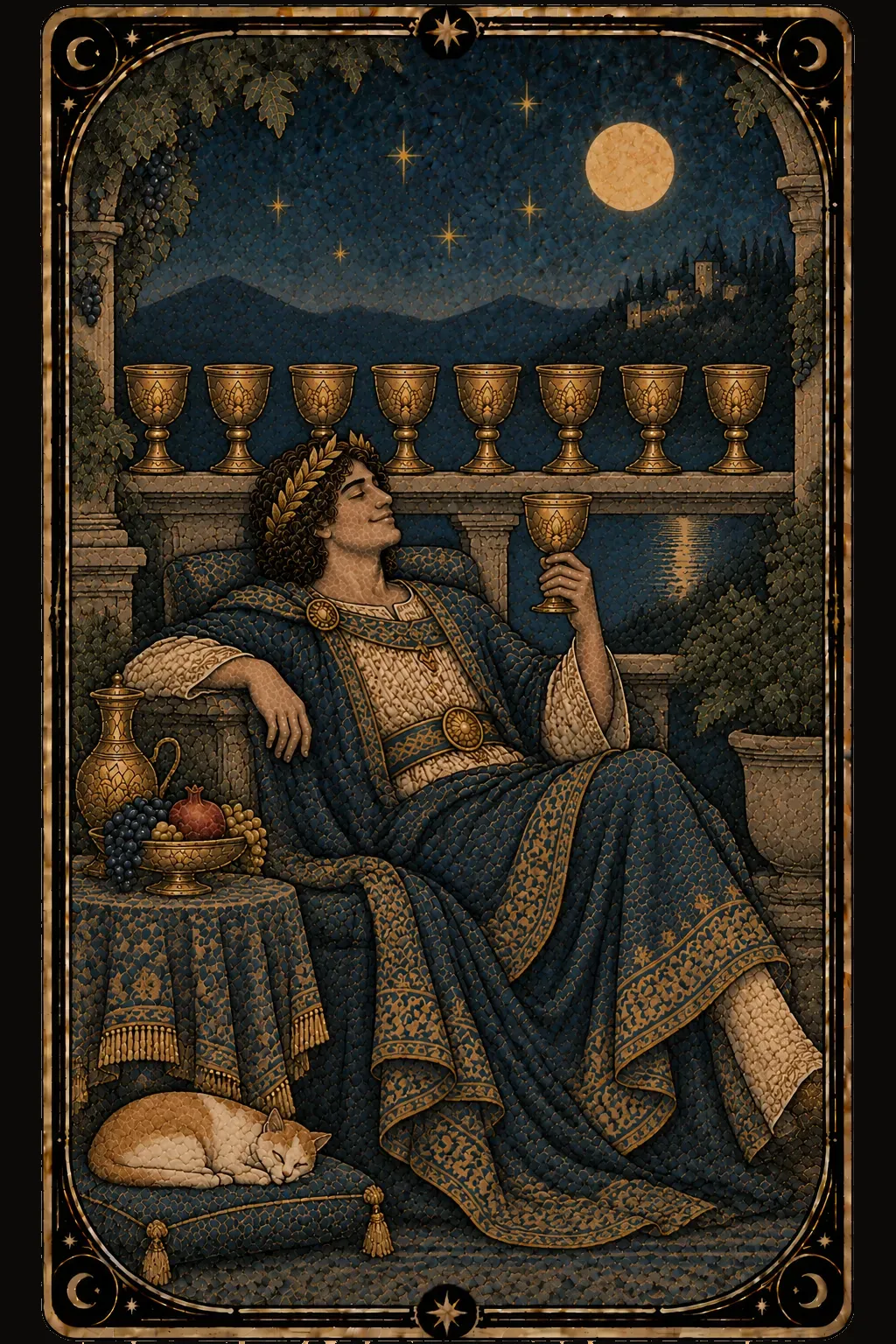
In the classical Rider–Waite image, a person sits before an arc of nine cups, arms crossed, in the mood of a host of the moment.
Tradition links this scene with satisfaction and with a feast of personal pleasure. The traditional image explains the theme of fulfillment. It does not claim that the TARORIA card copies Rider–Waite. In a reading, a capacity to be in your own good matters more than the number of cups as a promise of wishes.
Combinations with other cards
Next to the Sun, the Nine makes joy simpler and more visible: less pose, more genuine warmth. With the Wheel of Fortune, pleasure is felt as a lucky turn — you can live it without demanding that the turn become eternal. With the Magician, a temptation appears to make a project of a wish; it helps not to replace the taste of a fact with an endless improvement of the moment.
Neighboring cards show whether this is genuine contentment or a shop window. Which wish to count as fulfilled is the person’s decision.
Frequently asked questions
Does the Nine of Cups grant a wish?
No, not automatically. The card describes satisfaction and a capacity to notice what has been received. Sometimes a wish and a fact meet. This is a tone of fulfillment, not a mechanism for granting a dream.
Does it mean happiness in love?
It can describe a period when a bond is warm and desired. This is not a guarantee of an ideal relationship and not a forecast of a wedding. Reversed often speaks of dissatisfaction even with outer fullness.
Why is the card linked with pleasure?
Because the classical image is a person before their cups, for whom it is enough now. It is about a taste of life, recognition, a bodily and emotional I am well. Not about an endless party and not about a right to ignore consequences.
What does the reversed Nine of Cups show?
Often a break in pleasure: a wish did not match, joy is not felt, a dependence on outer confirmations, an empty table at a full shop window. Ask what is missing for the good to become real — and whether that is the wish you named.