Eight of Cups — tarot card meaning
Minor Arcana
Eight of Cups
The Eight of Cups is about a conscious decision to leave what has become emotionally exhausted. A person stands up and goes to look for another meaning, another depth, another why, even though from outside the cups may still look full.
The card is read too quickly as a breakup. Leaving can be inner: from a role, from a familiar story, from a feeling that no longer feeds. The outer shape of a life can still hold for a time.
General meaning
Seen as a whole situation, the Eight describes a moment when staying means betraying what you actually feel. Often without drama: you realize there is nothing here that still feels emotionally alive, and you walk away anyway.
Neighboring cards will show whether this is a search or an escape. Leaving for meaning is different from leaving so as not to feel. The card describes the movement away, not the destination.
Upright
Upright more often speaks of an honest break with what has emptied. A person sees that from the outside, everything may appear to be in place while internally it feels empty. They choose a path that does not yet promise convenience, but matches the truth of a feeling.
The upright Eight does not romanticize leaving as a feat. It is a hard step, often a lonely one. What matters is whether you are leaving toward something more alive — or simply away, without a question of what you want instead.
Reversed
Reversed often points to an inability to leave, or a return to what has already emptied. A fear of the unknown, duty, habit, a hope that the feeling will fill again if you wait a little more.
Sometimes a person has physically left, and the heart is still sitting among the same cups. The reversed card does not order you to stay or to run. It asks whether where you are now is consistent with what you already know about your feelings.
Love and relationships
In love, upright can describe leaving an emotionally dead zone: a cooled bond, a role of the convenient one, a pattern in which closeness has long been gone. This is not an automatic breakup. Sometimes people leave a way of loving, not a house.
The reversed card shows hesitation: a foot is already over the threshold, but a person returns to the familiar. Or a leaving has happened, and the grieving and the meaning have not yet been found. Look at what exactly is exhausted — feeling, respect, a shared aim. Do not reduce that question to a vague choice between staying and leaving.
Work and career
At work the Eight is often about leaving a matter that no longer has meaning: a profession, a project, a role, a team where you are present without inner consent. Upright can describe a search for a more honest use of yourself.
The reversed card notes getting stuck in an emptied role from fear, status, money as the only argument. The card does not promise a new position. It is useful to tell apart burnout that a pause can treat from an exhaustion of meaning that a pause does not fill.
Money and finances
In money questions the Eight can mean a readiness to leave what is profitable but dead: an income that holds you in someone else’s life. This is not advice to drop a source of income and not a promise that ahead will be better materially.
Reversed more often shows that a person is held precisely by financial fear, even though emotionally the cup is already empty. It is worth naming what staying costs — not only in money, but in a feeling of your own life — without a dramatic gesture of dropping everything tomorrow.
Advice
Ask directly: is there still something here that feels emotionally alive, or are you staying from habit and a fear of emptiness. If it is exhausted, name what exactly you are stepping away from — not necessarily from everything at once.
Leaving has meaning when there is at least a vague direction of truth. Otherwise you change the scenery and carry the same empty cups with you.
Symbolism
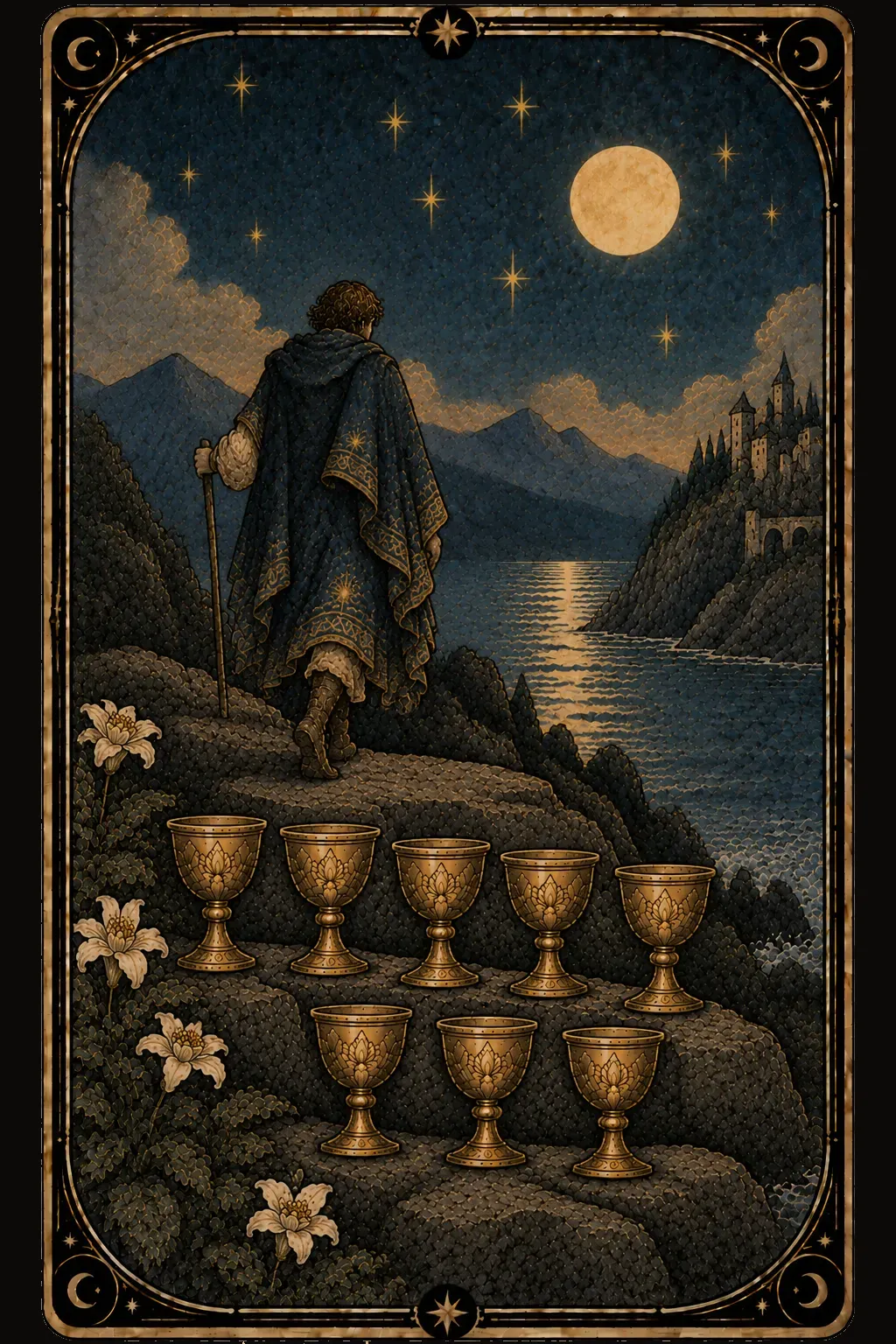
In the classical Rider–Waite image, a figure walks away from eight stacked cups into the night, toward a slope, under a moon.
Tradition links this scene with a search for a deeper meaning and with leaving what still looks sufficient from outside. The traditional image explains a quiet departure. It does not claim that TARORIA’s drawing is identical with Rider–Waite. In a reading, the step away matters, not the moon as a separate prediction of night, and not the image as proof of a breakup.
Combinations with other cards
Next to Death, the Eight strengthens the irreversibility of a stage: a former emotional pattern does not fill again in the same way. With the Chariot, the leaving receives direction and will — less wandering, more of a chosen route. With the Hierophant, it can be hard to leave a correct arrangement — a family, a role, a promise — even when the feeling is already silent.
Neighboring cards show whether this is a search or an escape. Where to go is not the card’s decision in place of a person.
Frequently asked questions
Does the Eight of Cups always mean a breakup?
No. Often it is a conscious decision to leave what has become emotionally exhausted: a role, a pattern, a way of being in a bond. A breakup is possible if that is the question. Just as often people leave inside a relationship or a job without changing their circumstances at once.
Why leave if the cups are still standing?
Because from the outside everything can be in place, and inside it feels empty. The Eight is precisely about that gap. Staying for a picture of fullness gradually costs more than an awkward step toward an unknown meaning.
Is this an escape?
Sometimes yes — if a person leaves so as not to feel, without a question of what they want. Upright more often speaks of an honest search. Neighboring cards and your motive tell meaning from flight. The card itself does not put a label.
What does the reversed Eight of Cups show?
Often an inability to leave, a return to what has emptied, a fear of the unknown, having left physically while the heart is still there. This is not an order to stay. Ask whether where you are now is consistent with what you already know.