Seven of Cups — tarot card meaning
Minor Arcana
Seven of Cups
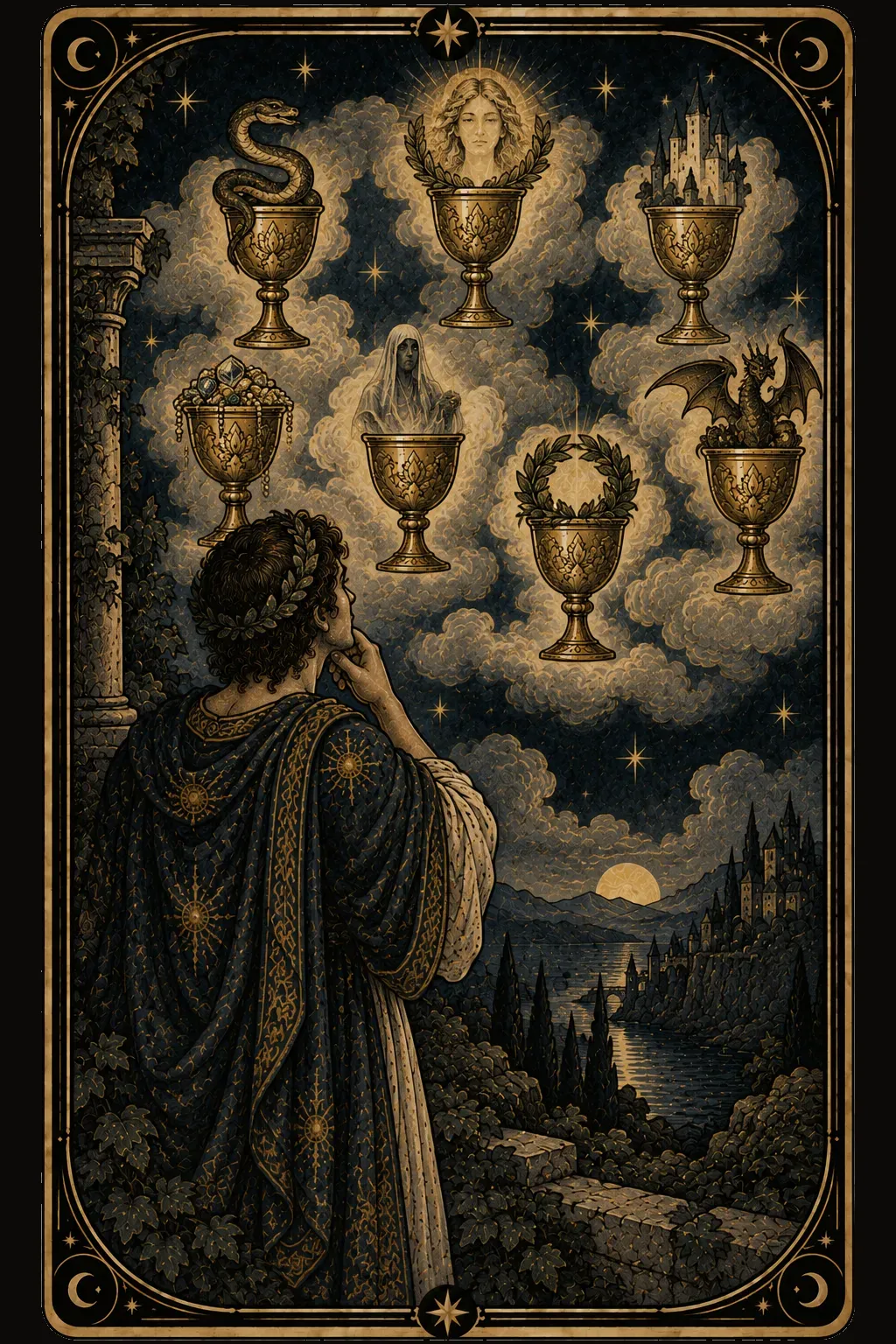
The Seven of Cups sets several cups in front of a person at once. Options, fantasies, tempting pictures, wishes that have not yet been checked by life. Choosing is hard, because each cup promises its own story.
The card is not about the wealth of choice as luck. It is about the work of telling a genuine wish from an image that looks good in the fog.
General meaning
In a spread, the Seven describes a fork of feelings and imagined lives. You can stay, leave, begin something new, return the old, imagine yourself in another role. Until the pictures are grounded, they all seem equally possible.
Neighboring cards will help you see where fantasy feeds, and where it hides a fear of one concrete step. The Seven itself does not choose for you. It shows that a choice has not yet been made — or has been made only in imagination.
Upright
Upright more often speaks of an abundance of images. A person sees many emotional doors: infatuations, lives, work, another self. This can be creatively fertile if a check against reality follows.
The upright Seven becomes a trap when a surplus of options replaces a decision. Then no cup is taken in the hands: it is frightening to spoil a dream with a fact. What matters is whether you are dreaming in order to understand a wish — or in order not to choose.
Reversed
Reversed often points to a clearing. The fog thins, one possibility becomes more concrete, a person tires of endless what if. Sometimes, on the contrary, the confusion is thicker: illusion, self-deception, a temptation that can no longer be told from a fact.
The reversed Seven does not promise a right choice. It asks whether you already see ground under your feet — or are still drinking the picture instead of the water.
Love and relationships
In love, upright can describe several attachments, an ideal image of a partner, a fantasy of how it could have been, difficulty choosing between an actual person and a beautiful story. Sometimes a person is in love with a potential, not with who is there.
The reversed card sometimes helps separate a wish from a projection — or shows that the illusion has only grown stronger. The card does not promise whom to choose and does not name a second person. Look at what you are answering: a gesture nearby, or a film in your head.
Work and career
At work the Seven is often about a fork of roles and paths that still exist as presentations: a project of your own, another field, an image of dream work. Upright can describe a period when everything seems possible and nothing has been started.
The reversed card notes either a narrowing of focus, or a danger of believing a beautiful offer without terms. It does not choose a vacancy. It is useful to put one option on the table: timelines, skills, money, people — and see whether the wish remains.
Money and finances
In money questions the Seven is especially cautious. Upright can describe tempting pictures of income, an ideal way to fix things, several financial fantasies at once. This is not advice to invest and not a promise of a win.
Reversed more often shows either a sobering, or an even greater mix-up of the wished-for and the possible. It is worth not comparing dreams with one another, but checking one concrete figure and condition. While the cups stay in the clouds, the budget is still on the ground, waiting.
Advice
Write down the options that are circling. Then add one fact to each: what is already there, what is not, what it will ask of you tomorrow morning.
Fantasy is needed in order to know a wish. A decision begins when you take one cup and agree that the others remain pictures for a time.
Symbolism
In the classical Rider–Waite image, a figure looks at seven cups in the clouds. Inside them are distinct visions: a human head, a shrouded figure, a serpent, a castle, jewels, a wreath, a monster.
Tradition links this scene with temptation by images and with a need for discernment. The traditional set of visions explains the theme of choosing among illusions. It does not claim that TARORIA’s drawing repeats Rider–Waite. In a reading, the fog of many options matters, not a decoding of each cup as a separate prediction.
Combinations with other cards
Next to the Moon, the Seven thickens the mirage: the wished-for and the frightening mix, and a pause is needed before believing the picture. With the Devil, the temptation becomes sticky — an image holds more strongly than an actual person or a real matter. With the Magician, a chance appears to turn one vision into action, if you choose and do not scatter your will across all seven.
Neighboring cards show whether this is a creative search or an escape from a choice. Which cup to take is the person’s decision.
Frequently asked questions
Is the Seven of Cups about choosing a partner?
It can be, if the question is about several attachments or an ideal image. More often the card is wider: many emotional scripts, fantasies, difficulty choosing. It does not point to whom to choose, and does not promise that all the options are real.
Does the card mean I am being deceived?
Not necessarily. Often a person is drinking their own pictures. Deception is possible if that is the question and neighboring cards lead toward hiddenness. The basic meaning is to tell a wish from a fact, including your own.
How do I not drown in options?
Bring one possibility down into reality: a deadline, a conversation, a trial step, a condition. The upright Seven is fertile while a check follows the dream. If there is no check, the options remain clouds.
What does the reversed Seven of Cups show?
Either a clearing and tiredness of what if, or even greater confusion and self-deception. Look at whether ground is already visible — or whether the picture has become even more convincing. The card does not certify the right choice.