Six of Cups — tarot card meaning
Minor Arcana
Six of Cups
The Six of Cups brings the past into today. A memory, the familiar scent of an old feeling, a person from a former chapter, a childlike simplicity, nostalgia, a scene you want to live again.
The card is often read as they will come back. It is more accurate to look at the quality of what returns: what exactly is stirring — warmth, something left unfinished, habit, a longing for simplicity. The card does not declare that a person will return.
General meaning
In the broader picture, the Six describes a tie with what has already been lived. Sometimes it is a healing memory: something to draw on from a time when love felt simpler. Sometimes it is an anchor that will not let you enter the present, because then it was real.
Neighboring cards will clarify whether the past is serving as a resource or a loop. The card itself is neutral toward the calendar: it is about the tone of a feeling, not a date of a meeting.
Upright
Upright more often speaks of a warm recognition. A familiar feeling returns without a required storyline. You can meet a person from the past, remember how you used to take joy in things, receive a gesture of simple kindness, want the sincerity that used to be there.
The upright Six does not promise that the past can be returned as it was. It notes that it is still alive inside and affects how you read the present.
Reversed
Reversed often points to getting stuck. A person compares everyone with someone who is already gone, idealizes then, cannot accept that the scene has changed. Or, on the contrary, they cut the past off sharply and will not take from it even a useful skill of warmth.
The reversed Six does not forbid remembering. It asks whether you are living today — or only replaying an old reel, expecting it to replace the current chapter.
Love and relationships
In love, upright can describe a familiar attraction, the softness of a first sincerity, contact with a person with whom there was already a story, a wish for the simplicity that once was between you. This is not an automatic forecast of a return.
The reversed card shows an idealization of an ex, an inability to let the new in because it is not like then, or a repeat of an old pattern without growing up. Look at what you want to return: a person, a feeling of safety, your former self. These are different wishes, and the card does not mix them into one promise.
Work and career
At work the Six can speak of a return to a former format, a familiar environment, a teacher, a matter that once pleased you. Sometimes it is useful to take an old skill of warm contact and carry it into the present role.
The reversed card notes nostalgia for how it was in that team, which gets in the way of fitting in now, or a refusal to learn from past experience. The card does not restore a former position. It is useful to ask which piece of the past is still professionally alive — and which is already a museum.
Money and finances
In money questions the Six is weaker than figures. Sometimes it is an old emotional debt, a gift tied to memory, a habit of spending as then, when it was simpler. Upright can describe a small gesture of support from someone from your past.
The card does not promise a return of money and does not advise financial steps from nostalgia. Reversed more often shows decisions that repeat an old money drama of a family or a former relationship. It is worth separating memory from the current budget.
Advice
Name what exactly from the past is warming you now: simplicity, a person, the openness you had then, a sense of home. Separate that from a fantasy that the scene will repeat one to one.
The past can be a source. It works poorly as a replacement for today’s life.
Symbolism
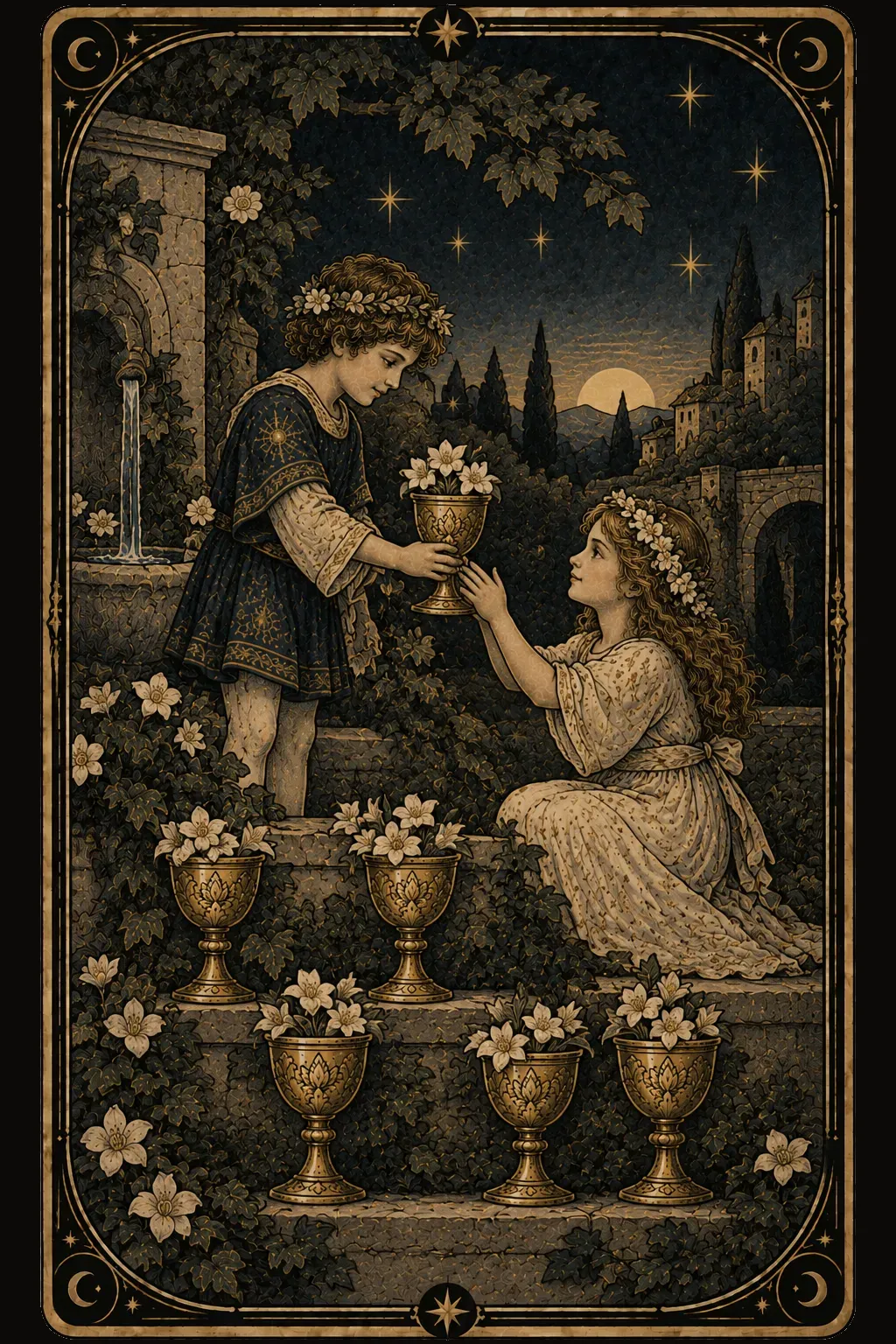
In the classical Rider–Waite image, two children in a courtyard exchange a cup filled with flowers. More cups stand nearby. Behind them is familiar old architecture; an adult figure walks away in the background.
Tradition links this scene with innocence, a gift, a return to a simple gesture. The traditional motif helps you read nostalgia and a childlike quality of feeling. It does not claim that the TARORIA card is drawn from Rider–Waite. In a reading, an exchange in the tone of the past matters, not the age of the figures as a pointer to a particular child.
Combinations with other cards
Next to the Wheel of Fortune, the Six strengthens a sense of a repeating cycle: a familiar feeling comes again, but already in different circumstances. With the High Priestess, the past is more inner — memory, things unsaid, what has not been spoken aloud. With the Moon, nostalgia easily becomes a mirage: you remember not a fact, but a wished-for picture.
Neighboring cards show whether this is a resource or a loop. Whether to bring a person back is not the card’s decision.
Frequently asked questions
Does the Six of Cups mean a person will come back?
No, not automatically. The card describes the past as a living feeling: memory, a familiar tone, nostalgia, sometimes contact with a person from a former chapter. A return is one possible context of the question, not a promise of the card.
Is this a childhood card?
It can touch childlike simplicity, family, an early experience of love and safety. More often it is about the quality of the past — sincerity, a gift, something left unfinished — not about a literal age. Look at which layer of the past is stirring.
Can the Six be read as a reconciliation with an ex?
Sometimes the tone is warm and familiar, if that is the question. This is not an instruction to meet and not a guarantee that it will be as before. Reversed more often warns against idealizing then. The decision remains with living people.
What does the reversed Six of Cups show?
Often getting stuck in the past, comparing everything with what used to be, a refusal to take even useful warmth from memory — or a sharp cutting of roots. Look at whether the memory helps today, or replaces it.