Five of Cups — tarot card meaning
Minor Arcana
Five of Cups
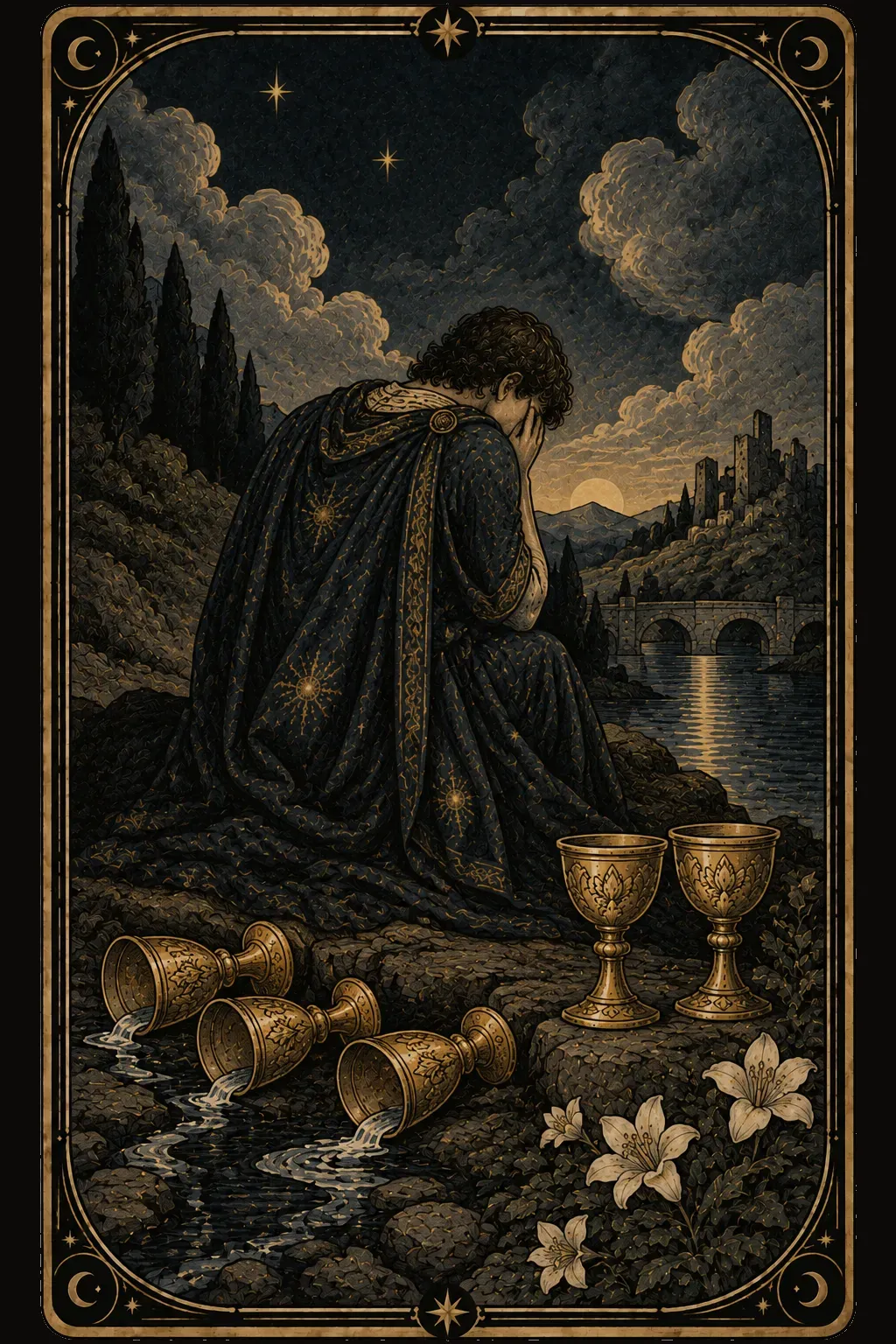
The Five of Cups stands where something has already spilled. A person looks at a loss, a mistake, a disappointment, words that cannot be taken back, a feeling that has changed. Pain occupies the foreground.
Behind, there is usually still a part that can be leaned on. The card does not demand that you see the good at once. First you need to name honestly what has been lost — and only then check what was not overturned along with it.
General meaning
In a spread, the Five describes grieving in a human way: it hurts, it is a pity, it feels empty, you want it to have been otherwise. This can be a break, a cooling, an unfulfilled expectation, a quarrel from which you did not come out as you were.
Neighboring cards will show whether the gaze has frozen only on what spilled, or whether there is already movement toward what still stands. The Five itself does not speed the grieving. It allows you to be in regret without making it the only horizon forever.
Upright
Upright more often speaks of attention to what has been lost. A person takes stock of the emotional loss: what did not come together, who is gone, which image of a future has fallen apart. This is an honest tone if the pain is still fresh.
The upright Five becomes a trap when regret turns into the only story. Then the standing cups are invisible not because they are not there, but because the gaze does not turn. What matters is whether you are grieving — or already living inside the same picture of what spilled.
Reversed
Reversed often points to a shift. A readiness appears to look away from what overturned, to accept that a part cannot be returned, and to lean on what remains: people, a sense of your own dignity, a lesson, a remaining piece of a bond.
The other pole is getting stuck even deeper, a refusal to grieve aloud, guilt that will not let go. The reversed card does not promise that the pain has ended. It asks whether movement away from the loss has begun — or whether a person has only gripped what spilled more tightly.
Love and relationships
In love, upright can describe disappointment in a partner, longing for how you used to be, pain after a quarrel, a sense that the best is already behind. Sometimes the bond is still there, but a person sees only what is no longer there.
The card does not predict a breakup as the only outcome. Reversed, it sometimes shows a readiness to notice remaining warmth, to forgive without crossing out the pain, or to let go of an image that keeps you from seeing the actual person. Look at what you are grieving — a fact, or a fantasy that reality did not match from the start.
Work and career
At work the Five can speak of disappointment in a project, a team, a chosen path. Expectation did not match the fact. A person tends to see the failure as total, even if a skill, contacts, or part of the result is still usable.
The reversed card sometimes notes that the gaze returns to what can still be used. It does not dictate a resignation. It is useful to separate a real loss — a deadline, trust, a role — from a global it was all for nothing.
Money and finances
In money questions, upright can describe regret over a spend, a missed agreement, a decision that cannot be replayed. The emotional tone is stronger than the figure: it is a pity, it is a shame, you want yesterday back.
The card does not promise reimbursement of a loss. Reversed, it sometimes shows that a person stops living only inside the mistake and notices what reserve or skill is still there. It is worth naming a concrete loss without turning it into the whole financial horizon.
Advice
Allow yourself to see what overturned, without pretending to be strong too soon. Name the loss shortly and exactly.
Then, when you can, turn your head: what did not spill. This is not optimism from duty. It is a check of whether there is still something to lean on that you are not yet using.
Symbolism
In the classical Rider–Waite image, a cloaked figure looks down at three overturned cups. Two cups still stand behind. A river and a bridge appear in the landscape beyond.
Tradition links this scene with grief and with a resource that has not yet come into view. The traditional image explains the doubleness of loss. It does not claim that TARORIA’s image copies Rider–Waite. In a reading, the direction of the gaze matters more than the color of the cloak as a running metaphor for the whole reading.
Combinations with other cards
Next to the Tower, the Five strengthens the shock of loss: something overturned quickly, and a person needs time to name what exactly. With Death, regret is linked with the end of a stage — not necessarily with literal dying, but with the impossibility of returning a former way of being together. With Judgement, a chance appears to draw an honest line: what has been mourned, what can be taken with you.
Neighboring cards show the depth of the loss and the possibility of a turn. The card does not set the speed of grieving for a person.
Frequently asked questions
Is the Five of Cups always about a breakup?
No. Often it is a loss, disappointment, regret — including inside a continuing bond. A breakup is possible if that is the question, but the card describes a gaze at what spilled, not a required end of a relationship.
Why do people say there is still a resource behind?
In a classical reading, some of the cups remain standing. The point is that not everything is destroyed: people, dignity, experience, a piece of feeling. This is not a demand to be glad. It is a reminder to check what you can still lean on when the pain settles a little.
What does the card mean if I blame myself?
Upright often includes regret about your own part: words, a choice, a missed gesture. Guilt can be part of grief. The reversed card sometimes helps separate a lesson from endless self-reproach. Look at whether the guilt moves you toward responsibility, or only holds you at what overturned.
Is the reversed Five already healing?
Not necessarily. Often the tone is softer: a readiness appears to look away, to accept what remains. Sometimes, on the contrary, the grieving gets stuck even deeper. Neighboring cards and the question will show whether this is movement or fixation.