Four of Cups — tarot card meaning
Minor Arcana
Four of Cups
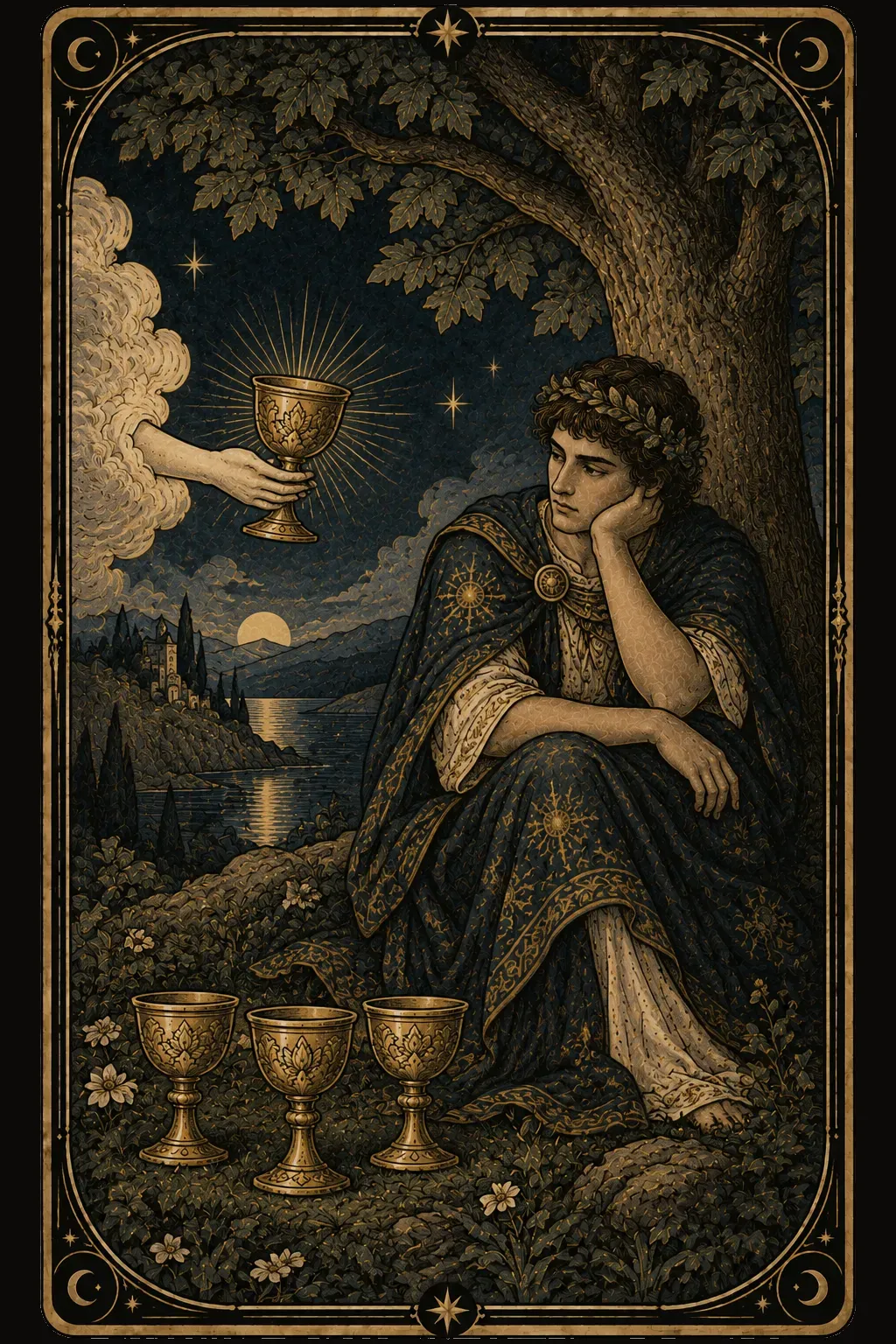
The Four of Cups describes a moment when feeling does not respond. A person sits inside a mood: satiety, apathy, resentment, tiredness of offers, a closed-off state that from outside is taken for calm.
A possibility may be standing nearby — a gesture, a conversation, a new chance — and the gaze is still down. The card does not scold for that. It names a pause in which the heart does not take what is offered.
General meaning
In a spread, the Four notes an emotional pause. Sometimes this is needed protection after overload. Sometimes it is a habit of not noticing what is here, because it does not match the picture of how I wanted it. Three cups are already there, a fourth is held out, and a person does not lift their eyes.
Neighboring cards will help you tell recovery from getting stuck. Withdrawal is not automatically wisdom. And it is not automatically guilt.
Upright
Upright more often speaks of no response to what is available. A person compares reality with an expectation and cannot sincerely be glad. The offer seems bland. Even care irritates if it arrives in the wrong form.
The upright Four can be an honest I cannot do this right now. What matters is whether the person sees what exactly they are declining — or whether refusal has become the background, and no warmth reaches them anymore.
Reversed
Reversed often shifts the gaze. A readiness appears to notice a gesture that used to be background. Apathy lets go a little. A person agrees to take at least a small part of what is offered.
The other tone is an even denser withdrawal: I want nothing, leave me, even a useful possibility is read as pressure. The reversed card does not promise sudden joy. It asks whether a thaw is beginning — or whether the defense has grown thicker.
Love and relationships
In love, upright can describe a cooling, emotional unavailability, a sense that a partner is offering the wrong thing, or tiredness of a bond in which a gesture no longer touches. A new interest can also go unnoticed if a person is still sitting inside an old mismatch.
The reversed card sometimes shows the gaze lifting: a readiness to hear again, to receive care, to come out of resentment. This is not an automatic reconciliation. Look at whether there is at least curiosity toward the actual person beside you — or whether you are comparing them with an absent ideal and therefore taking nothing.
Work and career
At work the Four is often about a loss of taste for the work. An offer of a change, a project, colleagues’ thanks draw no response. A person is present, but not engaged. Sometimes this is a signal that the load has emotionally emptied them, and a pause is needed, not one more chance.
The reversed card can mean that interest is returning a little, or, on the contrary, a full refusal even to look at possibilities. It does not move a career by itself. It is useful to name what exactly you do not want to take: a task, a role, the tone of a team — so the pause is a choice, not a fog.
Money and finances
In money questions the Four is almost never about a sum. Upright can describe indifference to an offer that looks advantageous but does not call up trust or joy; or a refusal to use a resource already there, from apathy.
The card does not promise a missed profit as a sentence. Reversed, it sometimes shows a readiness to consider an option that used to seem the wrong one. It is worth asking whether you are declining terms on the facts — or whether you simply do not want to feel anything, including responsibility for money.
Advice
Do not force yourself to be glad. First name the state: satiety, resentment, tiredness, boredom, a fear of investing again.
Then still look at what is held out nearby. You can refuse. But it is useful to see what exactly you are leaving untouched — otherwise withdrawal stops being a pause and becomes the only story.
Symbolism
In the classical Rider–Waite image, a figure sits under a tree with arms crossed. Three cups stand before them. A fourth is offered from a cloud by a hand.
Tradition links this scene with dissatisfaction with what is already there and with a possibility that is not yet received. The traditional image explains the theme of refusing a gesture. It does not claim that TARORIA’s drawing is identical with Rider–Waite. In a reading, the downward gaze matters, not the tree as a separate metaphor for the whole article.
Combinations with other cards
Next to the Hermit, the Four strengthens a withdrawal into oneself: the pause can be needed if it is a survey, not an ignoring of a real gesture. With the Hanged Man, the refusal to see what is offered drags on — another angle has not yet been found. With the Devil, withdrawal easily becomes a dependence on one’s own discontent: you take nothing because it is more familiar to suffer that way.
Neighboring cards show whether this is protection or getting stuck. Whether to take the cup that is held out is the person’s decision.
Frequently asked questions
Is the Four of Cups apathy?
Often yes: satiety, an absence of response, emotional withdrawal. Sometimes it is a needed pause after overload. The card does not make a diagnosis. It describes a moment when what is offered is not taken — consciously or blindly.
Does the card mean I am missing a chance?
It can point to a possibility that is not yet noticed. This is not a sentence that you have lost everything. It is worth lifting the gaze and naming what exactly you are declining. Sometimes the refusal is honest. Sometimes a person simply does not see the gesture.
What does the Four of Cups mean in love?
Often a cooling, resentment, a sense that a partner is offering the wrong thing, tiredness of gestures that do not touch. Reversed sometimes speaks of a readiness to notice the person again. The card does not arrange a reconciliation by itself.
How should I read the reversed Four?
Either a thaw: the gaze lifts, a readiness appears to take something small. Or an even denser withdrawal. Look at the question and the neighboring cards: is this movement toward contact, or a thickening of the wall.