Six of Wands — tarot card meaning
Minor Arcana
Six of Wands
The Six of Wands is recognition. Effort has been noticed: success, other people’s response, a moment when a result becomes visible.
People wait for the card as triumph forever. It is more accurate to read the visibility of an achievement. You have been seen. How you will bear that, and what comes after the ovation, is another question.
General meaning
A public — or at least outward — response to work. Praise, a win in a clear contest, the status of having succeeded, pride that can be shared. The effort is confirmed not only on the inside.
Nearby cards show the cost of recognition and how stable it is. This is a moment of visibility, not an eternal pedestal.
Upright
Upright, the note is usually an honest “I have been seen.” There is a real achievement behind the recognition: a path has been walked, a result can be shown. You can accept thanks without devaluing it.
The shadow appears when motivation begins to depend only on applause. If you are asking whether you will be valued, the card can point toward being noticed, not a guarantee of fame.
Reversed
Reversed, the work may go unrecognized. There is work, little response. Or they praise the wrong thing. Or a person cannot accept success and devalues it at once. Sometimes the recognition feels unearned — bought, noisy, without substance.
What has been done is not erased. Ask whose attention you are missing, and whether you are replacing the meaning of the work with the audience’s reaction.
Love and relationships
In love, upright can describe a moment when you are chosen openly, someone is proud of you, the connection is shown, initiative is answered in a way that can be seen. That is not a promise of an ideal couple.
Reversed, a lack of recognition, jealousy of other people’s attention, a success that is not shared. Do you need a partner’s ovation, or is a quiet “I see what you do” enough? The difference matters.
Work and career
At work this often marks a visible result: a presentation landed, a client chose you, someone on the team said “well done.” Upright describes recognition, not an automatic promotion.
Reversed, work without applause, or fame that does not match the contribution. Who are you working for: the work, or constant confirmation?
Money and finances
In money questions the Six can describe a noticeable success that affects terms: a bonus as the theme of the question, stronger terms in negotiations after a result. Upright is not a guaranteed sum.
It does not promise wealth. Reversed, outward success may not convert into stability, or there may be embarrassment about naming a price after praise. Distinguish recognition from a number. Applause is not a contract.
Advice
Allow the result to be seen: do not hide it from modesty, and do not inflate it. Then ask what you will do when the applause dies down.
Recognition is healthy while it follows the work. If the work begins to depend on recognition, motivation is tied too tightly to other people’s evaluation.
Symbolism
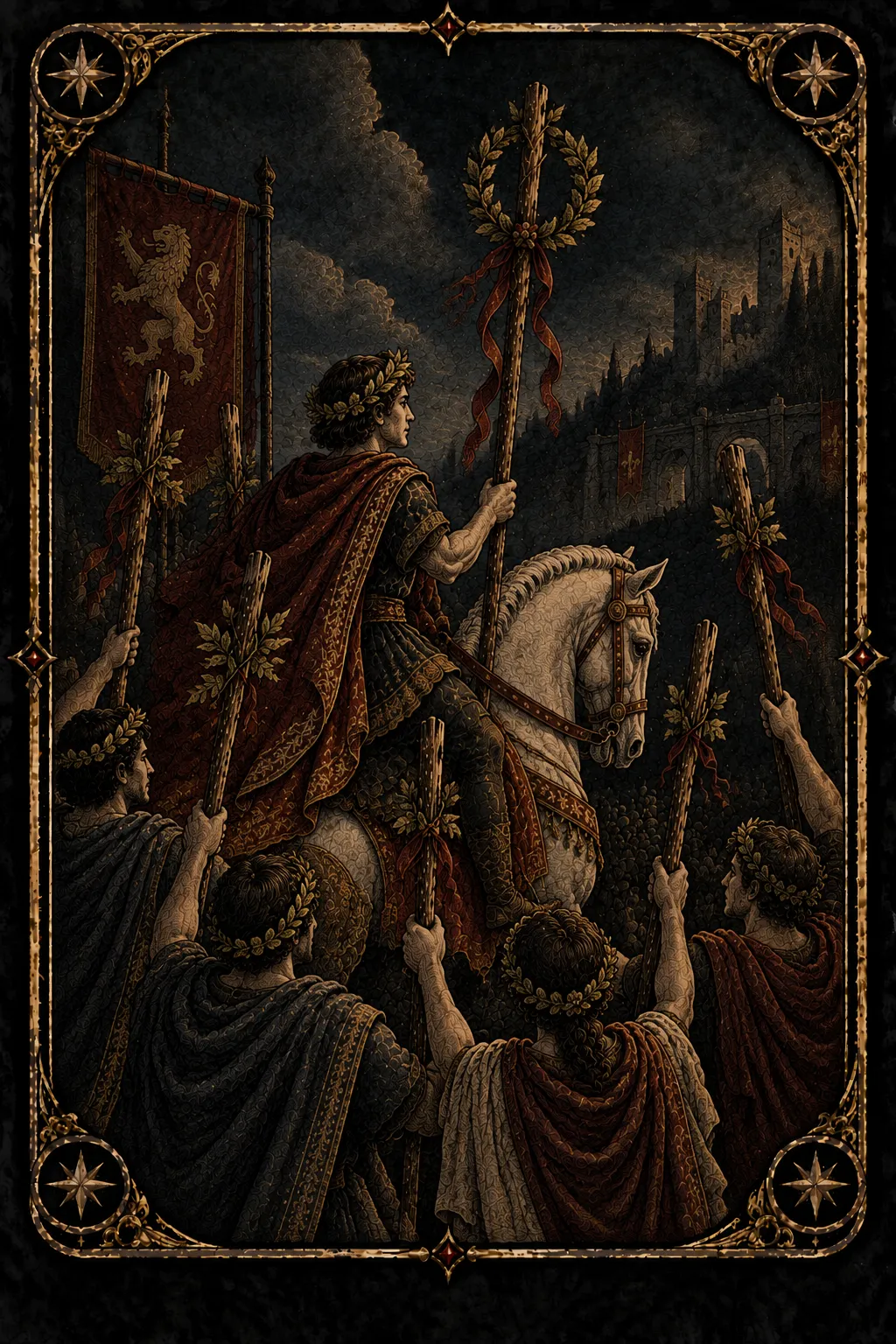
In the classical Rider–Waite image, a rider wears a wreath and holds a wand crowned with another wreath. People with wands stand around the rider.
The scene is traditionally associated with a return after success and with public confirmation of a path. TARORIA’s card does not need to copy this. In a reading, other people’s response to an achievement matters more than the horse as a promise of triumph.
Combinations with other cards
Beside the Sun, recognition sounds warmer and simpler, without a need for a pedestal. With the Devil, it is easy to become dependent on praise. With the Hermit, success can be quiet: the public audience is not the main witness, and that too is an honest tone if the question is not about publicity.
Nearby cards show the cost of visibility. How to receive a response remains the person’s decision.
Frequently asked questions
Does the Six of Wands promise victory and fame?
No. It describes recognition and a noticeable response to an achievement. Victory is possible as the theme of the question. The card does not guarantee lasting triumph and fame.
How is it different from the Ace of Wands?
The Ace is an impulse to begin, still without an audience. The Six is the moment when effort has already been noticed. One is the spark. The other is the visibility of a result.
What does the card mean if I am not being praised?
Reversed often speaks of a lack of response, recognition that went to someone else, or an inability to accept your own success. That does not mean there was no work. Look at whose attention is missing, and whether the audience is replacing the meaning of the work.
How should I read the reversed Six of Wands?
As recognition that is missing or misplaced: little response, praise for the wrong thing, devaluing your own result. What has been done does not disappear. Ask who you were moving for.