Seven of Wands — tarot card meaning
Minor Arcana
Seven of Wands
The Seven of Wands is defending a position. You have already reached something, and now it is being contested. You need to hold your place, your boundaries, what you have already established.
The card is reduced to “you are under threat.” More accurately: the question is not whether you have the strength, but whether this position is worth continuous defense.
General meaning
A need to stand your ground. Rivals, criticism, other people’s initiatives, doubt from inside. A person is in a position that can still be held, if it is not given up from tiredness.
Nearby cards show whether this is genuine defense or a siege of your own life. The Seven names pressure on ground already claimed, not an order to fight forever.
Upright
Upright, the defense is usually real. There is something to protect: an idea, a role, a boundary, the space of a venture. You can say no without dropping everything at every objection.
If you are asking whether to give in, the card more often describes a reason to hold the position than it promises that the pressure will end tomorrow.
Reversed
Reversed, the defense often fails. There is not enough stamina, a person is tired of standing their ground, the position no longer feels like theirs. Or defense has become hypervigilance: any challenge is read as an attack.
The card does not tell you to surrender. Ask whether this position is still yours, or whether you are holding it only because you have already invested.
Love and relationships
In love, upright can describe protecting a couple’s boundaries, standing for your “we” or your “I” inside a bond, pressure from relatives, interference from people around you, or a fight for personal space. That is not a forecast that enemies are attacking the relationship.
Reversed, tiredness of defending, or a fight that already matters more than closeness. What exactly are you protecting: a genuine bond, or a status that no longer feels alive?
Work and career
At work this often means holding a role, authorship, a place on a team, your own approach under pressure. Upright can describe a period when you need to say clearly where your responsibility ends.
A job title is not guaranteed. Reversed, burnout from constant defense, or a position you no longer want. Is this role worth spending energy every day to protect it?
Money and finances
In money questions the Seven is protecting terms: not giving away your price, not agreeing to worse from pressure. Upright is not profit.
It does not promise winning a dispute. Reversed, a concession from tiredness, or a hardness that already costs more than the sum at stake. Distinguish a fair boundary from a war over principle. Sometimes it is more useful to revise the position than to hold onto it out of pride.
Advice
Name what you are defending in one sentence. If it is still yours, hold the boundary calmly, without extra drama.
If the position is not yours, stepping away is not the same as defeat. Defense makes sense while the place still matters.
Symbolism
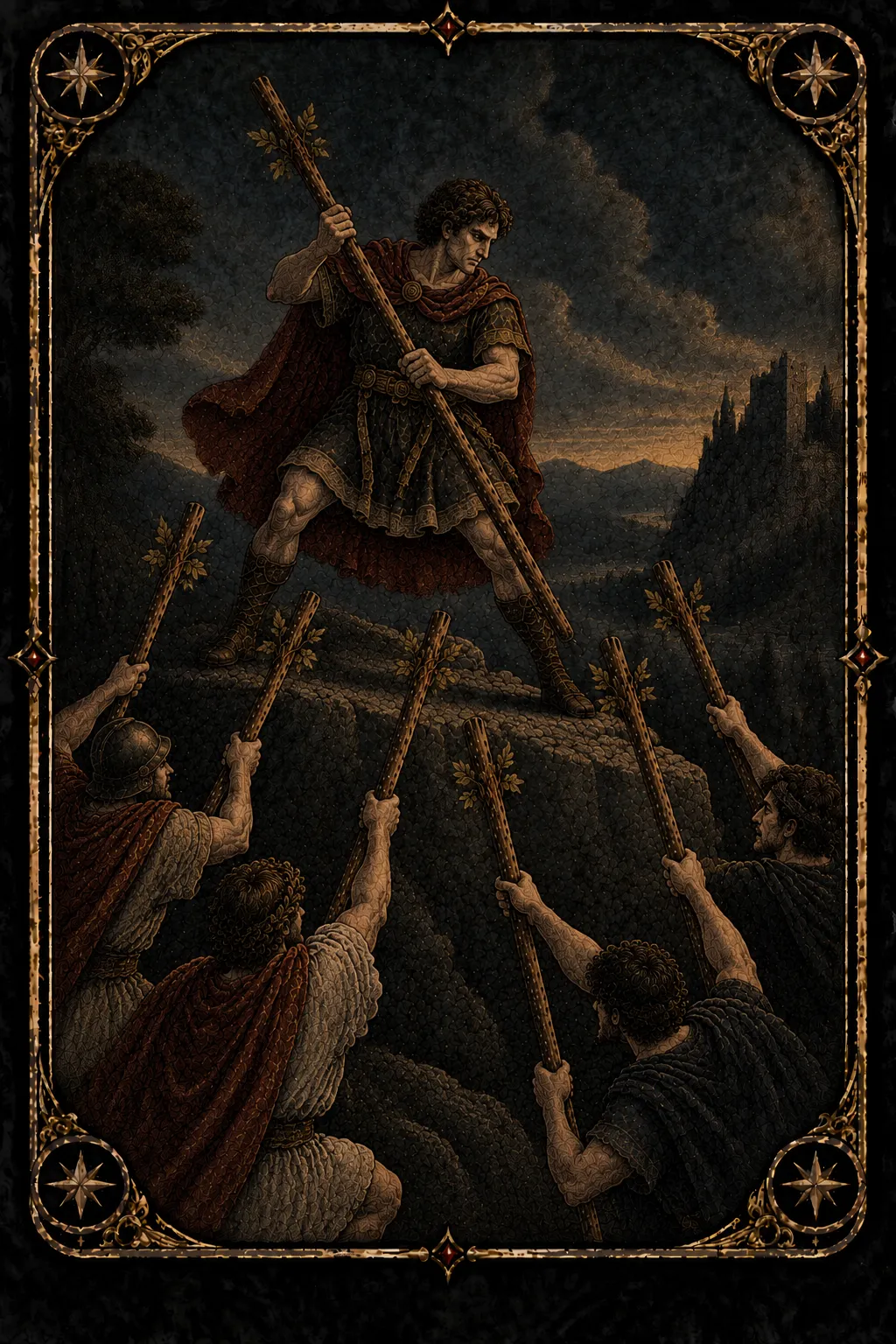
In the classical Rider–Waite image, a figure stands on higher ground and fends off six wands rising from below.
The scene is traditionally associated with unequal pressure, the advantage of position, and a need not to give up what has already been established. TARORIA’s card does not need to copy this. In a reading, the defense of a place matters more than the slope as a promise of war.
Combinations with other cards
Beside the Emperor, defense becomes structural: rules, territory, a right to say no. With the Moon, pressure grows shadows: it is hard to distinguish a real challenge from a fear of losing the place. With Temperance, you can keep the essence without answering every challenge at the same intensity.
Nearby cards show the cost of holding on. Whether it is worth it remains the person’s decision.
Frequently asked questions
Does the Seven of Wands mean I am being attacked?
Not necessarily in a literal sense. Often it is pressure on a position already established: criticism, competition, a dispute over boundaries. The card describes a need to stand your ground, not a castle under siege.
Do I always have to defend myself?
No. Upright can support holding a position that is still yours. Reversed asks whether it is still yours. The card does not tell you to surrender. Revising a position is also not automatically defeat.
How is it different from the Five of Wands?
The Five is a collision among equals, often without a clear advantage. The Seven is current pressure on something you have already reached: you need to hold what you have. One is friction among peers. The other is the defense of a place.
What does the reversed Seven of Wands show?
Tiredness of defending, doubt in your position, or defense that has become hypervigilance. Ask whether this position still actually matters to you, or whether you are holding it only because you have already put too much energy into it.