Five of Wands — tarot card meaning
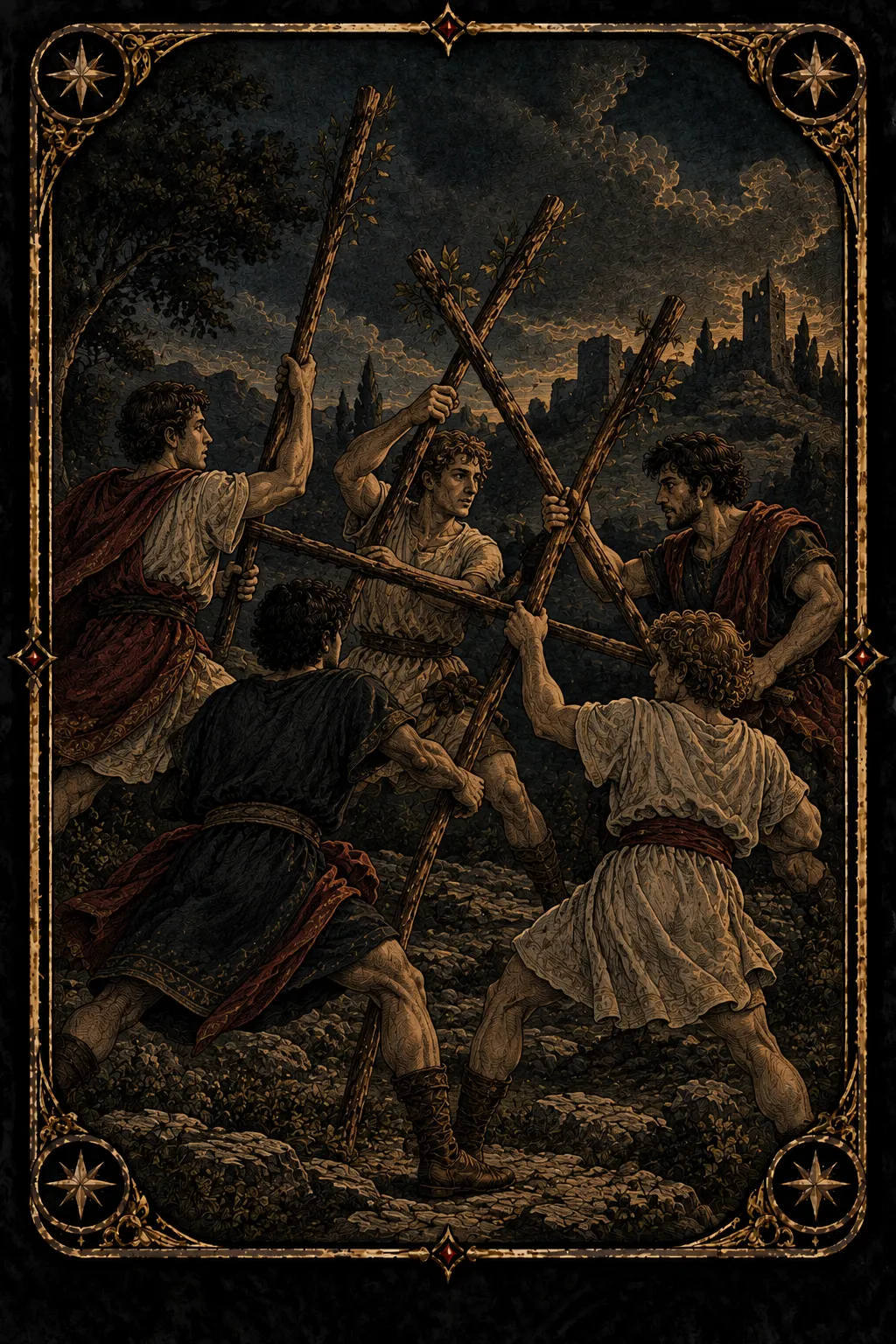
Minor Arcana
Five of Wands
The Five of Wands describes competing initiatives. Not necessarily enemies: an argument, competition, several people wanting to carry their own idea through at once.
The card is read as war. It is more accurate to look at the friction: everyone wants their version, and the room is still noisy. Clarity can come out of the noise. That happens only if you do not confuse sparring with destruction.
General meaning
Wants are competing in the open. Ideas argue, people interrupt, processes compete for attention. This can be a healthy collision after which ideas become clearer and positions stronger. It can also be chaos in which no one hears.
Nearby cards show whether this is play or damage to the shared work. The Five names friction between wills, not a verdict that you will be betrayed.
Upright
Upright, the argument is usually out in the open. There is someone to test yourself against: colleagues, rivals, inner parts that pull in different directions. Progress has not stopped. Different aims are simply colliding.
Taking part is not forbidden. Ask why you are in this fight: to hone what is yours, or so that no one else wins. The difference is audible in the tone.
Reversed
Reversed, competition often goes wrong. Exhaustion from constant arguing, a wish to leave. Or the conflict has gone underground: intrigue, passive resistance, a refusal to play while the tension remains.
Peace is not promised. Ask whether the sparring is ending, or whether you have simply stopped seeing opponents and keep swinging at empty air.
Love and relationships
In love, upright can describe a clash of characters, a fight over pace, jealousy of each other’s initiatives, a couple in which both want to lead. That is not an automatic breakup, and not “toxicity” by default.
Reversed, tiredness of bickering, or a quiet war. Can you argue and still stay on the same side? Competition inside a bond quickly eats warmth if winning matters more than remaining together.
Work and career
At work this is often a contest, overlapping responsibilities, a brainstorm that sounds like a quarrel. Upright can describe a setting where an idea is tested by friction.
A promotion does not follow. Reversed, burnout from politics, or a conflict everyone pretends is over. Is the argument honing the product, or only the ego?
Money and finances
In money questions the Five is competing interests: bargaining, a dispute over contribution, several people pulling at the same resource. Upright is not profit from a win.
It does not advise risky moves “in order to win.” Reversed, tiredness of bargaining, or a hidden conflict around a sum. Distinguish a business dispute from a wish to out-argue a person. Terms can be clarified without a tournament.
Advice
Name what the argument is actually about: one aim, not everything at once. If this is sparring, keep to the rules: do not humiliate, do not break what you share.
If you only want the others to lose, step into a pause. Strength that shows only through victory over others quickly turns healthy rivalry into a pointless conflict.
Symbolism
In the classical Rider–Waite image, five figures raise and cross wands in an open, brightly colored scene. They are not in armor, and the ground around them is open.
The scene is traditionally associated with contest, a students’ scuffle, and competition that has not yet become a bloody war. TARORIA’s card does not need to copy this. In a reading, the character of the collision matters more than the number of participants as a forecast of enemies.
Combinations with other cards
Beside the Five of Swords, a Wands argument easily slips into humiliation: no longer sparring, but a contest over being right. With Strength, a collision can stay sharp without turning poisonous: drive does not have to destroy. With the Hierophant, a question of rules appears: an honest contest, or a game with no agreement.
Nearby cards show whether this is honing or damage. How to take part remains the person’s decision.
Frequently asked questions
Is the Five of Wands always about enemies and a quarrel?
No. Often it is competition, colliding initiatives, an argument, useful friction. Hostility is possible if that is the question. The card itself is about friction between wills, not guaranteed betrayal.
How is it different from the Five of Swords?
The Five of Wands is the noise of active initiatives, often still without a final humiliation. The Five of Swords is the price of a win, the aftertaste once someone has already been “beaten.” One is a collision of energies. The other is what remains after being right.
Should I get into the argument?
The card does not tell you to. Upright can describe a setting where taking part sharpens you. Look at the motive: clarity and skill, or a wish for the others to lose. The decision is yours.
What does the reversed Five of Wands show?
Tiredness of competition, leaving the contest, or a conflict going into a quiet struggle. It does not guarantee peace. Ask whether the sparring is ending, or whether you are already swinging at empty air.