Queen of Cups — tarot card meaning
Minor Arcana
Queen of Cups
The Queen of Cups is linked with emotional depth and receptivity. This is a capacity to feel nuance — your own and someone else’s — and to stay attentive to it without letting it spill into everything.
The card is often reduced to a woman, a mother, or a seer. It is more accurate to look at the quality: empathy, care for feelings, the boundaries of sensitivity. The card does not assign a person’s gender. It is about how you handle emotion, not about who is supposed to do the feeling.
General meaning
In a spread, the Queen describes a person or a state in which feelings are read accurately. You can comfort, listen, notice what is unsaid, create a safe emotional environment. The strength here lies in receptivity, not in loudness.
The weak point is dissolving into other people’s experiences. Neighboring cards will show whether this is genuine empathy or an absence of a boundary. The Queen itself notes emotional skill, not an obligation to save everyone.
Upright
Upright more often speaks of a mature sensitivity. A person understands nuances, knows how to be warm without losing themselves entirely, cares for an inner climate — their own and that of people close to them. Intuition here is practical: I am uneasy is already information.
The upright Queen supports emotional depth without overwhelm. You can be open and still have a boundary. If the question is who holds the emotional climate, the card describes this skill, not a wife’s role by default.
Reversed
The reversed Queen often loses the boundary. Other people’s moods flood in, manipulation through hurt appears, a withdrawal into fantasy, emotional dependence, an inability to tell your feeling from another’s.
Sometimes, on the contrary, a person locks sensitivity and is ashamed of their depth. The reversed card does not make you too emotional. It asks whether receptivity is serving life — or whether you are drowning in feeling you do not dare to call your own.
Love and relationships
In love, upright can describe a deep empathy, a skill of hearing a partner, care for the emotional life of a relationship, a tenderness that does not require theatre. This is not a portrait of a mother and not an obligation to be a couple’s psychologist.
The reversed card shows dissolving, jealousy from oversensitivity, a withdrawal into hurt instead of a conversation, rescuing instead of closeness. Look at whether there is a boundary: can you feel the other person and still say what you want. Without that boundary, care can turn into self-erasure.
Work and career
At work the Queen of Cups is strong where people matter: support, ethics, atmosphere, creative and helping roles. Upright can describe a skill of holding a team’s emotional climate without becoming a dumping ground for other people’s dramas.
The reversed card notes burnout from other people’s feelings, blurred boundaries, decisions from pity instead of clarity. It does not promise a new position. It is useful to ask whether your receptivity is used as a gift — or as an endless unpaid resource.
Money and finances
In money questions the Queen is less often about calculation. Sometimes — spending from sympathy, a wish to buy calm for people close to you, difficulty asking to be paid for care. Upright is not about profit, but about the way empathy and money interact.
The card does not promise prosperity. Reversed, it can show financial decisions from guilt, pity, an emotional fog. It is worth separating compassion from an obligation you are not ready to carry. Kindness does not have to be paid for by your budget automatically.
Advice
Protect your receptivity as a skill, not as a lack of limits. Name which feeling is yours, which is another’s, and where the boundary is.
Depth is strong while you live in it, not drown. You can be warm without becoming a sea in which everyone disappears, including you.
Symbolism
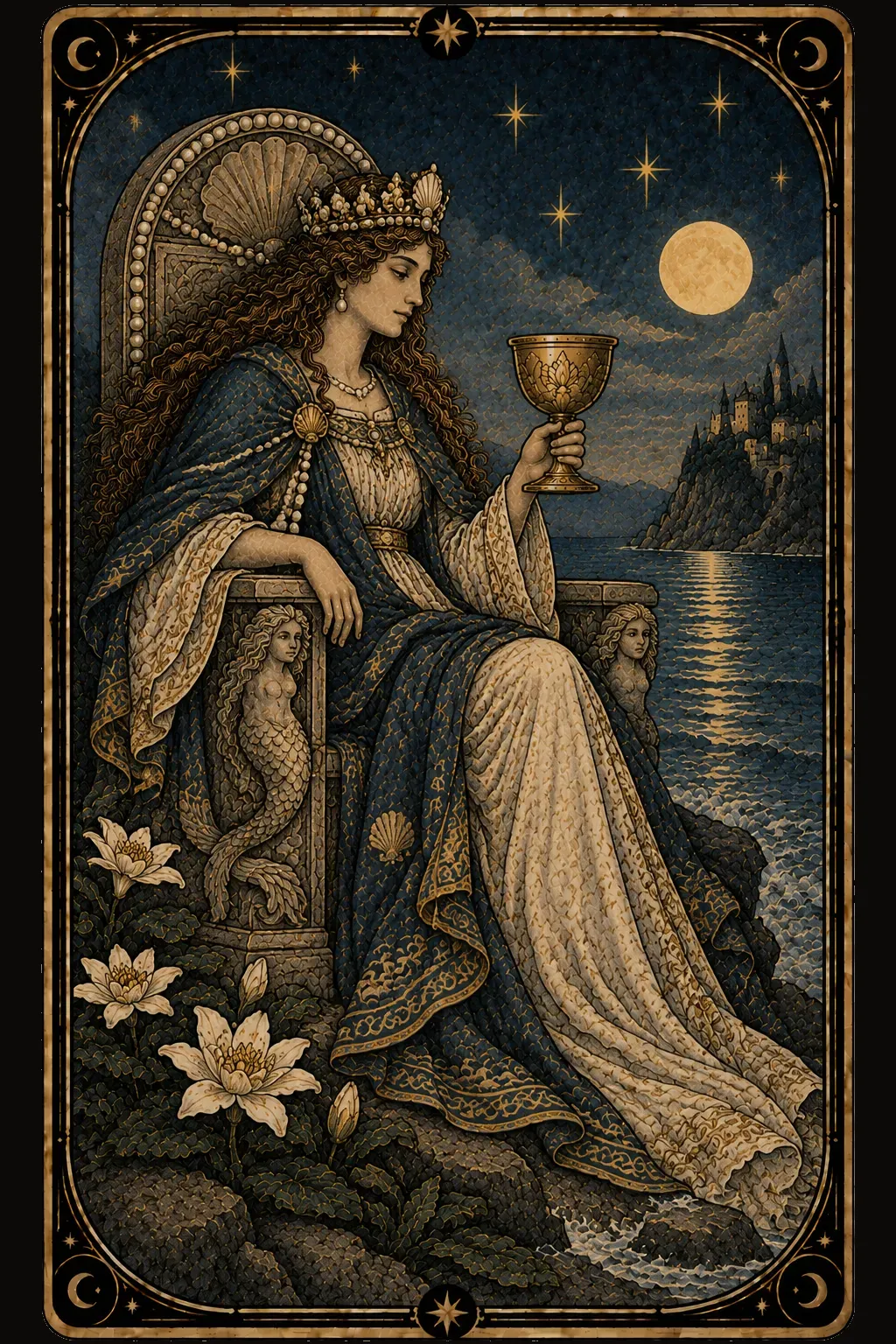
In the classical Rider–Waite image, a seated figure occupies a throne at the water’s edge and holds a covered, ornate cup. Angel figures are part of the cup’s decoration. The throne is carved with marine motifs; water lies around the seat.
Tradition links this scene with contemplation of feeling and with a depth that is not poured out at once. The traditional image explains the theme of inner water. It does not claim that the TARORIA card copies Rider–Waite. In a reading, a closed cup as careful attention matters more than the throne as a pointer to gender.
Combinations with other cards
Next to the High Priestess, the Queen goes even deeper inward: much is read without words, and honesty is needed so as not to confuse a secret with silently withdrawing. With the Star, receptivity becomes healing — warmth without a demand to be a savior. With Strength, empathy becomes steadier: you can feel deeply without collapsing into fusion or shutting down.
Neighboring cards show whether this is a gift or a flood. Where to set the boundary is the person’s decision.
Frequently asked questions
Is the Queen of Cups necessarily a woman?
No. It is a quality: empathy, emotional depth, care for inner life, the boundaries of sensitivity. The card does not assign a person’s gender. Look at who in the question holds the climate of feeling — and whether they are drowning in it.
Why is she linked with intuition?
Because the Queen’s receptivity notices nuances before they are named. This is not an obligation to be a seer. It is attention to an inner climate. Intuition here is practical: I am uneasy is already data.
Does the card mean motherhood?
Not necessarily. Care for feelings can include parenting if that is the question. Just as often it is about a skill of being deep and warm in any role. Do not reduce the Queen to a mother — or the boundary disappears, and emotional skill with it.
What does the reversed Queen of Cups show?
Often a loss of boundary: fusion with other people’s feelings, hurt as a language, fantasy instead of a conversation, shame of your sensitivity. Ask whether the depth is serving life — or whether you are drowning in feeling you do not name as yours.